

A majority of shares entitled to vote, represented in person or by proxy, constitutes a quorum at a California shareholder meeting. That is the default rule under Cal. Corp. Code § 602, and it applies unless the articles of incorporation say otherwise. There is a hard floor, too: quorum can never drop below one-third of the shares entitled to vote, with a narrow exception for mutual water companies and a separate cap that applies to close corporations.
For anyone running or attending a meeting, three things follow immediately from that statute:
- Voting threshold: whatever passes at the meeting needs approval from a majority of the shares actually represented, not a majority of all shares outstanding.
- Bylaw variance: the corporation's articles can raise the default majority requirement, but they cannot push quorum below the one-third statutory floor.
- Minimum floor: even a bylaw amendment cannot legally set quorum lower than one-third of shares entitled to vote, except for the mutual water company exception.
Key Takeaways
A California quorum defaults to a majority of shares entitled to vote under Cal. Corp. Code § 602, but disqualified shares under Section 112 can shrink that count sharply for specific agenda items.
| Point | Details |
|---|---|
| Default quorum rule | A majority of shares entitled to vote, present in person or by proxy, satisfies § 602 unless the articles say otherwise. |
| Statutory floor | Quorum cannot legally drop below one-third of shares entitled to vote, aside from the mutual water company exception. |
| Disqualified shares shift quorum | Section 112 excludes disqualified shares from the outstanding count for that specific matter, changing the threshold. |
| No quorum means limited options | Shareholders present can adjourn by majority vote, but no other business proceeds until quorum is restored. |
| Legalstepz supports documentation | Legalstepz drafts minutes, bylaws, and files Statements of Information to keep quorum records defensible. |
Table of Contents
- What Does Shareholder Meeting Quorum Mean Under California Law?
- How Do Disqualified Shares Change the Quorum Count?
- Which Shares Count Toward Quorum, and How Do Proxies Factor In?
- What Happens When Quorum Is Not Met?
- Organizer Checklist: Documenting Quorum Correctly
- What Should Shareholders Do to Protect Their Vote?
- Where Legalstepz Fits Into Your Compliance Picture
- The Practitioner's Perspective on Quorum Pitfalls
- Get Your California Compliance Documents Handled Right
- Sources
What Does Shareholder Meeting Quorum Mean Under California Law?
Section 602(a) says it plainly: a majority of the shares entitled to vote, present in person or by proxy, is enough to transact business, unless the articles set a different rule. Read that again, because the phrase "entitled to vote" matters. It does not mean every share issued by the corporation. It means shares eligible to vote on the matter at hand, as of the record date.
Section 602(b) is where the floor kicks in. Corporations can write their own quorum requirements into the articles, and many do, especially closely held companies that want higher thresholds for major decisions like mergers or new stock issuances. But no matter how the bylaws are worded, quorum cannot fall below one-third of the shares entitled to vote.
Two carve-outs matter here:
- Mutual water companies get separate treatment under the statute, reflecting their unique membership structure.
- Close corporations (a specific California designation for companies with a limited number of shareholders and a shareholders' agreement) may face a different cap depending on how their agreement is drafted.
Once you know the floor and the default, most quorum disputes come down to one question: which shares actually count?
How Do Disqualified Shares Change the Quorum Count?
This is where a lot of organizers get tripped up. Section 112 excludes shares disqualified from voting on a particular matter from the "outstanding" count used to determine quorum for that matter. That single rule can swing an entire vote.
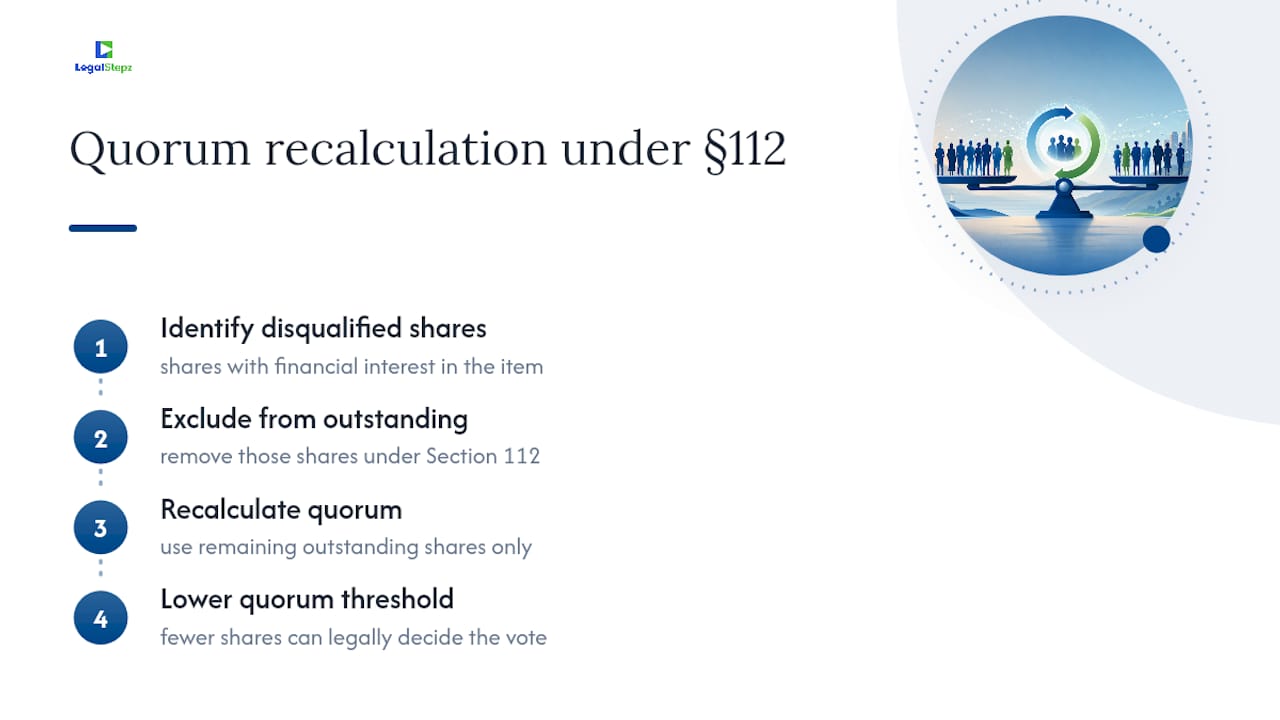
Picture a corporation where a large number of shares are held by a director with a financial interest in a proposed transaction the board wants approved. Under Section 112, those shares are excluded from the quorum calculation for that specific agenda item, which can significantly lower the number of shares required to reach quorum for that vote. In an extreme case, this can mean a small fraction of total shares legally decides a major transaction.
Pro Tip: Build your meeting agenda with quorum recalculation in mind. If an interested-party transaction is on the docket, note in the meeting notice which shares are disqualified for that item, and calculate quorum separately for each affected matter rather than assuming one quorum count covers the whole meeting.
Which Shares Count Toward Quorum, and How Do Proxies Factor In?
Quorum calculations start with the record date, the cutoff the board sets to determine which shareholders are eligible to vote and how many shares they hold. Anyone who buys shares after that date has no vote at this particular meeting, no matter how many shares they end up owning.
Proxies count the same as shares held in person. A shareholder who cannot attend can assign a proxy, and those shares are counted toward both quorum and the final vote. Corporations should use standardized proxy forms, track submission dates, and retain signed proxies for the corporate record. Sloppy proxy documentation is one of the most common reasons boards later face disputes over whether a vote was even valid.
Remote participation is allowed. Shareholders participating electronically can be deemed "present" for quorum purposes when the board authorizes it and the technology lets participants read, hear, and be heard by others at the meeting in real time.
Before any vote, organizers should:
- Confirm the record date and pull the certified shareholder list as of that date.
- Collect and log every proxy received, noting the date and shares represented.
- Verify remote attendee identity and connection quality before the meeting opens.
- Tally shares represented, in person, by proxy, and remotely, and confirm the total clears the quorum threshold before calling the meeting to order.
What Happens When Quorum Is Not Met?
If quorum fails to materialize, the meeting isn't dead. It just can't do most of its business yet.
- The shareholders present, even without quorum, can adjourn the meeting to a later date by majority vote of those who did show up.
- No other substantive business can be transacted once quorum is lost, with narrow exceptions.
- If quorum was established earlier in the meeting and later drops due to walkouts, business already approved by a majority of the required quorum may still stand.
- If the corporation misses its statutory window for holding an annual meeting altogether, any shareholder can petition the superior court, which can order a meeting and set both the record date and the form of notice.
That court remedy exists precisely because boards sometimes avoid meetings to dodge accountability. It's a real backstop, not just a theoretical one.
Organizer Checklist: Documenting Quorum Correctly
A defensible quorum determination starts long before the gavel drops. Follow this sequence:
- Set and publish the record date, then pull the certified shareholder list well ahead of the notice deadline.
- Send meeting notice that flags any agenda items involving disqualified shares under Section 112.
- Distribute standardized proxy forms and set a clear submission deadline.
- Log every proxy received, verify signatures and dates, and store copies in the corporate minute book.
- If offering remote participation, test the platform in advance and confirm it meets the statutory requirements for two-way communication.
- At roll call, tally shares represented in person, by proxy, and remotely, separately for any items with disqualified shares.
- Draft minutes that record the exact share count, the basis for quorum, and the outcome of every vote.
Pro Tip: Keep a running quorum worksheet during the meeting itself, updated live as proxies are confirmed and remote attendees log in. It's far easier to catch a shortfall in real time than to reconstruct the count after the fact when minutes are challenged.
For structure on how minutes should read, Legalstepz's guide to drafting annual minutes walks through the format that holds up under scrutiny.
What Should Shareholders Do to Protect Their Vote?
Your vote only counts if your paperwork does. A few things matter most:
- Confirm you held shares as of the record date, not the meeting date.
- Submit a signed, dated proxy through whatever channel the corporation specifies, and get confirmation it was received.
- Know your inspection rights under Section 1600, which let eligible shareholders request the shareholder list and certain corporate records if you suspect a meeting was mishandled.
If a corporation is stonewalling access to records you're entitled to see, Legalstepz's breakdown of record inspection rights covers exactly how to make that demand.
Where Legalstepz Fits Into Your Compliance Picture
Legalstepz built its guidance library around the exact problems this article covers: annual minutes drafting, bylaws requirements, and annual meeting timing rules. This piece was prepared by Peter, drawing on California statutory text and practitioner commentary to keep the explanations grounded in the actual code sections rather than general assumptions. For hands on help, Legalstepz's compliance packages and formation courses are built to walk California entities through exactly these requirements.
The Practitioner's Perspective on Quorum Pitfalls
The two mistakes I see most often: organizers forget to recalculate quorum when disqualified shares apply to a specific agenda item, and proxies get collected informally, with no dated record if anyone challenges the vote later. Both are avoidable. Build a quorum worksheet into your meeting prep, and treat proxy documentation as seriously as the vote itself.
— Peter
Get Your California Compliance Documents Handled Right
Quorum rules are only half the battle. The minutes, bylaws, and filings that document your meeting need to hold up if anyone ever challenges them, and that's exactly where Legalstepz saves you the guesswork of drafting from scratch.

Legalstepz's compliance packages cover the paperwork trail a properly run shareholder meeting requires: Statement of Information filings, annual minutes drafting, bylaws templates that spell out your quorum rules clearly, and registered agent service so you never miss a state deadline. For founders who want to handle formation themselves, Legalstepz also offers step-by-step online courses covering LLC and corporation setup and trademark registration. If your bylaws need a quorum provision that actually matches how your company operates, or your minute book needs a properly documented meeting record, start with a compliance package on the Legalstepz site and get it filed correctly the first time.
Sources
- California Code, Corporations Code - CORP § 602
- More quorum mysteries (NatLawReview)
- California investor rights and laws (DFPI)
- California Code, Corporations Code - CORP § 602 (FindLaw)