

A single-member LLC (SMLLC) in California is a limited liability company owned by one person, treated as a "disregarded entity" for federal taxes and reported on Schedule C. California does not follow that federal treatment for state purposes: you still must file Articles of Organization (Form LLC-1), name a registered agent with a California street address, file a Statement of Information within 90 days, and file Form 568 while paying the $800 annual minimum tax.
TL;DR:
- California requires LLCs to file Articles of Organization and Statement of Information within 90 days, with separate state filings and payments from federal treatment.
- LLC owners must pay a mandatory $800 annual minimum tax, regardless of income, along with filing Form 568 by the appropriate deadline each year.
- The LLC name must be distinguishable and properly include an LLC designation; a name search and reserve are essential before filing.
- Managing the LLC structure involves choosing between member-managed or manager-managed, with a written operating agreement recommended even for single owners.
- Staying compliant requires timely filings every two years for the Statement of Information and annual filings for Form 568, with penalties applying immediately for late payments.
Table of Contents
- Single Member LLC California Checklist: Formation and the First 90 Days
- How Do You File Articles of Organization in California?
- Why Does California Tax an SMLLC Differently Than the IRS?
- Member-Managed or Manager-Managed: Which Structure Fits Your LLC?
- What Ongoing Filings Keep a California LLC in Good Standing?
- Common Mistakes California SMLLC Owners Make (And Fixes That Work)
- What California SMLLC Owners Get Wrong Most Often
- Let Legal Stepz Handle the Filings While You Run the Business
- Where to File and Verify Your California LLC Paperwork
- Sources
Single Member LLC California Checklist: Formation and the First 90 Days
Before you touch a single tax form, get the entity itself squared away with the state. The first three months set the tone for everything that follows, and missing any one of these steps creates headaches that take far longer to fix than to prevent.
- Search the California Secretary of State's business database to confirm your LLC name is available and includes a required designator like "LLC" or "L.L.C."
- File Articles of Organization (Form LLC-1) and pay the standard filing fee of $70.
- Designate a registered agent with a physical California street address, either yourself or a hired service.
- File your Statement of Information within 90 days of formation, a $20 filing, then plan for it every two years after.
- Decide whether you need an EIN and register for any required state tax accounts based on your business activity.
Each item feeds into the next. Skip the Statement of Information deadline, for instance, and the state can suspend your LLC before you've even sent your first invoice.
How Do You File Articles of Organization in California?
Filing Form LLC-1 with the California Secretary of State is the legal act that creates your LLC. You can file online through the SOS business portal or submit a paper form by mail, and the current standard filing fee is $70. That's a modest cost compared to the compliance obligations that follow it.
Your LLC name has to be distinguishable from existing entities on record and must include an approved designator such as "LLC," "L.L.C.," or "Limited Liability Company." Run a name search on the SOS site before you file anything. A rejected filing over a name conflict costs you time and, in some cases, a second filing fee.
Here's the sequence most owners follow:
- Search and reserve your LLC name through the Secretary of State.
- Prepare and submit Form LLC-1, listing your registered agent and business address.
- Pay the $70 filing fee and wait for confirmation from the SOS.
- File your Statement of Information within 90 days to formally disclose ownership and management.
- Apply for an EIN if you plan to hire employees, open a business bank account, or later elect S-corp taxation.
One detail trips people up: the person who signs as the "organizer" on Form LLC-1 is not automatically the legal owner. The Statement of Information is the document that actually discloses who owns and manages the company, which matters if you have an attorney or formation service file on your behalf.
Your registered agent must have a physical California street address. A P.O. box doesn't qualify. You can serve as your own registered agent if you have a reliable in-state address and don't mind your name and address becoming part of the public record, or you can hire a registered agent service for privacy and consistency.
Pro Tip: Apply for your EIN directly through Irs at no cost. Third-party sites that charge a fee for this are selling you something you can get free in about ten minutes.
Why Does California Tax an SMLLC Differently Than the IRS?
The IRS treats a single-member LLC as a disregarded entity, meaning you report business income directly on Schedule C of your Form 1040. California doesn't extend that courtesy. The Franchise Tax Board treats an SMLLC as having a separate existence for purposes of the state's LLC tax, LLC fee, and return filing requirement, which means you file Form 568 regardless of how simple your federal return looks.
The minimum franchise tax applies to nearly every California LLC, every year, whether the business made money or not. Assembly Bill 85 created a temporary exception: entities that organized or registered with the SOS between January 1, 2021, and January 1, 2024, got their first taxable year's $800 tax waived. That window has closed, so confirm current-year rules with the FTB before assuming you qualify.
On top of the flat tax, California layers an LLC fee that kicks in once total income crosses a set threshold, calculated on a sliding scale tied to gross receipts. A CPA-authored breakdown of these California LLC tax obligations walks through the tiers in more detail if your revenue is climbing.
Deadlines matter as much as the numbers:
- Form 568 is generally due the 15th day of the fourth month after your taxable year ends.
- If a pass-through entity owns your SMLLC, the deadline moves up to the 15th day of the third month.
- An automatic extension to file does not extend your time to pay. The tax and fee are still due on the original deadline, or penalties and interest start accruing immediately.
If your LLC had zero income for the year, you still owe the $800 minimum tax and still must file Form 568. There's no exception for a quiet year.
Member-Managed or Manager-Managed: Which Structure Fits Your LLC?
California's LLC statute lays out two management structures, and you pick one when you file Form LLC-1. Member-managed means you, the owner, run daily operations directly. Manager-managed means you appoint someone (possibly yourself, formally) to handle operations while retaining ownership. The California Corporations Code spells out default voting and authority rules that apply when your operating agreement is silent on a given point.

Even as a sole owner, you should still draft a written operating agreement. Banks often ask for one before opening a business account, and if you're ever sued, a court looking for evidence that your LLC is a real separate entity, not just a personal checking account with a fancy name, will want to see one. Cover control and decision-making authority, how capital contributions work, how and when you'll take distributions, what happens to the LLC if you become incapacitated or die, and how disputes get resolved if you ever bring on a partner. Changing your management structure later means amending both the operating agreement and, in some cases, refiling paperwork with the state.
What Ongoing Filings Keep a California LLC in Good Standing?
Formation is the easy part. Staying compliant year after year is where owners lose track and rack up penalties they didn't see coming.
- File a Statement of Information every two years following your initial 90-day filing, and mark the deadline the moment you complete the first one.
- File Form 568 annually, calendared separately from your payment deadline since they don't always get treated the same way internally at the FTB.
- Set two separate reminders each year: one for filing your return, one for paying what you owe, since an extension covers only the former.
- Expect penalties and interest to start immediately on unpaid minimum tax, even if your filing itself is timely.
- If you miss a deadline, file as soon as possible and consider requesting penalty relief or consulting a tax professional before the balance compounds further.
A California annual report filing guide can help you map out the full two-year cycle so nothing catches you off guard.
Common Mistakes California SMLLC Owners Make (And Fixes That Work)
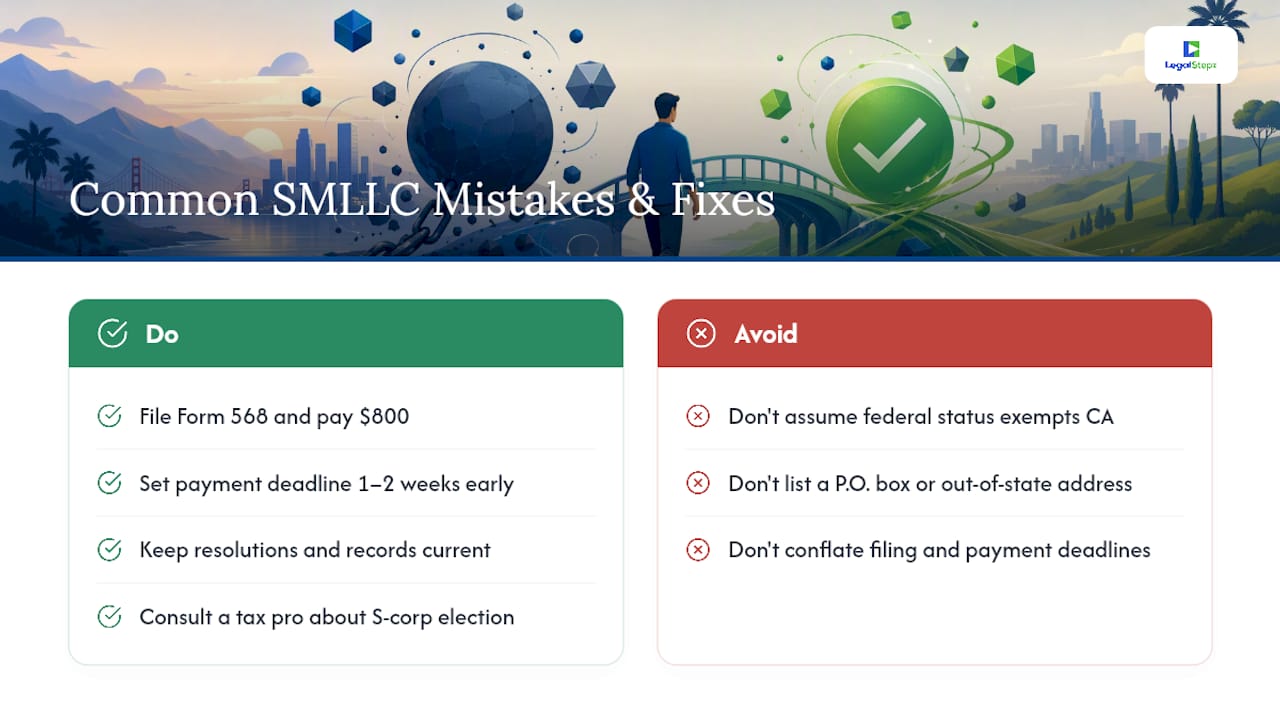
The single biggest error: assuming federal disregarded-entity status means California doesn't care about your LLC's existence. It does, and Form 568 plus the $800 minimum tax prove it every year. The second most common mistake is registered-agent confusion, listing a P.O. box or an out-of-state address that the SOS will reject outright.
Third, owners lump their filing deadline and payment deadline into one mental note, then get blindsided when the extension covers the paperwork but not the check. Set your internal payment deadline a week or two earlier than the actual due date, so a processing delay doesn't turn into a penalty.
Keep records even as a solo owner: draft annual resolutions, document major decisions, keep your operating agreement current. That paper trail is what separates your LLC from your personal finances if anyone ever challenges your liability shield.
Pro Tip: If your business is consistently profitable, talk to a tax professional about electing S-corp taxation for your LLC. It won't change your California filing requirements, but it can meaningfully reduce your self-employment tax exposure at the federal level.
What California SMLLC Owners Get Wrong Most Often
Most guidance on this topic treats California compliance as an afterthought bolted onto federal tax advice. That's backwards. The research is consistent: the Franchise Tax Board doesn't care that the IRS calls your LLC disregarded. It wants Form 568, it wants $800 (unless you caught the now-expired AB 85 window), and it wants both on time, whether you earned a dollar or a million.
The conventional advice, "form your LLC and you're protected," skips the part where liability protection depends on you actually treating the LLC as separate from yourself: separate bank account, real operating agreement, documented decisions. Skip that, and a court can disregard the very entity you paid to create.
If you take one thing from this: put payment deadlines on a calendar before filing deadlines, not after. The extension trap catches more new owners than any other single mistake, and it's entirely avoidable with a five-minute calendar entry.
— Peter
Let Legal Stepz Handle the Filings While You Run the Business
Legal Stepz exists for the exact tasks this guide just walked you through: filing your Statement of Information, keeping a registered agent on record with a valid California address, and sending compliance reminders so payment and filing deadlines never sneak up on you.
Doing this yourself is possible, and plenty of owners do. But every hour spent chasing SOS filing status or double checking FTB deadlines is an hour not spent on clients or product. A Legal Stepz compliance package files your paperwork correctly the first time, tracks your renewal windows automatically, and gives you a real person to ask when a notice from the state shows up that you don't understand. If you're weighing DIY against paid help, the calculation usually comes down to how much your own time is worth against the cost of a missed deadline and its penalties.
Start with the Legal Stepz formation and compliance packages to get your Statement of Information filed, your registered agent secured, and your renewal calendar set up before your 90-day window closes.
Where to File and Verify Your California LLC Paperwork
File and confirm everything directly through the source agencies:
- California Secretary of State — LLC forms and fees for Form LLC-1 and Statement of Information filings.
- Franchise Tax Board — SMLLC guidance for Form 568 and annual tax details.
- IRS EIN application for federal tax ID registration.
This article is general information, not a substitute for advice from a qualified financial advisor. Consult a qualified financial professional about your own circumstances before acting on anything here.
Sources
- California Secretary of State — LLC forms and fees
- Single member limited liability company (SMLLC) — Franchise Tax Board Tax News
- California Corporations Code — LLC management provisions (17704.07)