

If you're searching for the "state of California business license," this guide covers what that phrase actually means for your LLC or corporation: state-level entity filings and compliance obligations managed through the California Secretary of State and the Franchise Tax Board. This is not about local city or county permits. It covers Statements of Information, bylaws, annual minutes, and registered agent duties.
Your immediate next step: look up your entity on the California Secretary of State Business Search and confirm whether a Statement of Information is due. If you need help filing or want a registered agent, Legalstepz handles both.
- Statements of Information filed with the California Secretary of State
- Bylaws and operating agreements maintained internally (not filed with the state)
- Annual minutes and written resolutions kept in your corporate records
- Registered agent designation and maintenance
Table of Contents
- What does this guide cover for California entity compliance?
- Who must file a Statement of Information, and when?
- What does a registered agent actually do, and how do you stay compliant?
- Why bylaws and annual minutes matter more than most owners realize
- Your practical compliance checklist and annual calendar
- What happens when you miss a filing, and how to fix it
- State-level licenses and permits beyond entity filings
- State filings vs. local licenses: understanding the difference
- How entity type shapes your filing and licensing obligations
- How to file your Statement of Information online without common errors
- Key Takeaways
- Why proactive compliance beats reactive remediation every time
- How Legalstepz keeps your California entity in good standing
What does this guide cover for California entity compliance?
This guide is for California LLC and corporation owners, including foreign entities registered to do business in California. It covers the filings and internal records that keep your entity in good standing with the state.
In scope:
- Statement of Information (Form LLC-12 for LLCs; Form SI-550 for corporations)
- Registered agent requirements and how to update agent information
- Bylaws, operating agreements, and annual minutes
- Alter-ego audit practices and recordkeeping
- Penalties, remediation, and how to restore good standing
Out of scope: city and county business operation permits. Those are issued by local governments and follow a completely different process.
Official forms and filing portal: The California Secretary of State offers over 140 business entity filings through its online portal. Use bizfileOnline.sos.ca.gov for Statements of Information and most routine filings.
Pro Tip: If your mailing address on file with the Secretary of State is outdated, you will miss the reminder notice the SOS sends roughly three months before your due date. Update it on your next Statement of Information.
Who must file a Statement of Information, and when?
California stock corporations and qualified out-of-state corporations file annually. California nonprofit corporations and all LLCs file every two years, on an odd/even schedule based on their formation year.
| Entity Type | Initial Filing Window | Recurring Cadence |
|---|---|---|
| California LLC | Within 90 days of formation | Every 2 years (biennial) |
| Foreign LLC (registered in CA) | Within 90 days of registration | Every 2 years (biennial) |
| California stock corporation | Within 90 days of formation | Annually |
| Qualified foreign corporation | Within 90 days of registration | Annually |
| Nonprofit corporation | Within 90 days of formation | Every 2 years |
California Corporations Code § 17702.09 requires every LLC to file within 90 days of formation, then biennially during the applicable filing period. The Secretary of State maps each entity's recurring filing window to a six-month period based on formation month. Check your specific window using the SOS filing tips page or the bizfileOnline portal.
Miss the window and the consequences escalate fast: a penalty can be assessed, and the SOS notifies the Franchise Tax Board, which can trigger suspension. Filing late is almost always cheaper and faster than reinstating a suspended entity.
For a deeper look at how the annual/biennial cadence works in practice, the California Annual Report Explained guide walks through due-date calculations step by step.
What does a registered agent actually do, and how do you stay compliant?
Your registered agent is the person or company that receives legal documents, lawsuits, and official government notices on behalf of your entity. The address must be a physical California street address. No P.O. boxes.
Who can serve as your agent:
- A California resident individual who is available at the listed address during business hours
- A corporate registered agent with an active Section 1505 registration with the California Secretary of State (you must obtain their consent before naming them)
How to update your agent:
- File your next Statement of Information and enter the new agent's name and address in the designated fields.
- Confirm the agent's current status using the SOS Business Search.
- If using a corporate agent, verify their Section 1505 registration is active before listing them.
The SOS service of process page explains substituted service rules: if your agent cannot be reached, courts can serve the Secretary of State directly, and your entity may not learn about the lawsuit until a default judgment is entered.
Pro Tip: Keep your agent's name and street address identical across your Statement of Information, bank account records, and any contracts. Inconsistencies create administrative confusion and can complicate substituted service situations.

Why bylaws and annual minutes matter more than most owners realize
Bylaws and operating agreements are internal records and are never filed with the California Secretary of State. That distinction matters because many owners treat them as a formality rather than a governing document.
Good bylaws or operating agreements should expressly cover:
- Who makes decisions and at what voting threshold
- Quorum requirements for meetings
- Officer roles and their authority limits
- How the agreement can be amended
- Transfer restrictions on membership interests or shares
- Dispute resolution procedures
Annual minutes document that your entity actually operates as a separate legal entity. Without them, a creditor or opposing party in litigation can argue your LLC or corporation is just an alter ego of you personally, which is the legal theory that allows courts to pierce the corporate veil and reach your personal assets.
Relying on boilerplate templates is one of the most common legal pitfalls California business owners make. Statutory defaults often don't match how a real business actually operates, especially once you add partners, investors, or employees.
One more thing worth knowing: if you receive a notice demanding you file annual minutes or submit bylaws to the state for a fee, it is almost certainly a predatory third-party solicitation. State agencies do not request those documents.
Pro Tip: Schedule an annual alter-ego audit: review your minutes, bank records, and resolutions to confirm your entity is operating as a genuinely separate legal person. Practitioners consistently note that most owners wait until litigation to clean up records, which is far too late.
For bylaw-specific drafting guidance, the Legalstepz bylaws provisions guide covers what each clause should accomplish.
Your practical compliance checklist and annual calendar
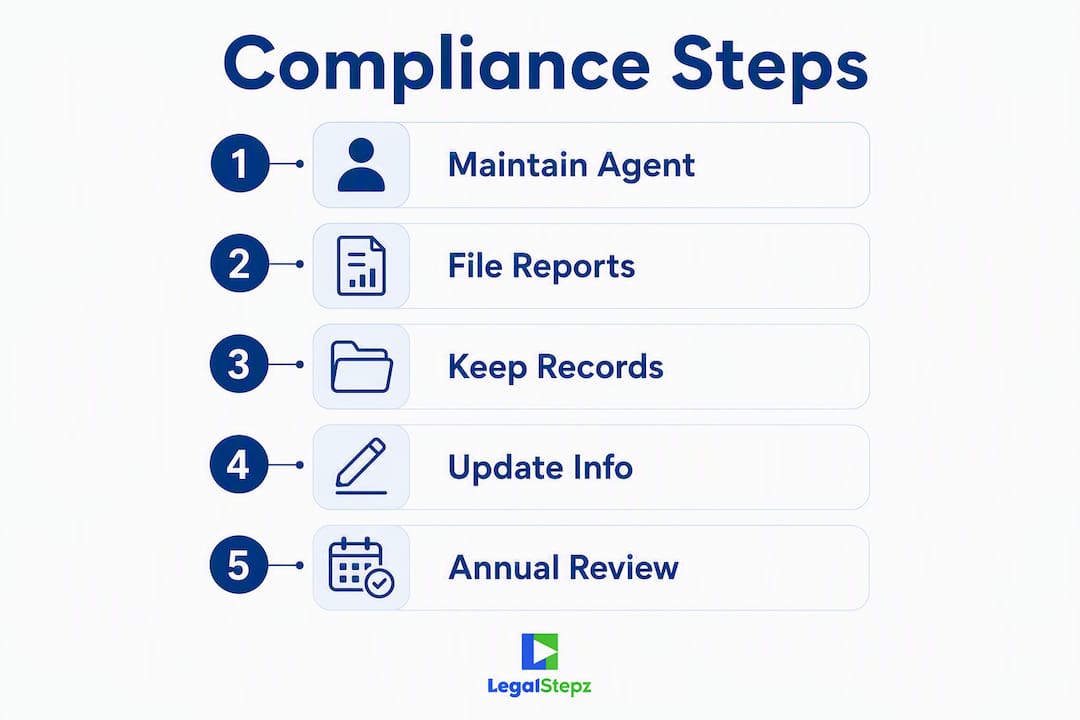
California Corporations Code § 17701.13 requires every LLC to maintain an agent for service of process and keep specific records at a California office. Here is what that looks like in practice.
| Document | Where Stored | Minimum Retention |
|---|---|---|
| Articles of Organization / Incorporation | Corporate records binder | Permanently |
| Statement of Information (filed copies) | Corporate records binder | 4 years minimum |
| Bylaws / Operating Agreement | Corporate records binder | Permanently |
| Annual minutes and resolutions | Corporate records binder | 4–6 years |
| Tax returns and FTB correspondence | Accounting files | 4 years |
| Bank statements and reconciliations | Accounting files | 4–6 years |
| Membership / stock ledger | Corporate records binder | Permanently |
Sample annual compliance calendar:
- January: — Confirm registered agent status and address are current in SOS records.
The California Business Record Keeping Basics guide goes deeper on retention rules and what a complete corporate records binder looks like.
What happens when you miss a filing, and how to fix it
Missing a Statement of Information triggers a sequence that gets more expensive the longer you wait.
The Form LLC-12 instructions specify a penalty for failure to file by the due date. After that, the SOS notifies the Franchise Tax Board, which can assess additional penalties and move to suspend your entity. A suspended entity cannot legally conduct business, enter contracts, or defend itself in court.
Step-by-step remediation:
- Check your entity status at the SOS Business Search.
- File all overdue Statements of Information at bizfileOnline.sos.ca.gov and pay assessed fees.
- If the FTB has suspended your entity, contact the FTB directly to resolve outstanding tax liabilities and request a Certificate of Revivor.
- Once the FTB clears the suspension, confirm active status with the SOS.
- Document the remediation in a corporate resolution noting the corrective actions taken.
Pro Tip: For complex reinstatements involving both SOS delinquency and FTB suspension, the process requires coordinating two separate agencies. Legalstepz handles this kind of multi-step remediation so you don't lose track of which agency needs what.
State-level licenses and permits beyond entity filings
Entity compliance filings are separate from state-level professional and industry licenses. Depending on your business type, California may require:
- Professional licenses: issued by boards under the Department of Consumer Affairs (contractors, accountants, real estate agents, healthcare providers)
- Seller's permit: required if you sell tangible goods, issued by the California Department of Tax and Fee Administration (CDTFA)
- Employer registration: with the Employment Development Department (EDD) if you have employees
- Industry-specific permits: from the California Department of Public Health, the Department of Alcoholic Beverage Control, or the Department of Food and Agriculture, depending on your sector
These are state-level requirements that apply regardless of your entity type. They run parallel to your Secretary of State filings, not instead of them.
State filings vs. local licenses: understanding the difference
Your California Secretary of State filings establish your entity's legal existence and keep it in good standing with the state. A local business license, issued by a city or county, grants permission to operate a business within that jurisdiction.
The two are entirely separate. Filing your Statement of Information with the SOS does not satisfy any local licensing requirement, and obtaining a city business license does not fulfill your state entity compliance obligations. Most California cities require a local business license annually, but that process runs through the city clerk or finance department, not the Secretary of State.
How entity type shapes your filing and licensing obligations
Your entity structure determines which filings apply to you and at what frequency.
LLC: Files Form LLC-12 biennially, must maintain a registered agent and California office, and is governed by an operating agreement. Members have flexible management options but must document decisions in writing to preserve liability protection.
Corporation: Files Form SI-550 annually, must maintain a board of directors, hold annual meetings, keep minutes, and adopt bylaws. The formality requirements are higher than for an LLC, and the consequences of skipping them are more acute.
Sole proprietorship: No Secretary of State entity filing required. No Statement of Information. No registered agent. The tradeoff is full personal liability for all business debts and obligations.
Foreign entities (LLCs or corporations formed in another state but operating in California) must register with the California Secretary of State and follow the same filing cadence as their California-formed counterparts.
How to file your Statement of Information online without common errors
- Go to bizfileOnline.sos.ca.gov and search for your entity by name or file number.
- Select "File Statement of Information" from your entity's record.
- Confirm or update: principal office address, registered agent name and address, officer/manager names and addresses, and business description.
- Pay the filing fee (currently $20 for LLCs; $25 for corporations, per SOS published fees).
- Download and save the filed confirmation as a PDF for your corporate records binder.
Common errors to avoid:
- Using a P.O. box for the registered agent address (not permitted)
- Listing an agent who has not consented to serve
- Entering an outdated principal office address that differs from your bank records
- Filing in the wrong biennial year (check your formation month against the SOS six-month window table)
Key Takeaways
California entity compliance requires active management of state filings, internal records, and registered agent status, and Legalstepz handles all three for California LLCs and corporations.
| Point | Details |
|---|---|
| Check your filing status first | Search your entity on the SOS Business Search and confirm your Statement of Information due date before anything else. |
| Missed filings cost $250 plus more | Failure to file a required Statement of Information can result in a $250 penalty imposed by the Franchise Tax Board, and the Secretary of State may notify the FTB, which could suspend your entity and block you from conducting business. |
| Bylaws and minutes stay internal | These records are never filed with the Secretary of State, but they are your primary defense against veil-piercing claims. |
| Annual alter-ego audit | Review minutes, bank records, and resolutions each year; most owners only do this after litigation starts, which is too late. |
| Legalstepz for filing and agent services | Legalstepz files Statements of Information, drafts bylaws and annual minutes, and provides registered agent services for California entities. |
Why proactive compliance beats reactive remediation every time
The pattern I see consistently in California entity compliance is that business owners treat state filings as a one-time task. Form the LLC, file the Articles, and move on. The Statement of Information due 90 days later gets missed. The biennial renewal after that gets missed. Then the FTB suspension notice arrives, and suddenly a $20 filing has become a multi-agency remediation project.
What makes this frustrating is that the risk is entirely preventable. An annual alter-ego audit, a current registered agent, and a properly customized operating agreement are not expensive or complicated. They are the difference between a business that can defend itself in court and one that cannot.
Custom bylaws matter for the same reason. Statutory defaults in California are designed for the average case. Your business is not the average case. The moment you add a second member, bring on an investor, or give an employee decision-making authority, silent bylaws that defer to statutory defaults create governance gaps that are genuinely hard to fix retroactively.
The compliance work that feels bureaucratic is actually the structural foundation of your liability protection. Skip it, and the LLC or corporation you formed to protect your personal assets may not protect them when it counts.
How Legalstepz keeps your California entity in good standing
California entity compliance has real consequences when it slips. Legalstepz was built specifically to handle the filings, records, and agent services that keep your LLC or corporation protected.
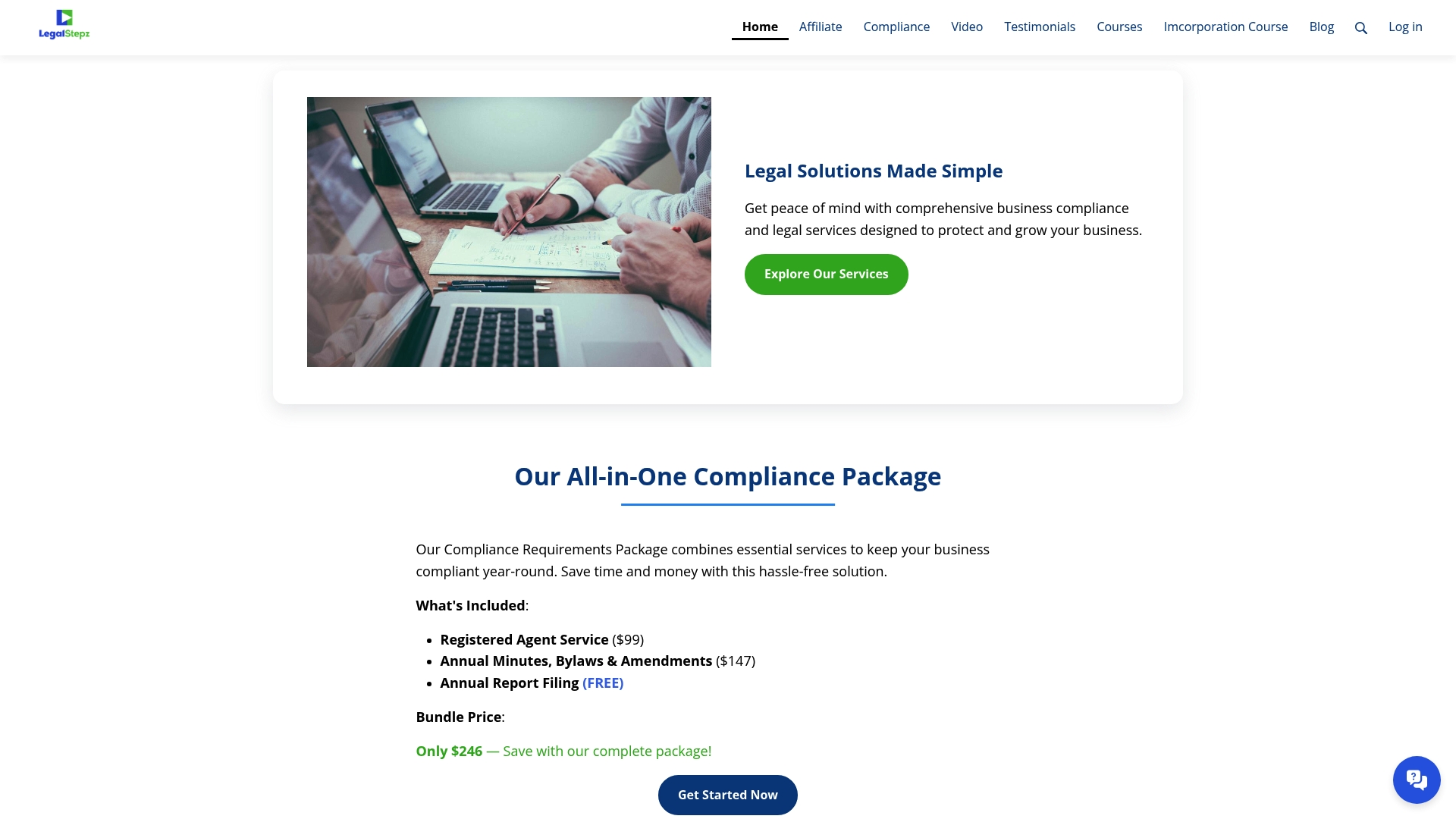
Legalstepz files your Statement of Information directly with the California Secretary of State, drafts annual minutes and bylaws customized to your ownership structure, and serves as your registered agent so you never miss a legal notice. For entities that are already delinquent or suspended, Legalstepz manages the multi-step remediation process across both the SOS and the FTB.
Services include standalone filings, bundled compliance packages, and registered agent plans. You provide the entity details; Legalstepz handles the paperwork, the portal, and the follow-up. Visit legalstepz.com to get started with your Statement of Information filing or registered agent service today.