

If you're building a brand in the United States, federal registration through the USPTO is almost always the right move. A state trademark registration protects your mark only within that state's borders, while a federal registration under the Lanham Act creates nationwide rights from the date you file. The core decision rule is simple: if you sell online, ship across state lines, or plan to grow beyond your home market, file federally. State registration makes sense only when your business is genuinely confined to one state and you have a specific reason to build a local public record quickly.
Named entities that anchor this system: the USPTO, the Lanham Act (the federal statute governing trademark rights), and at the state level, the California Secretary of State for entrepreneurs operating in California.
Key Takeaways
Federal registration through the USPTO is the right choice for most U.S. entrepreneurs because it creates nationwide priority, the ® symbol right, and CBP enforcement tools that state registration cannot provide.
| Point | Details |
|---|---|
| Federal beats state for scope | Federal registration covers all 50 states; state registration (e.g., California at $70/class) covers only that state. |
| Priority date is everything | Federal filing locks in a nationwide priority date from the application day, protecting markets you haven't entered yet. |
| State filing has a tactical role | A California state filing can create a quick public record while a federal application is pending, but it creates no federal priority. |
| Search before you file | Run TESS, your state registry, and common-law searches before filing anything; a clean TESS result does not mean the mark is clear. |
| Legalstepz trademark courses | Legalstepz offers step-by-step trademark courses and compliance packages to guide California entrepreneurs through search, filing, and maintenance. |
Table of Contents
- What is a state trademark and what does it actually protect?
- What are the real benefits of a state trademark?
- How to register a state trademark in California
- What is a federal trademark and why does it operate differently?
- What concrete legal tools does federal registration give you?
- How to register a federal trademark: steps, fees, and timeline
- Does a federal trademark supersede a state trademark?
- When should you choose state, federal, or both?
- What searches should you run before filing anything?
- Costs and timelines compared
- Common misconceptions that cost entrepreneurs money
- Practical next steps for a California entrepreneur
- Why most entrepreneurs underestimate the state vs. federal decision
- How Legalstepz can help you protect your brand
- Sources
What is a state trademark and what does it actually protect?
A state trademark is a mark registered under a state's own trademark statute, not under federal law. Each state runs its own registration system in parallel with the federal system, and the protection it creates stops at the state line. Period.
California's system, administered by the California Secretary of State, charges a filing fee per class that is lower than federal fees. That fee is low, and the process is relatively straightforward, but the protection you get reflects the price: your registered rights are enforceable only inside California. A competitor in Nevada, Texas, or anywhere else can use an identical mark without touching your state registration.
Who typically uses state registration?
- Brick-and-mortar shops with no online sales and no plans to expand beyond one state
- In-state service providers (a local cleaning company, a regional catering business) whose customer base is geographically fixed
- Entrepreneurs who need a quick public record while a federal application is pending
- Businesses that have been refused federal registration and want some form of documented state-level rights in the interim
State systems generally follow the Model State Trademark Bill, and rights are assigned by geography and timing of first use. That means a California state registration does not give you any priority over a business in Oregon using the same mark, even if you registered first in California.
What are the real benefits of a state trademark?
State registration has genuine advantages, but they come with hard limits worth understanding before you file.
Practical benefits of state registration:
- Lower cost. At $70 per class in California, state filing is a fraction of the USPTO's baseline fee.
- Speed. State registries typically process applications faster than the USPTO, which can take 12–18 months or longer.
- Public record. Registration creates a searchable state record that puts in-state competitors on notice.
- State-court remedies. You can pursue infringers in state court using the state trademark statute.
- State dilution protection. Some states, including California, offer dilution protection for marks that are famous within the state, even if they don't qualify for federal famous-mark status.
State filing makes sense when your business is strictly local and you have no near-term plans to sell online or expand. It also works as a tactical placeholder: if your federal application is pending and you want a documented state record in the meantime, a state filing creates that paper trail without waiting for USPTO approval.
The main limitation is non-negotiable: state registration does not create nationwide priority. A later federal registrant can, in most cases, push you out of markets beyond your documented local use area. Relying on state remedies or California's Unfair Competition Law instead of federal registration is a real risk for any brand that might expand.
Pro Tip: If your federal application is pending and you operate in California, a state filing can serve as a short-term record. Just know it creates no federal priority and provides no cross-state enforcement power.
How to register a state trademark in California
The California Secretary of State handles state trademark filings. Here's how the process works in practice:
- Search the California trademark database. Before filing, check the Secretary of State's records for conflicting marks already registered in California. This search is free and available online.
- Confirm actual use in California commerce. California requires that you are already using the mark in commerce within the state. You cannot file on an intent-to-use basis at the state level the way you can with the USPTO.
- Complete the state trademark application form. The California SOS provides the required form. You'll identify the mark, the class of goods or services, the date of first use in California, and the date of first use anywhere.
- Disclose prior federal filing history. California requires applicants to disclose any prior federal registration attempts and the reasons for any federal refusal. That history becomes part of the public state record, so a prior USPTO refusal will show up.
- Submit specimens showing use. You'll need to attach a specimen (a label, tag, screenshot, or similar evidence) showing the mark in actual use.
- Pay the $70-per-class fee and submit the application to the California Secretary of State.
Processing times vary, but California state trademark applications typically take a few months from submission to registration, assuming no issues arise. Delays usually happen when the application is incomplete, the specimen is rejected, or the examiner raises a conflict with an existing mark.
One practical note: the fee and disclosure requirements apply per class, so if your business covers multiple categories of goods or services, budget accordingly.
What is a federal trademark and why does it operate differently?
A federal trademark registration is issued by the USPTO under the authority of the Lanham Act, the federal statute that governs trademark rights across all 50 states. Unlike state registration, federal registration is a single filing that creates rights nationwide.

The legal mechanism that makes federal registration powerful is constructive nationwide priority. Under the Lanham Act, your priority date is established as of your application filing date, not the date you actually started using the mark everywhere. That means if you file today, you have constructive priority over anyone who starts using a confusingly similar mark anywhere in the country after your filing date, even in markets you haven't entered yet.
Federal registration also puts the entire country on constructive notice of your claim. Once your mark is on the USPTO register, no one can later claim they didn't know about it, which matters enormously in infringement disputes.
What federal registration gives you that state registration cannot:
- The right to use the ® symbol, which signals registered federal protection
- Access to federal courts for infringement claims, with broader remedies
- The ability to record your registration with U.S. Customs and Border Protection (CBP) to stop infringing imports at the border
- A nationwide presumption of ownership and validity of the mark
- A constructive use date as of the application filing date, establishing priority across all 50 states
- The foundation for international filing under the Madrid Protocol
What concrete legal tools does federal registration give you?
Federal registration under the Lanham Act is not just a certificate. It's a set of enforcement tools that state registration simply doesn't replicate.
Legal tools and remedies available to federal registrants:
- Nationwide presumption of ownership. In any infringement lawsuit, the registration certificate is prima facie evidence that you own the mark and have the exclusive right to use it nationwide.
- Federal damages. The Lanham Act allows recovery of actual damages, the infringer's profits, and in exceptional cases, attorney fees. Courts can also treble damages for willful infringement.
- Federal court jurisdiction. Federal trademark claims go to U.S. District Courts, which have nationwide subpoena power and consistent application of federal trademark law.
- Priority date from filing. Your application date locks in your priority position across the country, not just in markets where you've already used the mark.
- USPTO database listing. Your mark appears in the USPTO's searchable database, which means future applicants and their attorneys will find it during clearance searches, deterring conflicts before they start.
CBP Recordation: Once your mark is federally registered, you can record it with U.S. Customs and Border Protection. CBP officers can then detain or exclude shipments of infringing goods at the border, stopping counterfeit or copycat products before they reach U.S. consumers. This tool is unavailable to state registrants.
For any brand that sells physical goods, especially through e-commerce with international suppliers, CBP recordation alone can justify the cost of federal registration.
How to register a federal trademark: steps, fees, and timeline
Federal filing is more involved than a state application, but the process is well-documented and manageable for a prepared entrepreneur.
- Run a clearance search on TESS. The Trademark Electronic Search System (TESS) is the USPTO's free database of federal trademark records. Search for identical and similar marks in your class before spending money on an application.
- Supplement with state and common-law searches. TESS only shows federal records. Search relevant state registries and run internet and marketplace searches for unregistered users who may have prior common-law rights.
- Choose your filing basis. If you're already using the mark in commerce across state lines, file on a use-in-commerce basis. If you haven't started selling yet but have a bona fide intent to use the mark, file on an intent-to-use basis.
- Submit through TEAS. The Trademark Electronic Application System (TEAS) is the USPTO's online filing portal. The baseline filing fee starts at a few hundred dollars per class for the TEAS Plus option (which requires meeting additional upfront requirements) or higher for other TEAS forms.
- Prepare and submit specimens. For a use-in-commerce application, you'll need specimens showing the mark in actual commercial use (a product label, a website screenshot showing the mark with a purchase option, etc.).
- Respond to Office Actions if issued. The USPTO examining attorney may issue an Office Action raising issues with the mark (likelihood of confusion, descriptiveness, specimen problems). You typically have three months to respond, extendable to six months for a fee.
- Publication for opposition. If the examiner approves the mark, it's published in the Official Gazette for 30 days. Third parties can oppose registration during this window.
- Registration or Notice of Allowance. Use-in-commerce applications proceed to registration after publication. Intent-to-use applications receive a Notice of Allowance, and you then have six months (extendable) to submit proof of use.
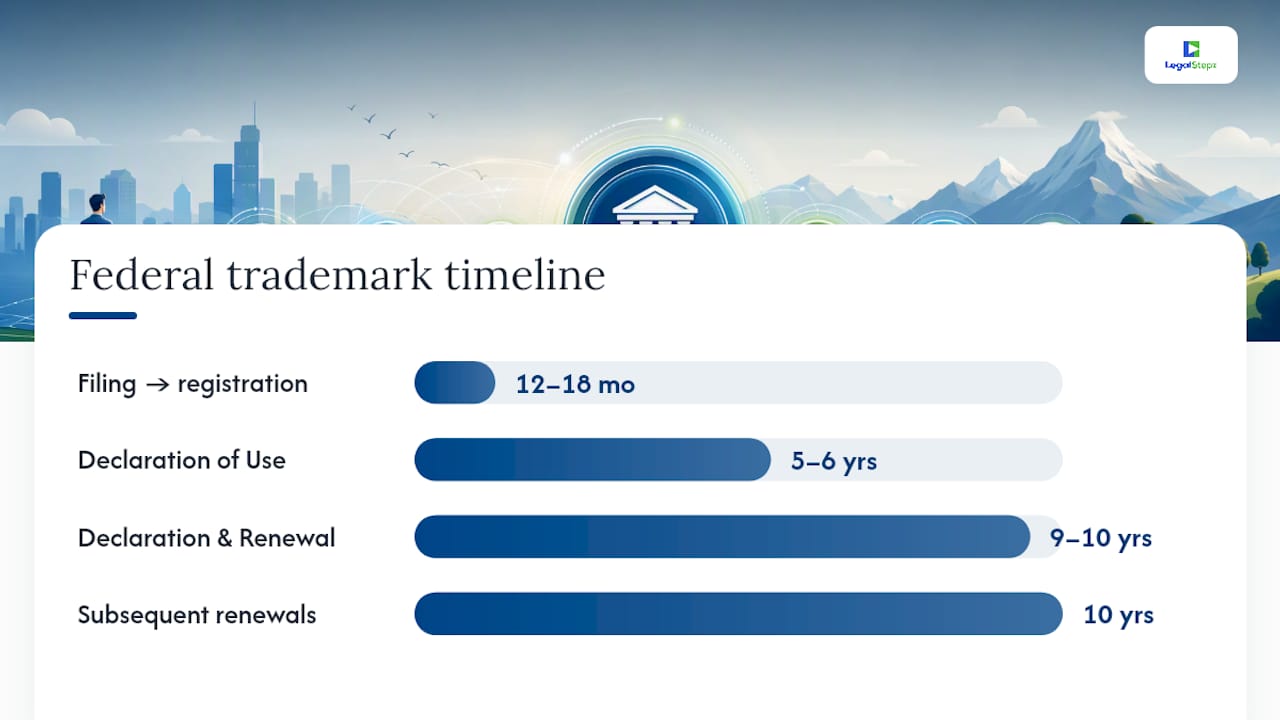
Typical timeline: From filing to registration, expect 12–18 months under normal circumstances, longer if Office Actions or oppositions arise.
Maintenance obligations:
- Between years 5 and 6 after registration: file a Declaration of Use (Section 8)
- Between years 9 and 10: file a combined Declaration of Use and Application for Renewal (Sections 8 and 9)
- Every 10 years after that: renew again
Pro Tip: If you receive an Office Action, don't ignore it. A missed response deadline abandons your application entirely. If the Office Action raises a likelihood-of-confusion refusal, consider consulting a trademark attorney before responding, since the arguments you make (or don't make) can affect your options on appeal.
Does a federal trademark supersede a state trademark?
Generally, yes, but with an important carve-out that every entrepreneur should understand before assuming federal registration solves everything.
When you file a federal trademark application, the USPTO's constructive nationwide priority rules establish your priority date as of the filing date across the entire country. That priority position typically overrides a state registration obtained after your federal filing date. A state registrant who files after your federal application date cannot expand their use into new markets and claim priority over you.
The critical exception is the remote-user carve-out under the Lanham Act. If a local business was already using a mark in a geographically remote market before your federal filing date, that prior local user may be allowed to continue using the mark in their established territory, even after your federal registration issues. Their rights are frozen geographically: they can keep using the mark where they already were, but they cannot expand.
A concrete example: A bakery in Sacramento has been using "Golden Crust" since 2019 and registered it with the California Secretary of State. A national bread company files a federal application for "Golden Crust" in 2023. The bakery's prior local use in Sacramento may be protected as a remote-user exception, but the bakery cannot open a "Golden Crust" location in Portland or Phoenix and claim priority over the federal registrant.
| Scenario | State registrant | Federal registrant |
|---|---|---|
| Geographic scope | State only | Nationwide |
| Priority date | Date of first use in state | Federal application filing date |
| Can expand to new states? | No priority outside home state | Yes, nationwide priority |
| Remote-user exception applies? | Yes, if prior local use predates federal filing | N/A (federal registrant holds nationwide rights) |
| Enforcement forum | State court | Federal or state court |
The practical implication: if you're a California business with a state registration and a competitor files federally, your window to expand is effectively closed the moment their federal application is filed. This is why federal registration matters even for businesses that feel "local" today.
When should you choose state, federal, or both?
The right answer depends on four variables: where you sell, how you sell, where you plan to go, and what your budget allows.
Decision checklist:
- Do you sell online or ship products to customers in other states? File federally.
- Are you franchising or licensing your brand? Federal registration is a practical requirement for most franchise agreements.
- Is your entire customer base physically within one state, with no online sales? State registration may be adequate for now.
- Do you have a tight budget and a pending federal application? A state filing can create a short-term record while you wait.
- Are competitors in your space filing federally? If they are, a state registration leaves you exposed.
- Are you in a crowded trademark space with many similar marks? A professional clearance search before any filing is worth the cost.
If/then rules:
- If you sell online or ship across state lines, file federally. Interstate commerce triggers federal trademark law, and state registration provides no protection outside your state.
- If you're strictly local (a neighborhood restaurant with no delivery beyond city limits, no online sales), state registration may be sufficient for now, but plan for federal if that changes.
- If your federal application is pending and you operate in California, a state filing creates a documented public record in the interim. It does not create federal priority.
- If you're in a high-value brand category (tech, consumer goods, food and beverage), file federally from day one. The cost of a federal application is far lower than the cost of rebranding after a conflict.
Pro Tip: Filing both is a legitimate strategy for California entrepreneurs: register with the California Secretary of State for a quick local record, and simultaneously file with the USPTO for nationwide protection. The state filing does not accelerate or strengthen your federal application, but it documents your California use date in a public record.
What searches should you run before filing anything?
Skipping clearance searches is the most expensive mistake in trademark practice. Filing an application for a mark that conflicts with an existing registration wastes your filing fee and can expose you to an infringement claim.
- Search TESS (the USPTO database). Go to the USPTO's TESS system and search for identical and phonetically similar marks in your class. Search both the exact mark and variations. TESS contains only federal records, so a clean TESS result does not mean the mark is clear.
- Search the relevant state registry. For California entrepreneurs, search the California Secretary of State's trademark database. If you operate in multiple states, search each state's registry.
- Run internet and marketplace searches. Search Google, Amazon, Etsy, and industry-specific directories for businesses using the same or similar name. Common-law rights arise from use in commerce and are geographically limited, but they can still block your registration or create infringement exposure in the user's territory.
- Consider a professional clearance search. A comprehensive clearance search conducted by a trademark attorney or search firm covers federal records, state records, common-law use, domain names, and business directories. For a brand you're investing in seriously, this is money well spent.
Document every search you run, including the date, the database searched, and the results. If you later face an infringement claim, that documentation shows you acted in good faith.
Pro Tip: TESS searches are free but limited. They won't surface a competitor who has been using your mark for years without registering it. A common-law user with prior use in their territory can still oppose your federal application or sue for infringement. Don't treat a clean TESS result as a green light.
Costs and timelines compared
Here's a direct comparison of what each path typically costs and how long it takes.
| Factor | State (California) | Federal (USPTO) |
|---|---|---|
| Filing fee per class | $70 | From $350 (TEAS Plus) |
| Processing time | A few months (typical) | 12–18 months (no conflicts) |
| Geographic scope | California only | All 50 states |
| Use requirement at filing | Yes (must be in use) | No (intent-to-use basis available) |
| Renewal cycle | Varies by state | Every 10 years (with year 5–6 declaration) |
| ® symbol right | No | Yes |
| CBP recordation | No | Yes |
Maintenance obligations to calendar:
- California state trademark: Renewal requirements vary; check the California Secretary of State's current schedule for your registration class.
- Federal trademark: File a Declaration of Use between years 5 and 6. File a combined renewal between years 9 and 10. Repeat renewal every 10 years. Missing these deadlines cancels your registration.
For current USPTO fees, the USPTO fee schedule is the authoritative source. Fees can change, so verify before filing.
Common misconceptions that cost entrepreneurs money
Several widespread beliefs about trademarks lead to real legal and financial problems. Here are the ones that come up most often.
Myth vs. fact:
- Myth: Registering my LLC or corporation name with the state gives me trademark rights. Fact: Entity name registration and trademark registration are completely separate legal systems. The state approves your entity name for corporate filing purposes only. It creates no trademark rights whatsoever. A business can be incorporated as "Blue River Designs LLC" and still infringe another party's "Blue River" trademark.
- Myth: Owning the domain name means I own the trademark. Fact: Domain registration and trademark rights are separate. Owning blueriverdesigns.com does not give you trademark rights in "Blue River Designs," and you can still infringe another party's trademark even while owning the domain.
- Myth: I need to register at the state level before I can file federally. Fact: The two systems are independent. State registration is not a prerequisite for federal filing, and many businesses file directly with the USPTO without ever registering at the state level.
- Myth: Common-law rights protect me everywhere I do business. Fact: Common-law trademark rights arise from actual use in commerce and are geographically limited to the area where you've actually used the mark. They don't travel with your website traffic or your social media following.
The practical consequence of these misconceptions is significant. A business owner who forms an LLC, buys a domain, and assumes they're protected may spend years building brand equity in a name they don't legally own. When a federal registrant shows up with a priority date earlier than your first use, you may be forced to rebrand entirely.
For more on how entity name registration differs from trademark protection, the California entity name availability guide and the common business name mistakes resource at Legalstepz cover this in detail.
Practical next steps for a California entrepreneur
If you're a California-based entrepreneur ready to protect your brand, here's a concrete action plan.
- Search TESS first. Before anything else, run a search on the USPTO's TESS database for your mark and close variations in your class. This is free and takes 30 minutes if you know what you're doing.
- Search the California Secretary of State's trademark database. Even if you plan to file federally, knowing what's already registered in California helps you assess local conflict risk.
- Run common-law searches. Search Google, Amazon, Yelp, and industry directories for businesses using your mark or something confusingly similar. Document what you find and when you searched.
- Decide on your filing path. If you sell online or plan to expand, file with the USPTO using TEAS. If you're strictly local and need a quick record, file with the California Secretary of State at $70 per class while your federal application is being prepared.
- Prepare your specimens. For a use-in-commerce filing (state or federal), gather evidence of the mark in actual commercial use: product labels, website screenshots showing the mark with a buy button, packaging photos.
- File and track your application. Once filed, monitor your application status. For federal filings, respond to any Office Actions within the deadline. For California filings, watch for examiner correspondence.
- Set a maintenance calendar. Federal registrants must file between years 5 and 6, and renew every 10 years. Put these dates in your calendar the day your registration issues.
The trademark process walkthrough at Legalstepz covers each of these steps in detail, including what to have ready before you file.
Pro Tip: When filing with the California Secretary of State, you must disclose any prior federal filing attempts and the reasons for any federal refusal. That history enters the public state record permanently. If your USPTO application was refused, think carefully about whether a California state filing is the right move, since the refusal reason will be visible to anyone who searches the state database.
Why most entrepreneurs underestimate the state vs. federal decision
Most of the entrepreneurs I work with at Legalstepz come in thinking the state vs. federal trademark question is mainly about cost. It's not. It's about what you're actually buying.
A state registration buys you a public record and state-court access. A federal registration buys you a nationwide priority date, the ® symbol, CBP enforcement, and a presumption of ownership that shifts the burden in any infringement fight. Those are fundamentally different assets. The $280 difference in filing fees between a California state filing and a USPTO TEAS Plus application is not the real comparison. The real comparison is between having a legal tool that works in one state and having one that works in all fifty.
The entrepreneurs who regret going state-only are almost always the ones who didn't think they'd expand, then did. The ones who regret going federal are almost none, because federal registration doesn't prevent you from also enforcing state rights. File federally early, maintain it properly, and you'll rarely wish you'd done less.
How Legalstepz can help you protect your brand
Getting trademark registration right from the start saves you from expensive conflicts and rebranding down the road. Legalstepz offers step-by-step trademark courses that walk California entrepreneurs through the full process: from running your first TESS search to filing your USPTO application and managing maintenance deadlines. The courses are built for business owners who want to understand what they're filing, not just hand it off blindly.
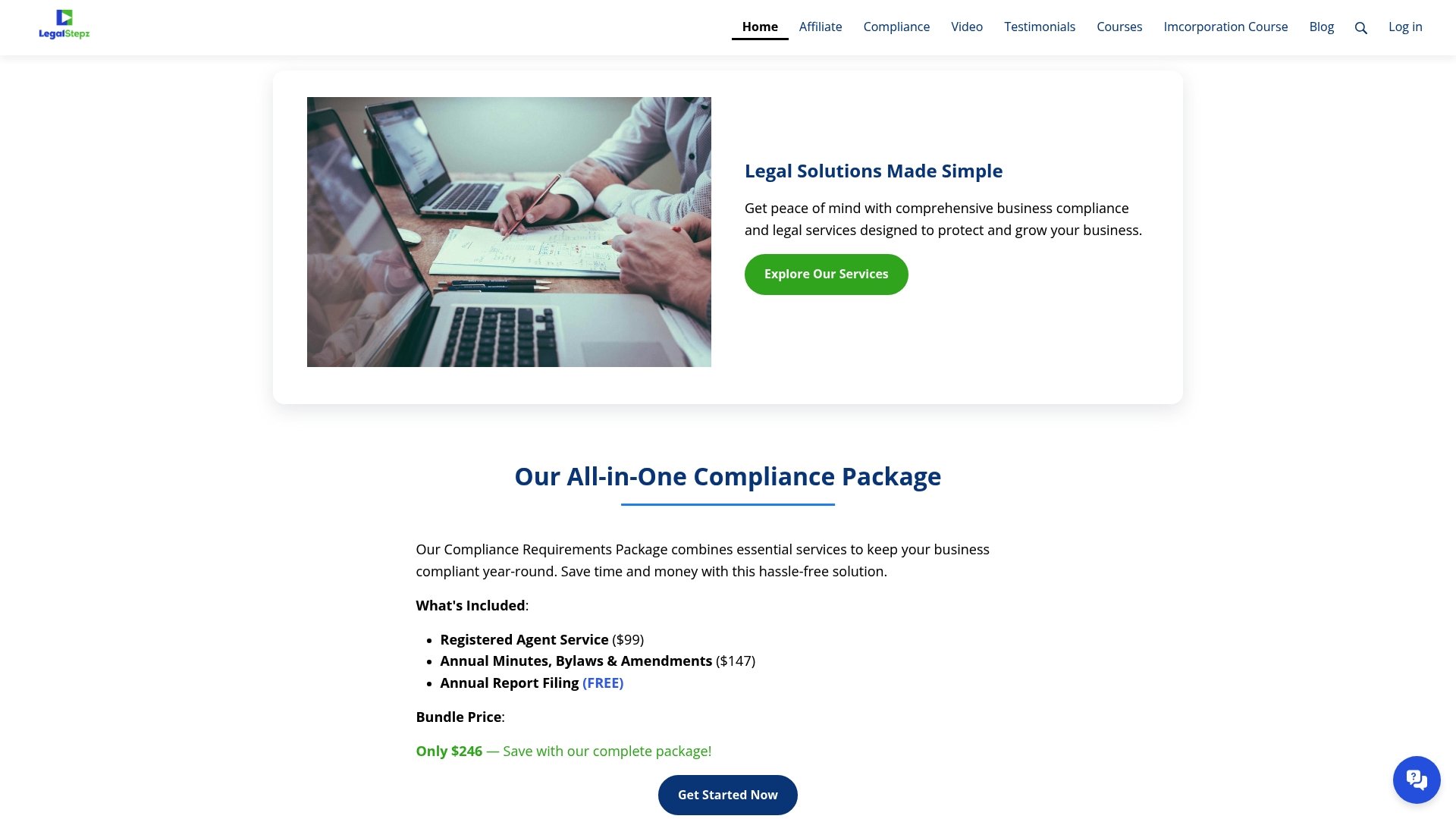
Beyond education, Legalstepz provides compliance packages, registered agent services, and business formation support tailored to California corporations and LLCs. If you're at the point where you know you need to file but want a clear, structured path through the process, the trademark course is the right starting point. Visit Legalstepz to see the full course catalog and compliance offerings, and take the first concrete step toward protecting your brand.
Sources
Every entrepreneur filing a trademark should have these resources saved before they start.
- Trademarks and Service Marks :: California Secretary of State
- Why register your trademark? | USPTO
- Intellectual property rights enforcement (CBP)
TESS searches are federal-only. Always add a California Secretary of State search and a common-law internet search to your clearance process before filing in either system.
This article provides general information about U.S. trademark law and is not a substitute for legal advice. Trademark eligibility, priority, and enforcement depend on the specific facts of your situation. Confirm current fees and requirements directly with the USPTO and your state's trademark office, and consult a qualified trademark attorney for guidance on your specific mark.