

Trademark classes are the international 45-class system the USPTO uses to sort every registration, with Classes 1 through 34 covering goods and Classes 35 through 45 covering services. Your first move is simple: write down the exact goods or services your brand actually sells, then search the USPTO Trademark ID Manual for wording that matches. Each class you file under carries its own fee, so pick classes based on what you sell now or genuinely intend to sell soon, not on wishful thinking.
TL;DR:
- Filing in fewer, well-chosen classes with exact ID Manual language can reduce costs and avoid delays caused by examiner rewording.
- Using current Nice Classification editions ensures your descriptions match officially approved wording and align with international filings.
- Targeted search across both your core classes and related coordinated classes prevents overlooked conflicts and missed protection opportunities.
- Common application failures include vague descriptions, incorrect class choices, and neglecting to search related classes before filing.
- Seeking professional guidance, such as trademark courses or legal services, can help ensure precise classification and smoother application processing.
Table of Contents
- What Are Trademark Classes and Why Does the Nice Classification Matter?
- A Quick Reference to the 45 Trademark Classes
- How Do You Choose the Right Trademark Class?
- How Do You Search the USPTO Trademark ID Manual?
- What Does It Actually Cost to File in Multiple Classes?
- What Are Coordinated Classes and Why Do They Matter for Your Search?
- What Mistakes Cause Trademark Applications to Fail?
- Where Can You Get Help Choosing and Filing the Right Classes?
- Why the Standard Trademark Class Advice Falls Short
- Sources
What Are Trademark Classes and Why Does the Nice Classification Matter?
The 45 class system did not originate at the USPTO. It comes from the Nice Classification, an international agreement managed by the World Intellectual Property Organization. The USPTO adopted it so a trademark filed in the United States lines up with filings in dozens of other countries, which matters if you ever expand internationally or license your brand overseas.
Here's the part that trips people up: classes are functional, not industry based. The USPTO doesn't ask "what industry are you in?" It asks "what does this specific product or service actually do?" A leather jacket and a leather wallet both belong to the fashion world, but they land in different classes because one is clothing and the other is a small leather good.
- Classes 1 through 34 cover physical and digital goods, from chemicals to clothing to computer software.
- Classes 35 through 45 cover services, from advertising to legal work to restaurant operations.
- The USPTO's own guidance on goods and services defines goods as products customers purchase and services as activities performed for someone else's benefit.
The Nice Classification's Thirteenth Edition took effect January 1, 2026, and it governs current class headings and explanatory notes. If you're researching class language using an older edition, you're working from outdated wording.
A Quick Reference to the 45 Trademark Classes
Scanning the full class list for the first time feels like reading a phone book. Here is an overview of goods and services classes:
Goods, Classes 1 to 34 include chemicals, cosmetics, pharmaceuticals, computer software, paper goods, leather goods, furniture, clothing, toys, foods, beverages, and wines and spirits. Services, Classes 35 to 45 include advertising, financial services, construction, transportation, education, software as a service, hospitality, medical services, and legal services.
Startups often file in key classes such as software, apparel, retail services, education and entertainment, and SaaS and technology services. For the complete, current wording, the Nice Classification overview from WIPO and the USPTO's ID Manual remain the two sources worth bookmarking.
How Do You Choose the Right Trademark Class?
Picking a class isn't guesswork if you follow a sequence. Here's the method that keeps founders from either underprotecting their brand or wasting money on classes they'll never use.
- Build a brand inventory. List every product or service you currently sell, plus anything you have concrete plans to launch within the near future. Vague ambitions don't count. The USPTO wants actual use or a bona fide intent to use.
- Split goods from services. A single brand often needs both. A clothing line that also runs pop-up retail events may need Class 25 for the apparel and Class 35 for the retail service itself.
- Search the ID Manual for exact wording. Don't paraphrase. Find the closest pre-approved identification and use it, or refine your description to match the manual's structure as closely as possible.
- Check coordinated classes. Related classes often get grouped for search purposes because consumers don't draw the same lines the USPTO does.
- Weigh the cost against the coverage. Practitioners commonly point small businesses toward filing 2 to 4 core classes that reflect real current use, rather than blanketing ten classes speculatively.
- Decide what to add later. You can expand coverage in future filings once a product line launches, but that means a new application and a new fee, not a free amendment.
Pro Tip: Map your business by what you actually deliver, not by what industry you'd describe yourself as being in. A "fitness brand" might need Class 25 for apparel, Class 41 for training services, and Class 9 for a companion app. Three classes, one identity.
How Do You Search the USPTO Trademark ID Manual?
The ID Manual isn't a suggestion box. The USPTO treats its entries as pre-approved identification language, and using that exact phrasing is the single easiest way to avoid a delay.
Search by function first, not by brand category. Typing "clothing" gets you a wall of results; typing "hooded sweatshirts" or "athletic footwear" narrows things fast. Read the class number attached to each result closely, because the manual sometimes shows the same word type mapped to different classes depending on context.
- Use specific nouns describing the item or activity, not marketing language.
- Filter results by class number to confirm you're looking at the right group.
- When no exact match exists, choose the closest listed phrase rather than inventing new wording, since free-form descriptions risk surcharges or office actions.
Statistic to know: the base USPTO filing fee is $350 per class as of January 2025, and that fee assumes you used acceptable ID Manual language. Custom descriptions that need examiner review can trigger extra costs on top of that base rate.
Software filers hit this wall constantly. Recorded software you sell on a disc or preloaded on hardware typically falls under Class 9. A downloadable app or a SaaS platform your customers access online usually falls under Class 42 instead. Filing software under the wrong one of these two is one of the most common reasons a trademark application gets an office action.
What Does It Actually Cost to File in Multiple Classes?
The math is straightforward, and it's worth doing before you file rather than after. The USPTO's base fee runs $350 per class. File in one class and you owe $350. File in two, and it's $700. Add a third and you're at $1,050.
- One class, clean ID Manual wording: $350 total.
- Two classes, both using pre-approved language: $700 total.
- Any class using a custom description that needs examiner rewording risks an added surcharge on top of the base fee.
Adding a class after your original filing isn't a simple amendment. It means a new application with its own fee and its own review timeline. If you're unsure whether your business will expand into a second category within the next year or two, talk to a trademark practitioner before deciding whether to file now or wait.
What Are Coordinated Classes and Why Do They Matter for Your Search?
Coordinated classes are groups the USPTO treats as related for search purposes, even though the class numbers themselves differ. The logic follows how consumers shop, not how the numbering system reads on paper.
Apparel, footwear, and retail store services built around clothing are a classic coordinated cluster. So are software products, downloadable apps, and the technology consulting services built around them. Searching only your target class and ignoring its coordinated neighbors is how brand conflicts slip past a clearance search. A practical guide for online sellers on evaluating trademark risk before launch makes a similar point: protection planning has to account for where a product actually sells, not just what class number it technically occupies.
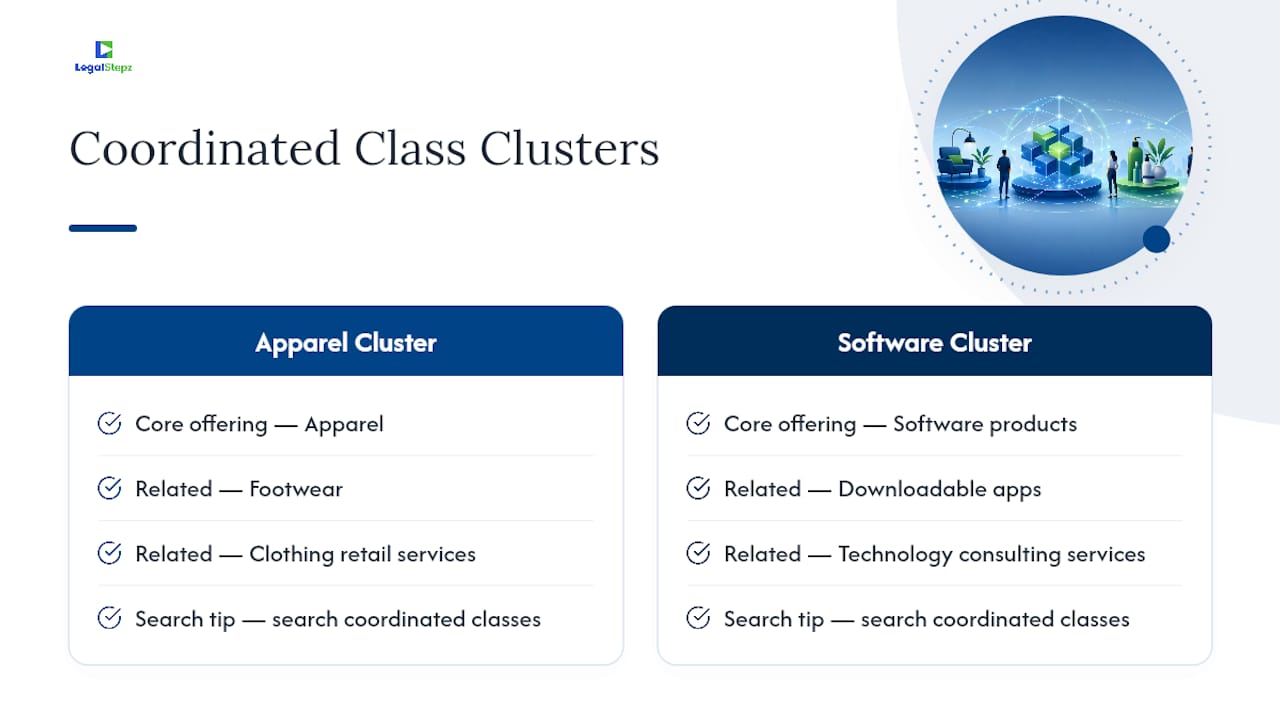
The rule of thumb for small businesses: search every coordinated class connected to your core offering, but only file in the ones tied to real commercial use or plans you're actually acting on soon.
What Mistakes Cause Trademark Applications to Fail?
Most refusals and office actions trace back to a small set of repeat offenders. Vague identifications top the list. "Consulting services" or "clothing" alone won't cut it. The USPTO wants specificity.
Filing under the wrong software class is another frequent error, along with picking too few classes and leaving real product lines unprotected, or the opposite mistake: filing too many speculative classes and paying for coverage you'll never use. Skipping the coordinated class search rounds out the common failures, since it's how brand conflicts get missed before they become legal headaches.
Here's a six step checklist to run before you submit anything:
- Confirm your goods/services list matches actual current use or a genuine, near-term plan.
- Search the ID Manual and copy language exactly where a match exists.
- Confirm the class number attached to each identification matches your expectation.
- Run a clearance search across your target classes and their coordinated classes.
- Calculate your total fee based on the number of classes at $350 each.
- Have someone outside your own head read the application description for clarity.
Pro Tip: If you're not sure whether your business will get an office action, ask this: does your identification language sound like something a USPTO examiner has already approved, or does it sound like your own marketing copy? Marketing copy gets flagged.
Where Can You Get Help Choosing and Filing the Right Classes?
Choosing classes correctly the first time saves you money and months of delay. A trademark course is available to walk business owners through ID Manual searches, class selection, and the filing mechanics that trip up first-time applicants.
Beyond the course, Legalstepz publishes practical breakdowns of trademark search methodology and real specimen examples that show how ID Manual wording connects to actual proof of use.
- The trademark course covers class selection logic and search technique.
- The blog library breaks down search strategy and common filing pitfalls.
- Registered agent and compliance filing services help entrepreneurs keep the paperwork side handled after registration.
If you want a structured path through this rather than piecing it together from USPTO pages alone, Legalstepz is built for exactly that.
Why the Standard Trademark Class Advice Falls Short
Most trademark class guidance treats classification like a lookup problem: find your industry, find the matching number, done. That's backwards. Classification is a functional exercise, and the businesses that get burned are almost always the ones that classified by identity rather than by deliverable. A "wellness brand" isn't a class. Supplements, apparel, coaching services, and a companion app are four different classes wearing one brand name.
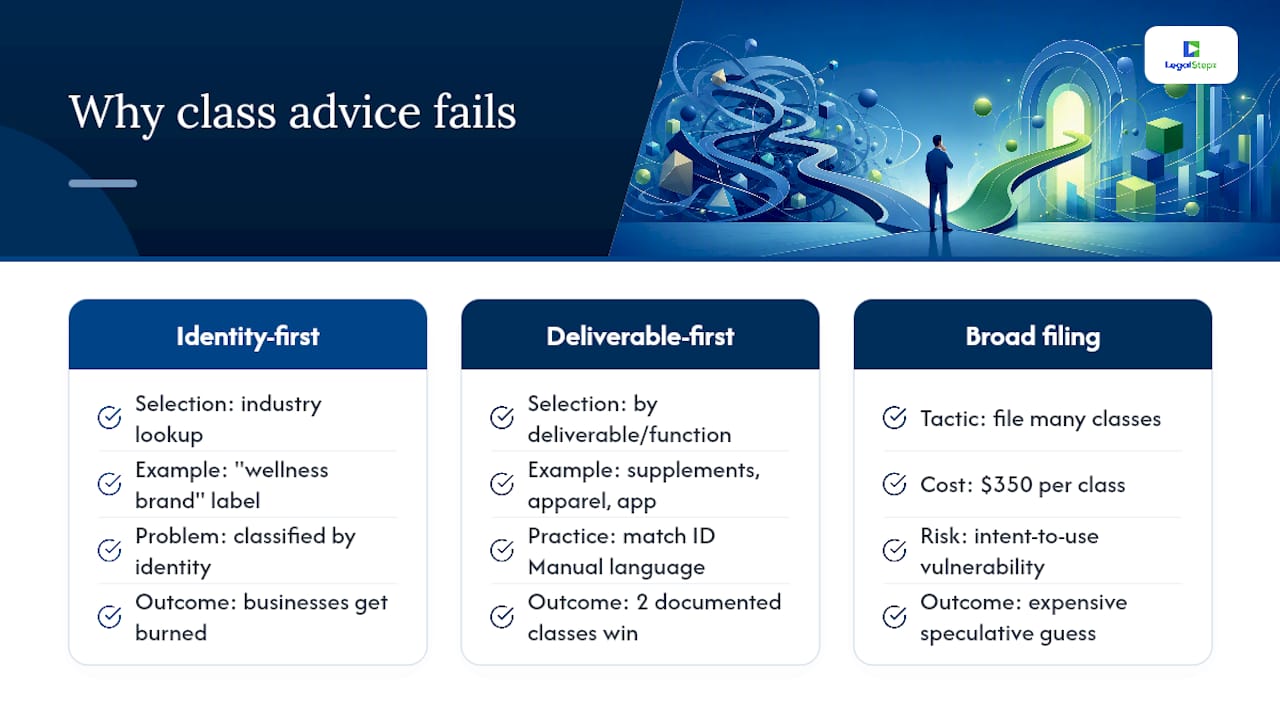
The conventional advice to "file broadly to be safe" deserves more skepticism than it gets. Filing five speculative classes at $350 each to cover hypothetical future products isn't caution. It's an expensive guess, and a trademark filed on intent to use without follow through can become vulnerable later if that use never materializes.
What actually matters, based on how the USPTO evaluates applications, is precision over breadth. Get your goods and services description exact, matched to real ID Manual language, filed in the classes tied to what you're actually building. Two well documented classes beat six vague ones every time. Start there before worrying about anything else.
— Peter
This article is general information, not a substitute for advice from a qualified lawyer. Consult a qualified legal professional about your own circumstances before acting on anything here.