
The government floor for a single-class trademark filing in California is $350 at the federal level and $70 at the state level. Realistically, though, most entrepreneurs spend a few hundred dollars doing it themselves, or a few thousand dollars with attorney help for one class. What moves that number most is how many classes you file in, whether you write your own goods and services description instead of using the USPTO's approved wording, and whether you file as intent to use rather than already using the mark in commerce.
TL;DR:
- Filing a two-class federal trademark application with no additional help can cost around $700, with professional assistance potentially raising total expenses above $4,000 for multiple classes.
- The USPTO charges $350 per class plus surcharges for description and information deficiencies, which can significantly increase costs if not carefully managed.
- California registration costs an additional $70 per class but only offers protection within the state, making it less suitable for online or expanding businesses.
- Professional services such as clearance searches, application preparation, and office action responses can add thousands of dollars to the overall cost, especially in contested or complex cases.
- Maintaining a trademark involves recurring costs, with filings due around years five and ten, costing a few hundred dollars per class, which should be factored into the total budget.
Table of Contents
- What Does It Cost to Trademark Something in California in 2026?
- What Are the Official USPTO and California Trademark Fees?
- How Much Do Professional Trademark Services Cost?
- What Are Trademark Maintenance and Renewal Fees?
- How Do Classes and Filing Basis Change Your Total Cost?
- How Can You Avoid Unnecessary Trademark Fees?
- What's a Realistic Filing Budget Checklist?
- Why California Entrepreneurs Get Trademark Costs Wrong
- Get Help With Your California Trademark Filing
- Where to Verify These Trademark Fees
- Sources
- FAQ
What Does It Cost to Trademark Something in California in 2026?
The fastest way to size up your budget is to compare the two most common paths side by side.
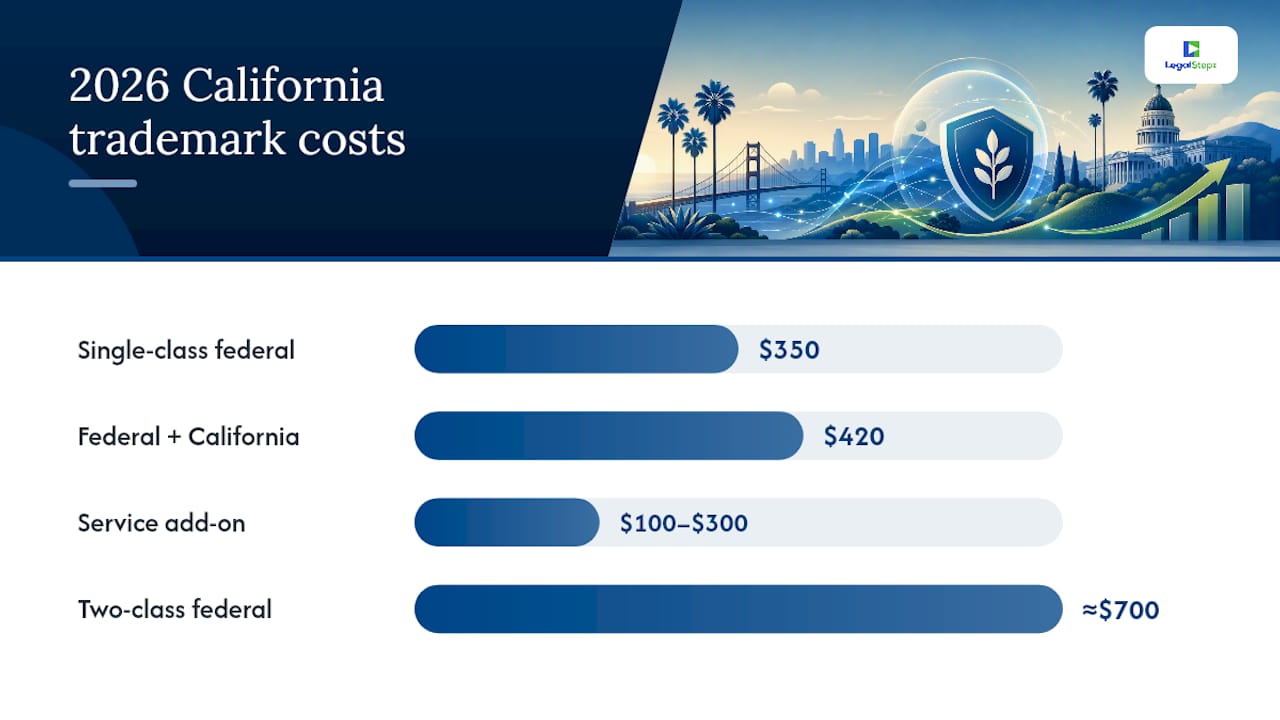
A bare-bones, single-class federal filing done yourself runs $350 in government fees. Add a California state registration in the same class and you're at $420 combined, assuming you skip every surcharge and file cleanly on the first try. Bring in a budget online filing service and expect another $100 to $300 on top of the government fee, mostly for guided forms and basic review.
Two classes roughly doubles the government cost. Filing in two USPTO classes without state registration puts you at double the single-class federal fee before any professional help, and a modest attorney fee for a two-class application commonly pushes the all-in total well over typical single-class costs.
Those attorney ranges swing widely because they depend on how much clearance research and back-and-forth with the USPTO your specific mark requires.
What Are the Official USPTO and California Trademark Fees?
Every dollar in your budget traces back to a fee schedule, and the USPTO fee schedule sets the federal baseline for 2026.
- Base application fee: $350 per class of goods or services, the number every applicant pays no matter which filing basis they choose.
- Free-form identification surcharge: an extra fee per class if you write your own description of goods and services instead of pulling exact language from the USPTO's Trademark ID Manual.
- Insufficient information surcharge: a fee per class if your application is missing required details the examiner needs to process it.
- Statement of use fee: a fee per class, required once you actually start using an intent-to-use mark in commerce.
- Extension request fee: a fee per class, charged each time you need more time before filing that statement of use.
Fee snapshot: A single-class application with a free-form description and missing information could rack up $650 in USPTO fees alone, nearly double the $350 baseline, before an attorney charges a cent.
California layers its own fee on top if you also want state-level protection. The California Secretary of State charges $70 per classification for a state trademark or service mark, with registrations valid for five years before renewal. State filing is cheap and quick, but it only protects you inside California, so businesses selling online or planning to expand should weigh that limitation against the higher upfront federal cost.
How Much Do Professional Trademark Services Cost?
Government fees are fixed. Professional fees are where your total budget actually gets decided, and they break down into three distinct purchases.
- Clearance search. A basic knockout search checking obvious federal conflicts might run you little to nothing if you do it yourself on the USPTO's database, while a comprehensive search covering state registrations and common-law use through a paid service typically costs more, depending on scope.
- Application preparation. Budget online filing services sit at the low end. Solo attorneys and small firms charge noticeably more for personalized review and correct classification. Large firms sit at the top of that range, often justified by experience with complex or contested marks.
- Office action response. If the USPTO raises an objection, which happens often enough to plan for, responding typically adds a meaningful chunk to your original attorney fee, sometimes as much as the initial filing cost itself.
A realistic single-class scenario with a solo attorney, one office action, and no state filing often lands between $1,500 and $2,500 all-in. A two-class filing with a large firm and a contested office action can push past $4,000.
What Are Trademark Maintenance and Renewal Fees?
Registration isn't a one-time purchase. The USPTO requires ongoing paperwork to keep your mark alive, and skipping a deadline can cost you the registration entirely.
- Section 8 declaration: due between the fifth and sixth year after registration, costing a fee per class according to USPTO trademark fee information.
- Grace period surcharge: if you miss the standard window, a six-month grace period is available but adds a surcharge per class on top of the base fee.
- Combined Section 8 and Section 9 renewal: due every 10 years, typically costing a few hundred dollars per class depending on how the filings are combined.
- Ongoing monitoring: watching for infringing marks isn't required, but budgeting for periodic searches or a monitoring service protects the investment you already made in registration.
For a single class, that's roughly $325 at year five or six, then another few hundred dollars per class every decade after that. Multiply everything by your class count, and maintenance costs scale exactly the way filing fees do.
How Do Classes and Filing Basis Change Your Total Cost?
Every additional Nice class multiplies your government fees directly. Two classes means $700 in USPTO fees instead of $350, and professional time roughly follows suit since each class needs its own description and evidence of use.
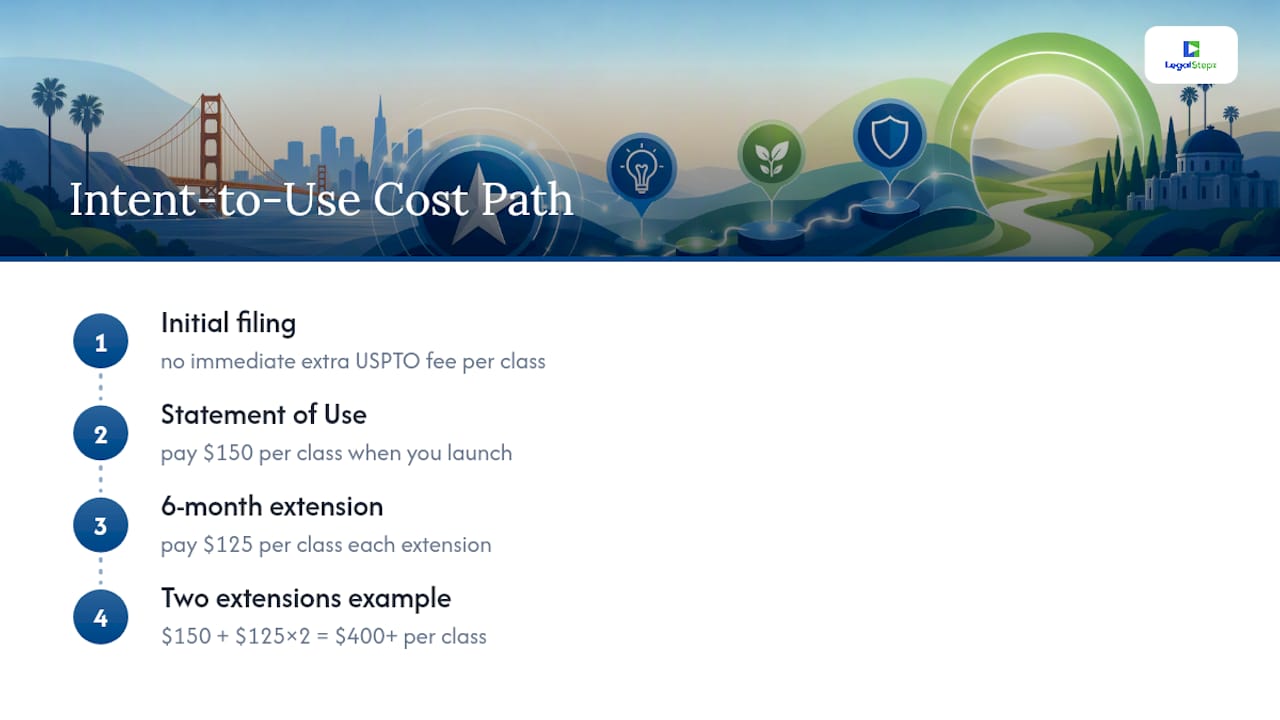
Filing on an intent-to-use basis, meaning you haven't sold anything under the mark yet, adds steps rather than immediate fees. You'll eventually pay $150 per class for a statement of use once you launch, and possibly $125 per class for each six-month extension if you're not ready yet. A mark filed as intent to use and extended twice before use begins can add $400 or more per class over the life of the application.
The practical rule: only include a class if you're actively selling, or planning to sell within the next few years, in that category. Speculative classes just inflate cost without adding protection you'll use.
How Can You Avoid Unnecessary Trademark Fees?
Most avoidable cost comes from three preventable mistakes, and all three are fixable before you ever submit an application.
Pro Tip: Search the Trademark ID Manual for your exact goods or services before writing a single word of your own description. Matching approved language exactly is the single easiest way to dodge the $200 free-form surcharge.
- Use Trademark ID Manual language instead of writing your own description, since custom wording triggers the $200 per-class surcharge automatically.
- Run a real clearance search covering federal, state, and common-law use, not just a quick USPTO database check, since catching conflicting marks early saves you from filing on a mark you'll have to abandon later.
- Double-check every required field and upload a genuine specimen of use before submitting, since incomplete applications trigger the $100 insufficient-information surcharge.
- Pay for attorney review once your mark, industry, or class count gets complicated, because the cost of a mistaken filing usually exceeds the cost of getting it checked first.
What's a Realistic Filing Budget Checklist?
Work through these steps in order and you'll have a defensible number before you file anything.
- Decide state, federal, or both. Multiply $350 (federal) and/or $70 (California) by your number of classes.
- Pick your search depth. Budget for a comprehensive search if your mark is distinctive and valuable; a basic knockout search may suffice for a low-risk name.
- Estimate application prep. Add a DIY cost of near zero, a filing service fee, or an attorney fee depending on complexity.
- Build in contingency. Reserve 50% to 100% of your professional fee for a likely office action.
- Mark your maintenance calendar. Note the Section 8 deadline around year five and the combined renewal at year ten so you're not caught off guard later.
Why California Entrepreneurs Get Trademark Costs Wrong
Most people budget for the filing fee and forget everything that happens after it. That's backwards. The $350 base fee is the cheapest part of owning a trademark. The real cost shows up in the search you skipped, the office action you didn't plan for, and the renewal deadline you forgot five years later.
Legal Stepz built its trademark education content around that gap. Our step-by-step search guidance and timeline breakdowns exist because California business owners keep making the same three mistakes: skipping the search, writing their own goods description, and filing without a maintenance plan. Every task in the budget checklist above maps to something we cover in detail for entrepreneurs who want to handle this correctly the first time.
— Peter
Get Help With Your California Trademark Filing
If the budget above tells you a DIY filing makes sense, great. If it tells you your situation, multiple classes, an unclear description, or a business that's growing past California needs more structure, there are options that can provide a faster path than hiring a large firm by the hour. There are courses and compliance packages available for California entrepreneurs who want procedural clarity without paying attorney rates for every step.
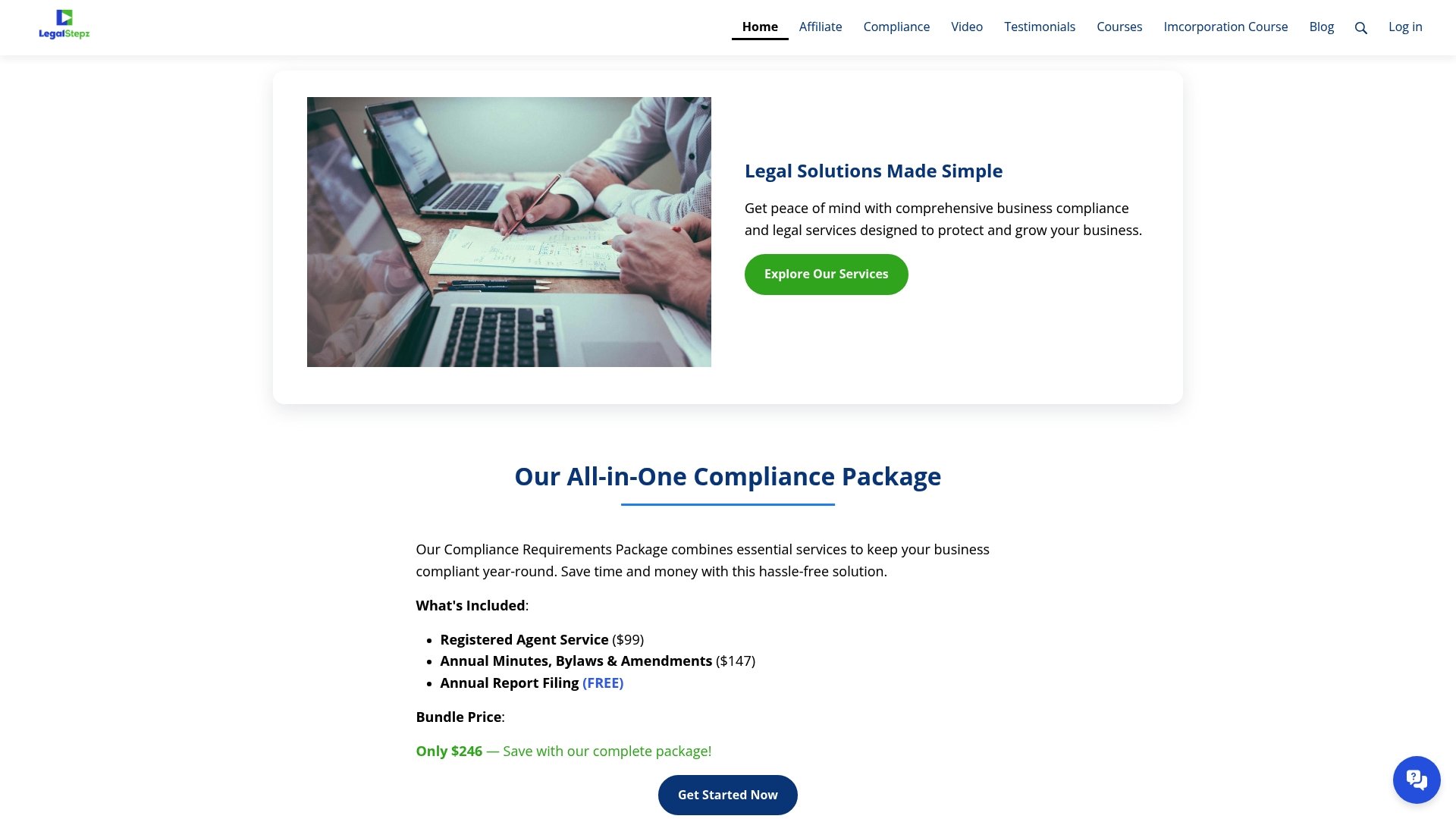
That includes step-by-step trademark filing education, Statement of Information filing, registered agent service, and annual minutes and bylaws preparation, all the pieces that keep a California entity compliant once your trademark is filed. Visit the relevant landing page to see current course and package pricing, and pick the option that matches how much of this process you want to handle yourself.
Where to Verify These Trademark Fees
Confirm every figure directly at the source: the USPTO fee schedule, the California Secretary of State trademark page, and Legal Stepz's application walkthrough for procedural detail.
This article is general information, not a substitute for advice from a qualified lawyer. Consult a qualified legal professional about your own circumstances before acting on anything here.
Sources
FAQ
How Much Does It Cost to Trademark a Business Name in California?
Expect $350 in USPTO fees per class at minimum, plus $70 per class if you also register at the state level, before any professional fees.
Is a California State Trademark Cheaper Than a Federal One?
Yes. State registration costs $70 per class versus $350 federally, but it only protects your mark inside California, not nationwide.
What Triggers the $200 USPTO Surcharge?
Writing your own goods and services description instead of using approved Trademark ID Manual wording triggers a $200 per-class surcharge.
How Often Do You Pay to Maintain a Trademark?
You file a Section 8 declaration around year five or six for $325 per class, then a combined renewal every 10 years after that.
Does Filing Intent to Use Cost More Than Filing Based on Use?
It can, since intent-to-use filings eventually require a $150 per-class statement of use and possibly $125 per-class extension fees if you're not selling yet.