

California state trademark registration usually finishes in weeks to a few months, and it protects your mark for a term before renewal. Federal registration through the USPTO runs longer: the agency's own averages show 4.2 months to a first examining action and 9.7 months to registration or abandonment as of this writing. Add publication and a 30-day opposition window, and the federal track can stretch past a year for some applicants.
- California state filing: weeks to a few months, five-year term
- USPTO average: 4.2 months to first action, 9.7 months to disposal
- Federal publication triggers a mandatory 30-day opposition period
Before you file anything, search both the California Secretary of State database and USPTO's TESS trademark database. Skipping that step is the single most common way entrepreneurs waste a filing fee on a mark that was never available.
Key Takeaways
California trademark registration typically completes in weeks to a few months at the state level, while federal USPTO registration averages 9.7 months and requires clearing a 30-day opposition window.
| Point | Details |
|---|---|
| State timeline is fast | California registration often finishes in weeks to a few months for complete, correct filings. |
| Federal timeline is longer | USPTO averages 4.2 months to first action and 9.7 months to registration or abandonment. |
| Search before you file | Check both California SOS records and USPTO TESS to avoid wasting filing fees. |
| Renewal has a fixed window | California renewal costs $30 and the window opens six months before the five-year term expires. |
| Specimens cause most delays | Physical-format, unaltered specimens matter more to processing speed than any other single factor. |
Table of Contents
- Should You File State or Federal Trademark Protection First?
- What Is the California Secretary of State Trademark Timeline?
- How Long Does USPTO Federal Trademark Registration Take?
- State vs. Federal Trademark Registration: Which Costs and Timelines Compare?
- What Does a 12-Month California Trademark Timeline Look Like?
- What Causes Trademark Filing Delays and How Do You Avoid Them?
- How Do You Check Your Trademark Application Status?
- What California Entrepreneurs Should Know Before Filing
- Sources
Should You File State or Federal Trademark Protection First?
The right answer depends on where your customers are, not how big your ambitions are. California state registration through the Secretary of State fits businesses that sell strictly within the state and want fast, affordable protection without the federal wait. Federal registration through the USPTO is built for businesses selling across state lines, running ecommerce, or planning to expand outside California, since only a federal mark gives you nationwide enforcement rights and standing on platforms like Amazon's brand registry.
Plenty of California entrepreneurs do both, just staggered. File state protection now to lock in a public record and local enforcement rights, then submit the federal application once revenue or expansion plans justify the higher cost and longer timeline. That sequencing matters:
- Purely local retail, service, or restaurant brands: state registration alone often suffices.
- Ecommerce, SaaS, or franchise-model businesses: federal registration is close to mandatory.
- Businesses expecting to scale within two to three years: file state now, federal later, rather than waiting and losing priority.
Read more on the state versus federal trademark decision before committing to one path.
What Is the California Secretary of State Trademark Timeline?
California trademark applications go through the Secretary of State's TMbizfile portal, or you can file in person or by mail. Priority follows date of receipt: online submissions get timestamped first, in-person filings second, and mailed applications last. That order matters if two businesses are racing to register a similar mark.
- Confirm your filing method. TMbizfile online is fastest for establishing priority; mail is slowest and riskiest.
- Pay the filing fee. California charges a filing fee per classification of goods or services, and multi-class applications multiply that fee.
- Submit compliant specimens. The state wants physical-format specimens, generally sized to standard 8.5 by 11 dimensions, and will reject anything that looks altered or defaced.
- Wait for review. Complete, correctly formatted filings typically clear in several weeks to a few months.
- Track renewal. Registration lasts for a term. Renewal costs a fee and the renewal window opens before expiration.
Pro Tip: Photograph or scan three identical specimens flat, without cropping or editing, before you file. The California SOS rejects specimens that appear digitally manipulated, and a rejection resets your clock.
The most common reason a straightforward filing drags past three months isn't the state's backlog. It's applicants submitting a folded receipt or a screenshot instead of a proper specimen.
How Long Does USPTO Federal Trademark Registration Take?
Your filing basis changes everything about your federal timeline. A Section 1(a) application, filed on actual use in commerce, moves faster because there's no statement of use step waiting in the wings. A Section 1(b) intent-to-use application adds months, since you can't get a final registration until you prove you're actually using the mark.
USPTO's published averages put the first examining action at 4.2 months after filing, and disposal (registration or abandonment) at 9.7 months. Different filing bases, including Section 44 and Madrid Protocol filings, carry their own adjusted schedules.
| Stage | Typical Timing |
|---|---|
| Filing to first examining action | ~4.2 months |
| Office action response deadline | 3 months (extension often available) |
| Publication to opposition deadline | 30 days |
| Notice of allowance to statement of use | 6 months (extensions available) |
| SOU acceptance to registration | ~2 months |
- If your application draws an office action, you generally have three months to respond, with extension options in many cases.
- Publication in the Trademark Official Gazette starts the 30-day opposition clock, when any third party can formally challenge your mark.
- Intent-to-use applicants get a notice of allowance and six months to file a statement of use, or request an extension before that deadline expires.
- Once your SOU is accepted, registration typically issues within about two months.
State vs. Federal Trademark Registration: Which Costs and Timelines Compare?
Here's the trade-off in one table:
| Factor | California State | USPTO Federal |
|---|---|---|
| Filing fee | $70 per class | Varies by class and filing basis |
| Typical time to registration | Weeks to a few months | ~9.7 months average |
| Registration term | 5 years | 10 years |
| Renewal | $30 fee, window opens 6 months before expiration | Renewal filings at 5 to 6 years and every 10 years |
| Geographic scope | California only | Nationwide |
| Public opposition process | No formal opposition period | 30-day opposition after publication |
Businesses that serve one city or region, and don't need to fight infringement outside California, usually stop at state registration. Businesses selling online, shipping products nationwide, or planning multi-state expansion need the federal mark to actually enforce their rights outside state lines.
Pro Tip: A state registration doesn't show up in USPTO's federal database, so it won't stop someone else from filing federally on a similar mark. If national reach is even a possibility, don't treat state registration as a substitute for a federal filing, treat it as a placeholder.
What Does a 12-Month California Trademark Timeline Look Like?
A realistic timeline starts before you file anything and continues well past your registration date.
- Pre-filing (weeks 1 to 2): Run clearance searches through both the California Secretary of State database and USPTO's TESS system, gather specimens, and decide your filing basis.
- Filing day: Submit through TMbizfile or USPTO's Trademark Center. You'll get a serial number immediately for federal filings.
- Months 1 to 4: Monitor for a first examining action. Respond to any office action within the three-month deadline.
- Months 4 to 6 (federal only): Watch for publication in the Trademark Official Gazette and the 30-day opposition window that follows.
- Months 6 to 12 (intent-to-use federal only): File your statement of use within six months of the notice of allowance, or request an extension before that deadline lapses.
- Check status every three to four months during quiet periods.
- Switch to weekly checks around publication and any response deadline.
- For state filings, expect a final decision well before the 12-month mark if your specimens and descriptions were correct from the start.
What Causes Trademark Filing Delays and How Do You Avoid Them?
Most delays trace back to four repeat offenders. Specimens that don't clearly show the mark in actual use, or that fail California's physical-format rules, get bounced back and cost you weeks. Vague goods and services descriptions invite office actions asking you to clarify, so describe what you actually sell rather than a broad category. Filing state or federal without a prior search wastes your fee entirely if a conflicting mark already exists.
- Draft specific, accurate identifications of goods and services before you file, not after an office action asks for it.
- Search both state and federal databases before spending a dollar on filing fees.
- Missing a USPTO office-action deadline or statement-of-use deadline can abandon your application, though a petition to revive is sometimes available within strict time limits.
Pro Tip: If you get an office action citing likelihood of confusion or mere descriptiveness, those refusals often need a real legal argument, not a quick fix; see Protecting Your Brand & Trade Mark Registration for practical trademark registration advice. Get counsel involved before your three-month clock runs out.
How Do You Check Your Trademark Application Status?
For federal applications, check the USPTO Trademark Status and Document Retrieval (TSDR) system or the Trademark Center using your serial number. For California filings, TMbizfile shows your state application's current stage.
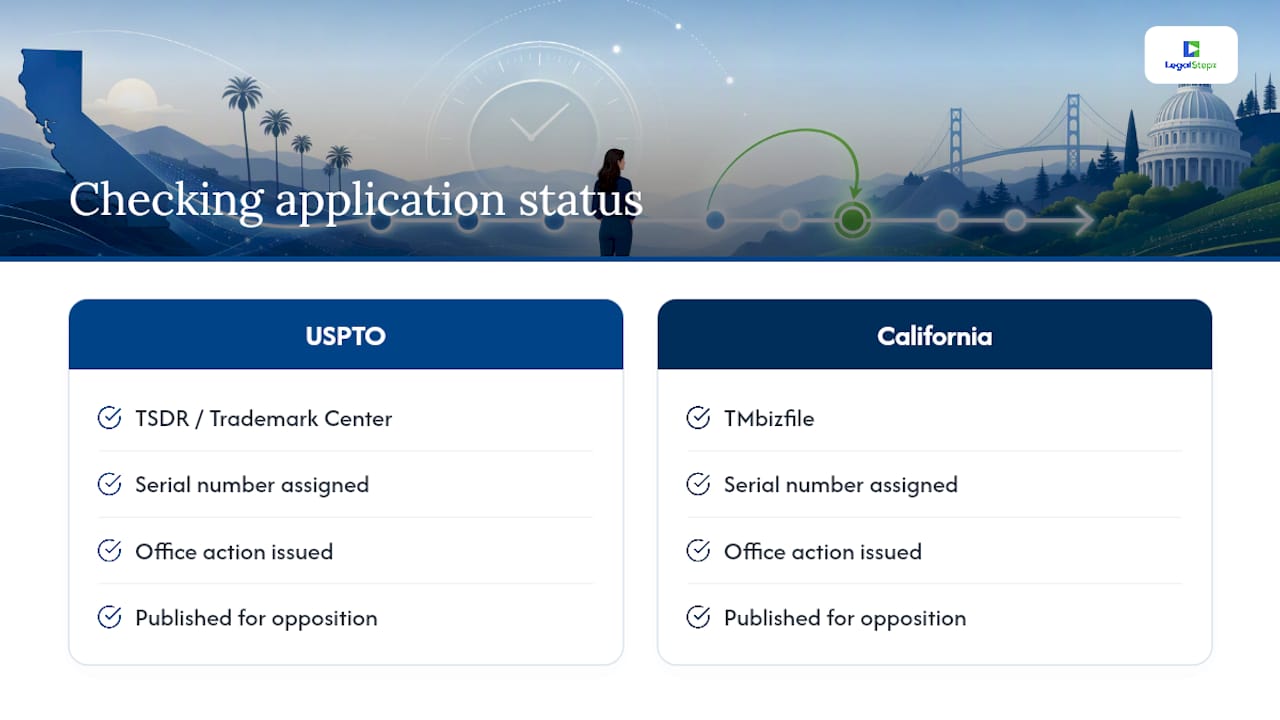
Watch for these status changes: serial number assigned, office action issued, published for opposition, notice of allowance, and registered. USPTO recommends checking every three to four months before publication, then shifting to weekly checks once you're near publication or a response deadline.
What California Entrepreneurs Should Know Before Filing
Most of the timeline risk in this process comes down to preparation, not paperwork speed. Legalstepz offers trademark search assistance to catch conflicts before you file, along with application support for both state and federal filings.

If your mark is simple and your goods description is clean, a self-paced trademark course can walk you through DIY filing. If you're facing an office action or a crowded field of similar marks, get direct help before you burn a response deadline. Either way, have your specimens, ownership details, and goods description ready before you start at Legalstepz.