

File your federal trademark application through the USPTO's Trademark Center, the required online filing platform. Before you start, nail down your mark's drawing and specimen, pick the right filing basis, and write precise goods and services descriptions, then pay the nonrefundable fee and track everything through TSDR. Budget 12 to 18 months from filing to registration, and expect to respond to at least one office action along the way.
TL;DR:
- Most rejections stem from incomplete or vague descriptions, specimen mismatches, or insufficient search and clearance work before filing.
- Filing in the USPTO Trademark Center requires setting up an account, submitting clear files, accurately selecting goods and services, and paying fees per class.
- Responding to office actions promptly within three months, especially addressing likelihood of confusion or specimen issues, is crucial to avoid abandonment.
- Maintaining registration depends on timely filings of declarations of use and renewal applications, with deadlines typically every five and ten years.
- Preparing thoroughly and leveraging specialist resources can significantly reduce application delays and reduce the risk of rejection.
Table of Contents
- What Do You Need Before Starting a USPTO Trademark Application?
- Section 1(a) or 1(b): Which Filing Basis Fits Your Situation?
- How Do You Pick the Right Goods and Services Description?
- Filing in Trademark Center: The Actual Steps
- What Does a Trademark Application Cost, and How Long Does It Take?
- How Do You Respond to a USPTO Office Action?
- From Publication to Registration: What Happens After Examination?
- What Happens After You Register a Trademark?
- A Practitioner's Take on What Actually Trips Up Filers
- How Legal Stepz Helps You File With Confidence
- Where to Verify Trademark Filing Details
- Sources
What Do You Need Before Starting a USPTO Trademark Application?
Most rejections trace back to skipped homework, not bad luck. Before you touch Trademark Center, work through these decisions.
- Decide your drawing format: a standard character mark (plain text, no font or color claims) or a special form drawing (logo, stylized text, color).
- Save a specimen showing real use in commerce (a labeled product photo, a screenshot of a website order page) as a JPG or PDF if you're filing under Section 1(a).
- Run a clearance search and match your goods or services to entries in the Trademark ID Manual.
- Confirm your filing basis (use in commerce or intent-to-use) and, for intent-to-use, plan how you'll later prove use.
- Gather applicant details, identify who will sign as the authorized party, and set up your payment method.
- Create your USPTO.gov account in advance so identity verification doesn't slow you down on filing day.
Pro Tip: Open your USPTO.gov account at least a day before you plan to file. Multifactor authentication setup occasionally hits a snag, and you don't want that discovered five minutes before a deadline.
Section 1(a) or 1(b): Which Filing Basis Fits Your Situation?
Your filing basis is a legal claim, not a checkbox, and it shapes what evidence you need and when.
- Section 1(a), use in commerce: You're already selling the goods or offering the services under this mark. You submit a specimen now and can move straight to examination without a Statement of Use step later.
- Section 1(b), intent-to-use: You haven't launched yet but have a genuine plan to. You skip the specimen at filing but must submit a Statement of Use (SOU) after receiving a Notice of Allowance, with its own fee.
- Foreign basis (Section 44 or 66): Available if you have a foreign registration or an international application through the Madrid Protocol. Applicants domiciled outside the United States must retain a U.S.-licensed attorney to file.
- Mark format: Standard character marks protect the wording itself across any font or style, generally the broader choice. Special form (logo) marks protect the specific visual design but not the words in other presentations.
A software startup launching in three months with a signed lease and a finished landing page is a textbook 1(b) filer. A bakery already selling under its name at a farmers market files 1(a) with a photo of the packaging as its specimen.
How Do You Pick the Right Goods and Services Description?
Vague wording is the single most avoidable cause of an office action. The USPTO wants language it can classify cleanly, and the ID Manual exists precisely so you can borrow its pre-approved phrasing.
- Select an entry that matches what you sell today, not what you hope to sell someday.
- Compare acceptable versus unacceptable phrasing: "clothing, namely, t-shirts and hoodies" clears easily; "clothing and related accessories" typically draws a refusal for indefiniteness.
- Remember that narrowing your identification later is usually permanent. The Trademarks Registration Toolkit warns that once you narrow scope, you generally cannot broaden it back.
Pro Tip: If your business spans multiple classes, like a company selling both physical goods and a software app, get help before filing. Multi-class applications multiply the number of ways wording can go wrong, and each class carries its own fee.
Filing in Trademark Center: The Actual Steps
Trademark Center replaced the older TEAS forms as the mandatory filing system starting January 18, 2025, and it walks you through the application with a guided interface rather than a static PDF-style form.
- Set up your account. Verify your identity and enable multifactor authentication on USPTO.gov before you begin a new application.
- Enter owner details. Legal name, entity type, and address exactly as they'll appear on the certificate.
- Upload your drawing and specimen. Double-check file format and that any date of first use is accurate. Mismatched or blurry specimen uploads are a common, avoidable rejection trigger.
- Select your class or classes using the goods/services language you already drafted from the ID Manual.
- Preview your fees before submitting. The system displays costs transparently as you build the application, so nothing should surprise you at checkout.
- Submit and save your serial number. This number is how you'll track your filing going forward.
Once submitted, your application appears in your Trademark Center docket, and you can check its status anytime through TSDR. Typical pendency runs 12 to 18 months from filing to registration, so treat your serial number like a tracking number for a package that takes over a year to arrive.
What Does a Trademark Application Cost, and How Long Does It Take?
Filing fees are charged per class of goods or services, and the total climbs fast if your business touches more than one category.
- Your base cost depends on which application option you select and how many classes you file under.
- Extra steps add cost: a Statement of Use filing, a request to extend the SOU deadline, or a response to certain office actions each carry their own fee.
- Every fee the USPTO charges is nonrefundable, win or lose, according to USPTO training materials covering office action responses.
Pendency typically breaks down into stages: serial number assignment happens almost immediately, examination assignment takes a few months, and if your application clears without issue, publication and registration follow. The Trademarks Registration Toolkit confirms the realistic range sits at 12 to 18 months, longer if you hit an office action or opposition. Read more about the full trademark process before you file.
How Do You Respond to a USPTO Office Action?
Getting an office action isn't a rejection. It's the examining attorney flagging a problem you can usually fix, and how you respond determines whether your application survives.
- Identify the type. A nonfinal office action raises an issue for the first time; a final office action means your prior response didn't resolve it and your next move needs to count.
- Know the common grounds. Likelihood of confusion under Section 2(d), descriptiveness under Section 2(e)(1), specimen problems, and indefinite identifications account for most refusals.
- Track your deadline. Most office actions require a response within three months, with one paid extension option available in many cases. Certain Madrid Protocol or Section 66(a) matters carry a six-month window instead.
- File the correct TEAS response form and make sure it's signed by an authorized party. An unsigned or incomplete response triggers a notice of incompleteness and can lead to abandonment if the clock runs out.
Pro Tip: If the office action invites you to call or email the examining attorney, take them up on it. A five-minute conversation about a minor wording fix often resolves things faster than a formal written response, and it's free.
Avoid boilerplate language that doesn't address the specific refusal, and think carefully before agreeing to narrow your goods and services just to move faster. That narrowing is often permanent.
From Publication to Registration: What Happens After Examination?
Clearing examination isn't the finish line, just the next checkpoint.
- Publication in the Trademark Official Gazette opens a 30-day window during which any party can file an opposition against your mark.
- Notice of Allowance arrives next for intent-to-use applications, starting a six-month clock to either file your Statement of Use or request an extension.
- Statement of Use filing requires a specimen showing actual use, similar to what a 1(a) applicant submits at the outset. Check real specimen examples before you submit to avoid a bounce-back.
- Once your SOU is accepted, the certificate of registration typically issues within a few months. Keep every filing receipt and specimen on record for future maintenance filings.
What Happens After You Register a Trademark?
Registration isn't permanent by default. It requires upkeep, and missing a deadline can undo years of work.
- Section 8 declaration, due between the fifth and sixth year after registration, confirms you're still using the mark.
- Section 9 renewal, combined with a Section 8 filing, comes due every ten years after that.
- Missing these windows can cancel your registration, and revival options are limited and time-sensitive.
- Monitor new filings that might conflict with your mark, and bring formal challenges through the Trademark Trial and Appeal Board (TTAB) if you need to oppose or cancel someone else's registration.
Pro Tip: Set a calendar reminder a full year before your Section 8 deadline. Waiting until the final month leaves no room to fix a specimen problem if your first one gets rejected.
A Practitioner's Take on What Actually Trips Up Filers
Most refusals aren't about bad marks. They're about rushed identifications and specimens that don't quite match what's claimed. The applicants who sail through examination spend an extra hour on the ID Manual and take a genuinely representative specimen photo before they ever open Trademark Center. That hour costs nothing compared to a second filing fee and another six months of waiting.
— Peter
How Legal Stepz Helps You File With Confidence
Filing a trademark application yourself is entirely doable, but the details above are exactly where applicants stumble: wrong specimen format, indefinite goods descriptions, missed office action deadlines. Legal Stepz built a Trademark Course around those specific failure points, with filing walkthroughs, real specimen examples for different mark types, and ID wording templates you can adapt to your own goods and services.
The course doesn't replace Trademark Center. It sits alongside it, so you know exactly what to click and why before you start the clock on a nonrefundable fee. Legal Stepz also handles the compliance side many founders forget once the trademark work is done, including registered agent services and annual filings for California entities. If you're about to file, start with the Trademark Course and walk into Trademark Center already knowing what a strong application looks like.
Where to Verify Trademark Filing Details
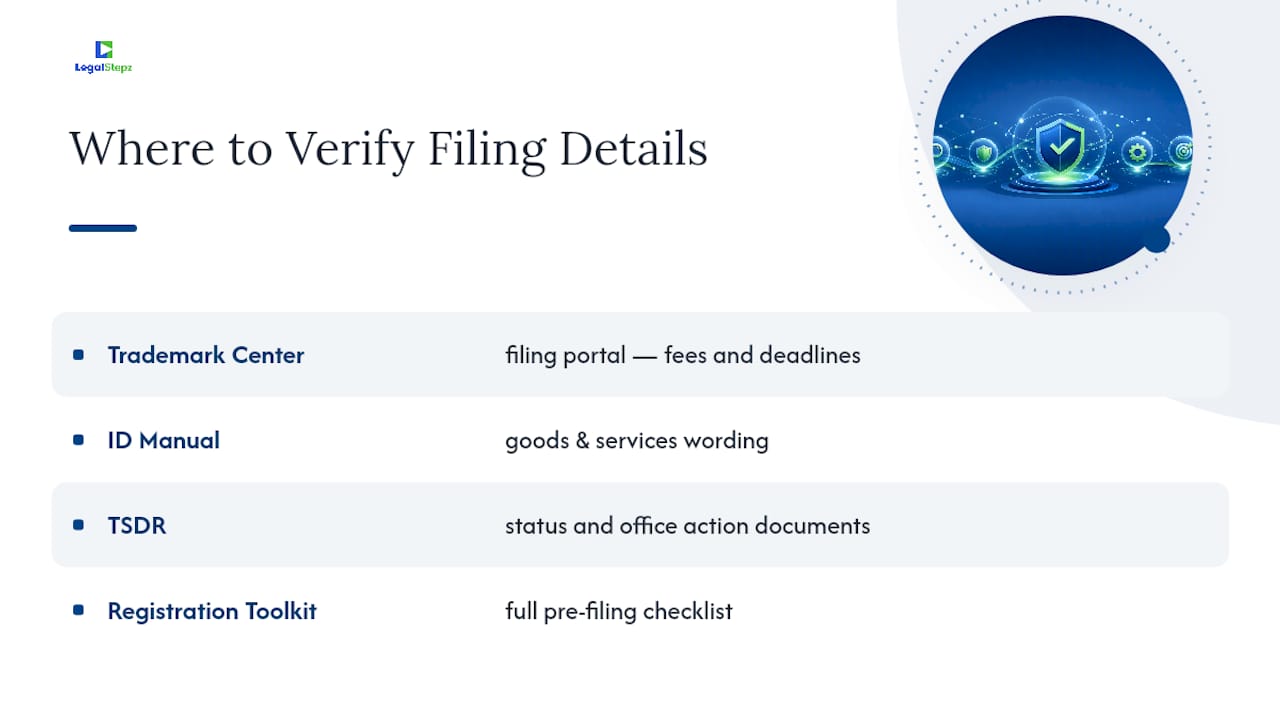
Fees, deadlines, and form requirements change, so confirm current details directly with the USPTO before you file. Start with the Trademark Center filing portal, the ID Manual for goods and services wording, TSDR for status and office action documents, and the Trademarks Registration Toolkit for a full pre-filing checklist. These official sources control deadlines and fee amounts, not third-party guides.
This article is general information, not a substitute for advice from a qualified lawyer. Consult a qualified legal professional about your own circumstances before acting on anything here.