

Corporate formalities are the administrative, governance, and financial practices that prove your LLC or corporation operates as a legally separate entity from you personally. Get them right, and your personal assets stay protected. Ignore them, and a court can hold you personally liable for your company's debts.
TL;DR:
- Corporate formalities preserve your limited liability shield. Without them, courts can "pierce the corporate veil" and come after your personal savings, home, or car.
- Every U.S. state applies some version of an alter-ego or veil-piercing test. Your records are the evidence that decides the outcome.
Do these three things in the next 72 hours:
- Open a dedicated business bank account if you haven't already, and stop running any personal expenses through it.
- Locate or create a central folder (physical or digital) for your formation documents: articles of incorporation or organization, bylaws or operating agreement, and any state filings.
- Start a minute book, even a simple binder or shared document, to log decisions and approvals going forward.
Table of Contents
- What exactly are corporate formalities?
- The corporate formalities checklist every owner needs
- Why corporate formalities matter: the corporate veil and how courts pierce it
- How requirements differ: corporations versus LLCs
- How to implement formalities: a practical timeline and U.S. cost ranges
- What to do if you haven't followed formalities
- When should you consult a lawyer?
- Key Takeaways
- Formalities are strategic assets, not just paperwork
- How Legalstepz supports your compliance from day one
- Authoritative resources for next steps
What exactly are corporate formalities?
Corporate formalities are the administrative, legal, and procedural steps that show a corporation or LLC operates as a legally distinct entity. The phrase covers a wide range of behaviors, from how you sign contracts to whether you hold an annual meeting, but the through-line is always the same: every formality creates evidence that your business is real, separate, and not just an extension of you.
Think of it this way. When you formed your LLC or corporation, the state gave you a liability shield. Corporate formalities are how you keep that shield polished. Stop maintaining them, and the shield corrodes.
Concrete examples business owners recognize immediately:
- Bylaws or operating agreement. The governing document that spells out ownership, voting rights, and how decisions get made.
- Meeting minutes. A written record of what was discussed and decided at board or member meetings.
- Separate bank accounts. Business money flows through a business account. Personal money stays personal.
- Stock or membership ledger. A running record of who owns what percentage of the company.
- Corporate resolutions. Signed written approvals for major decisions: taking a loan, adding a partner, buying real estate.
Three authorities shape how these requirements work in the U.S.: state corporate statutes (which set the baseline rules for your entity type), common-law veil-piercing tests (which courts apply when someone sues), and IRS practice (which scrutinizes undocumented compensation and distributions). All three look at the same thing: your paper trail.
The corporate formalities checklist every owner needs
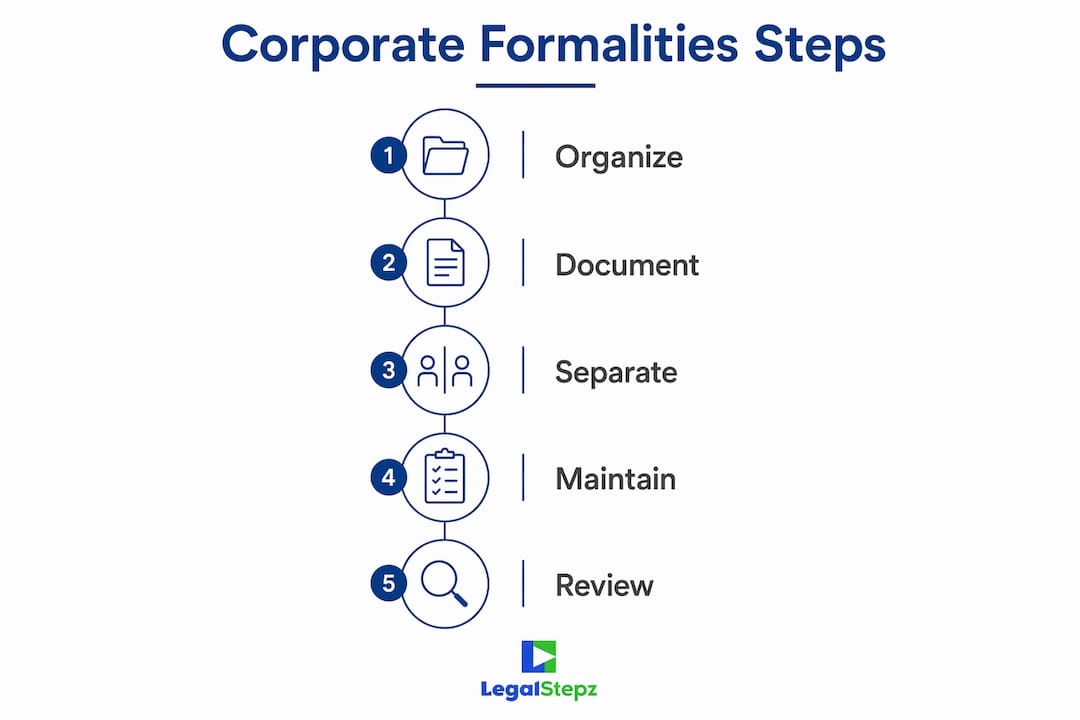
Common formalities include maintaining separate bank accounts, keeping accurate records, recording meeting minutes, holding annual meetings for corporations, and maintaining bylaws or operating agreements. Here is the full working checklist:
- Separate bank account. Use it exclusively for business transactions. Courts treat commingled accounts as the single clearest sign of alter-ego status.
- Bylaws or operating agreement. Draft it, sign it, and actually follow it. A document that sits in a drawer and gets ignored is almost as bad as having none.
- Annual meetings and minutes. Corporations are typically required by state statute to hold shareholder and board meetings. LLCs often are not, but holding them anyway and documenting them strengthens your position.
- Stock or membership ledger. Keep a current record of ownership. This matters especially during financing, sale, or disputes over equity.
- Corporate resolutions. Any significant decision — a new loan, a key hire, a real estate purchase — should be approved in a signed resolution before you act on it.
- Registered agent. Every U.S. LLC and corporation must maintain a registered agent in its state of formation. Missing a service of process because your agent's address is outdated is an avoidable disaster.
- Annual report filings. Most states require an annual or biennial report and a fee to keep your entity in good standing. Missing these can result in administrative dissolution.
- Accounting and tax records. Maintain organized financial statements, tax returns, and supporting documentation. The IRS and opposing counsel both look here.
- Compensation and distribution approvals. Failing to document officer compensation or equity distributions creates leverage for opposing counsel and can trigger IRS reclassification.
Pro Tip: If you run a single-member LLC or are the sole officer of your corporation, you still need minutes or written resolutions. Courts look for consistent patterns of behavior, not whether multiple people were in the room. A one-page written consent signed by yourself, dated and filed in your minute book, counts.
Why corporate formalities matter: the corporate veil and how courts pierce it
The corporate veil is the legal boundary between your personal assets and your company's liabilities. When it holds, a creditor who wins a judgment against your business cannot touch your personal bank account or home. When a court pierces it, that protection disappears.
Courts do not pierce the veil lightly. But when they do, the analysis is granular. Judges examine minute books, bank statements, email trails, capitalization levels, and whether corporate mechanisms like officer compensation approvals were followed. A missing document or a single commingled account can shift the analysis.
The factors courts most commonly weigh in a U.S. veil-piercing case:
- Commingling of funds. Paying personal bills from the business account, or depositing business revenue into a personal account, is the fastest path to personal liability.
- Undercapitalization. Forming an entity with almost no assets, then running significant liabilities through it, signals that the entity was never meant to stand on its own.
- Failure to follow governing documents. If your bylaws say the board must approve loans over $50,000 and you signed one without a resolution, that gap becomes evidence.
- Use of the entity to commit fraud. Courts will pierce the veil when the entity structure was used to deceive creditors or evade obligations.
Here is a generic but realistic scenario. A sole owner of a small construction LLC uses the company debit card for groceries, pays the company's subcontractors from a personal account when cash flow is tight, and never holds a single member meeting. A subcontractor sues after a dispute. The owner's attorney argues limited liability. The plaintiff's attorney pulls three years of bank statements and shows the court that the LLC and the owner were financially indistinguishable. The court agrees. The owner's personal savings are now on the table.
Good records do not just protect you in court. They also protect you during financing, when lenders and investors will ask for exactly this documentation before they commit a dollar.
How requirements differ: corporations versus LLCs
LLCs are not exempt from veil-piercing risk. Courts apply similar alter-ego tests to LLCs as they do to corporations when finances and records are not kept separate. The difference is in the statutory baseline, not the underlying risk.

State statutes set different detail levels for required corporate actions, so always confirm your state's specific annual report requirements and fees. The table below is a U.S.-focused general guide.
| Dimension | Corporation | LLC |
|---|---|---|
| Governing document | Bylaws (required by statute in most states) | Operating agreement (required in some states; strongly recommended in all) |
| Meeting requirements | Annual shareholder meeting typically required; board meetings often quarterly | No statutory meeting requirement in most states; meetings still recommended |
| Recordkeeping | Stock ledger, minute book, resolutions — all typically required by statute | Membership ledger, written consents, financial records — best practice |
| Signing and contracts | Officers sign in corporate capacity; title matters | Members or managers sign in LLC capacity; avoid signing personally |
| Common pitfall | Skipping board resolutions for major decisions | Treating the LLC as a personal checking account |
The LLC's flexibility is real, but it misleads many owners. The absence of a statutory meeting rule does not mean governance and financial separation can be ignored. Courts apply the unity-of-interest analysis across entity types. An LLC owner who never separates finances or documents decisions faces the same veil-piercing exposure as a corporation that skips every board meeting.
For both entity types, two items are non-negotiable regardless of state: a dedicated business bank account and a signed governing document. Everything else builds on that foundation. For deeper guidance on choosing between these structures, the differences in compliance obligations are worth understanding before you file.
How to implement formalities: a practical timeline and U.S. cost ranges
Getting compliant is not a one-day project, but it is not overwhelming either. Here is a prioritized implementation plan.
Day 1–7: the non-negotiables
- Open a business bank account if you do not have one. Use it for every business transaction from day one.
- Locate your formation documents (articles of incorporation or organization) and your bylaws or operating agreement. If you do not have a signed operating agreement, draft one now.
- Create a minute book: a physical binder or a shared digital folder. Label it clearly and put your formation documents in it.
- Confirm your registered agent's current address with your state. Update it if anything has changed.
Months 1–3: build the governance layer
- Draft and sign any missing corporate resolutions for decisions already made (loans taken, leases signed, officers appointed).
- Set up a basic bookkeeping system. QuickBooks, Wave, or Xero all work for small entities. The goal is clean monthly financials you can produce on request.
- Check your state's annual report due date and fee. Calendar it now.
Months 3–12: ongoing compliance rhythm
- Hold your first formal annual meeting (or document a written consent in lieu of meeting) and file the minutes.
- Review and update your membership or stock ledger if ownership has changed.
- Confirm that officer compensation and any distributions are documented in writing and approved by resolution.
Annual tasks (ongoing)
- File your state annual report and pay the fee. Registered agent annual fees typically vary depending on the provider and state.
- State annual report fees vary widely depending on the state. Check your specific state's secretary of state website.
- Review and update your minute book after any significant business event: new financing, a key hire, a change in ownership.
Who owns what: the business owner handles bank account setup and formation document assembly. A bookkeeper or CFO handles monthly financials and annual reconciliations. Outside counsel handles complex resolutions, equity events, and remediation. For annual filing requirements by state, confirm the specifics with your state's secretary of state.
Pro Tip: Set a recurring calendar reminder every January: "Annual meeting / written consent + state annual report check." Two hours a year on this task is far cheaper than one hour of litigation discovery.
What to do if you haven't followed formalities
Finding gaps is common. The right response is methodical remediation, not panic.
Step 1: Assemble what you have. Pull together every document related to your entity: formation papers, any signed agreements, bank statements, tax returns, and any email threads where major decisions were discussed. This is your baseline.
Step 2: Separate the bank accounts now. If personal and business funds are still mixed, open a dedicated business account today and stop all commingling immediately. This is the single highest-priority fix because it creates a clear before/after line in your records.
Step 3: Reconstruct missing minutes and resolutions. Reconstructing missing records should be done carefully: contemporaneous summaries with attesting signatures and corroborating bank reconciliations are preferred over backdated fabrications. Date-stamped summaries that acknowledge they are reconstructions, signed by the relevant parties, are far better than nothing and far safer than documents that appear to be something they are not.
Step 4: Formalize compensation and distributions in writing. Undocumented shareholder loans or distributions may be recharacterized by the IRS, producing tax liabilities and penalties on top of any liability exposure. Get these documented now with signed resolutions.
Step 5: Draft or update your governing documents. If you never had bylaws or an operating agreement, or if the one you have is years out of date, get a current version signed and filed in your minute book.
Remediation strengthens your position, but it has limits. A court that sees years of consistent noncompliance will not treat a recently assembled minute book as a complete cure. The goal is to stop the bleeding and demonstrate a genuine change in practice going forward. Good corporate recordkeeping practices from this point forward are what actually rebuild the shield.
Pro Tip: When reconstructing records, have your attorney attest to the reconstruction process in writing. That attestation becomes part of the record and signals to any future reviewer that the documents were assembled in good faith, not fabricated.
When should you consult a lawyer?
Most formalities maintenance is something owners can handle with good systems and occasional professional help. But certain situations call for a lawyer immediately.
Red flags that warrant immediate legal advice:
- A lawsuit has been served on your business or you personally.
- A lender or creditor is demanding personal guarantees and you are unsure of your exposure.
- You are in a bankruptcy or tax audit context where commingling is being scrutinized.
- You are planning a significant equity event: bringing on investors, issuing new shares or membership units, or selling the company.
- A co-owner dispute has arisen and your governing documents are incomplete or unsigned.
For a business law consultation, bring these documents and ask these questions:
- What is my current veil-piercing exposure based on my records?
- Which gaps in my minute book are highest priority to fix?
- Are my officer compensation and distribution practices documented adequately for IRS purposes?
- Do my bylaws or operating agreement reflect how the business actually operates today?
- What resolutions do I need to ratify decisions already made?
- If I am sued tomorrow, what is the weakest point in my formalities record?
- What ongoing compliance calendar do you recommend for my entity type and state?
Counsel can help with remediation plans, defensive documentation, negotiating with creditors, and representing you in veil-piercing litigation. The earlier you engage, the more options you have.
Key Takeaways
Corporate formalities are the governance and financial practices that keep your personal assets legally separate from your business, and maintaining them consistently is the single most effective way to preserve limited liability protection.
| Point | Details |
|---|---|
| Core definition | Formalities are the administrative and governance practices that prove your entity is legally separate from you. |
| Top three priorities | Open a dedicated business bank account, sign your governing documents, and start a minute book. |
| Veil-piercing risk | Courts examine commingling, undercapitalization, and missing resolutions to decide whether to hold owners personally liable. |
| LLC owners are not exempt | LLCs face the same alter-ego analysis as corporations; financial separation and written records are non-negotiable for both. |
| Legalstepz can help | Legalstepz handles minute-book setup, bylaws and operating agreement drafting, registered agent service, and annual filings. |
Formalities are strategic assets, not just paperwork
The conventional framing of corporate formalities as "legal busywork" gets it exactly backwards. Every minute book entry, every signed resolution, every clean bank reconciliation is a piece of infrastructure that compounds in value over time.
Consider what happens when a business owner tries to raise a seed round or sell the company. The first thing a serious investor or acquirer does is a records review. If the minute book is empty, the operating agreement is unsigned, and three years of distributions have no paper trail, the deal either falls apart or the owner takes a significant price reduction to account for the cleanup cost and legal risk the buyer is absorbing. That is a real financial consequence, not a hypothetical one.
The same logic applies to litigation resilience. An owner with clean records walks into a veil-piercing dispute with a defensible position. An owner without them is negotiating from weakness before the first deposition.
Treating formalities as strategic infrastructure rather than compliance overhead changes how you prioritize them. A few hours a year on meetings, minutes, and resolutions is not overhead. It is the maintenance cost of an asset that protects everything else you have built.
How Legalstepz supports your compliance from day one
Staying current on formalities is straightforward once the systems are in place. Getting those systems set up is where most owners stall.

Legalstepz handles the pieces that take the most time: drafting bylaws and operating agreements, setting up and maintaining your minute book, providing registered agent service so you never miss a service of process, and filing annual minutes and state reports on schedule. The process starts with a document review and gap assessment so you know exactly where you stand before any work begins. Whether you are starting fresh or catching up on years of missed filings, Legalstepz gives you a clear path forward without the guesswork of figuring out state-specific requirements on your own. Visit legalstepz.com to get started.
Authoritative resources for next steps
-
Penn & Webb PLLC — Corporate Formalities, Contracts, and Insurance: A practical overview of how formalities, contracts, and insurance work together to protect business owners. Good starting point for understanding the full protection framework.
-
NorthStar Law Group — The Importance of Corporate Formalities: Covers both corporations and LLCs with clear explanations of what each entity type needs to maintain its liability shield.
-
Legalstepz — Annual Requirements to Maintain Limited Liability: State-by-state guidance on ongoing annual filings and recordkeeping obligations. Use this to build your compliance calendar.
-
Legalstepz — Why Corporations Maintain Corporate Records: Practical best practices for minute books, ledgers, and documentation. Useful for both new and established entities.
-
Legalstepz — Incorporation versus Limited Liability Company: A deeper look at the legal and compliance differences between corporations and LLCs, helpful if you are still deciding on entity type or considering a conversion.
-
Legalstepz.com: For minute-book setup, bylaws drafting, registered agent service, and annual filing support, this is the starting point.
This article is general information, not legal advice. Confirm current rules and requirements with your state's secretary of state and a qualified business attorney for your specific situation.