

A DBA in California is defined as a Fictitious Business Name (FBN), the official term used under California Business and Professions Code §§ 17900–17930 to register a trade name that differs from your legal business name. If you want to know what does DBA mean California, the short answer is this: it is a county-level registration that lets you operate under a name other than your own. It does not create a new legal entity, and it does not protect your personal assets. Every California entrepreneur should understand those three facts before filing anything.
What does DBA mean in California, and who needs one?
A DBA, short for "Doing Business As," is the informal term for what California officially calls a Fictitious Business Name. You need one any time you operate under a name that is not your own legal name or your registered entity name. A sole proprietor named Maria Gonzalez who wants to run "Coastal Bloom Florals" must file an FBN statement. A registered LLC named "Gonzalez Holdings LLC" that wants to market services as "Bay Area Home Pros" also needs one.
The DBA meaning in California is purely administrative. It creates a public record linking your trade name to your legal identity. That transparency protects consumers, who can look up who actually owns a business operating under a catchy brand name. County clerk offices across California maintain these records, and a fictitious business name is essentially a legal alias connecting a trade name to the registered owner.

Sole proprietors, general partnerships, LLCs, and corporations can all file a DBA. The requirement applies whenever the operating name differs from the legal name on file. Skipping this step is not a minor oversight. California law treats operating under an unregistered fictitious name as a violation, and courts can bar you from enforcing contracts made under that name.
How to register a DBA in California
The DBA filing process in California follows a specific sequence. Skipping any step can void your registration entirely.
- Search for name availability. Check your county clerk's database to confirm no one else in your county has already registered the same name. This does not guarantee statewide exclusivity, but it is the required first step.
- File the Fictitious Business Name Statement. Submit the FBN statement at the county clerk's office in the county where your principal place of business is located. Filing fees vary by county but typically range from $26 to $100 for the first business name.
- Publish in a local newspaper. California law requires you to publish the FBN statement once a week for four consecutive weeks in a newspaper of general circulation in the county. This publication must begin within 30 days of filing.
- File the affidavit of publication. After the newspaper run completes, the publisher provides an affidavit. You must file this affidavit with the county clerk. Failing to submit this proof voids the entire registration.
- Obtain a certified copy. Request a certified copy of your filed FBN statement from the county clerk. This document is not optional for practical business use.
The full process typically takes four to six weeks from initial filing to completed registration, mostly due to the newspaper publication window.
Pro Tip: Order at least two certified copies when you file. Banks require one to open a business account under the fictitious name, and you will want a second copy for contracts or lease agreements.
Renewal is also required. California DBA registrations expire after five years. Mark the renewal date on your calendar the day you file, because there is no automatic reminder from the county.
What are the legal implications of a DBA in California?
A DBA registers a name. It does nothing more than that. This distinction matters enormously for California business owners who assume registration equals protection.
A DBA does not create a separate legal entity. Personal liability stays with the business owner or the underlying entity. If a customer sues "Coastal Bloom Florals," they are actually suing Maria Gonzalez personally. Her personal bank account, car, and home are all fair game if a judgment goes against her.
A DBA also provides no trademark rights. Trademarks protect brand identity and prevent competitors from using confusingly similar names. A DBA only serves an administrative and public notice function. You can register "Pacific Coast Consulting" as your FBN today, and a competitor in another county can register the exact same name tomorrow.
"A DBA ensures administrative transparency but not exclusive ownership of the business name. Entrepreneurs who treat their FBN registration as brand protection are exposed to costly rebranding if another party holds trademark rights to the same name."
The DBA does matter for contracts and legal proceedings. Courts require that you use your registered fictitious name correctly in legal documents. If you sign a contract under an unregistered name, that contract may be unenforceable. The FBN statement is the legal link between your trade name and your identity, which is why name registration must precede any formal business activity under that name.
DBA vs LLC in California: what is the real difference?
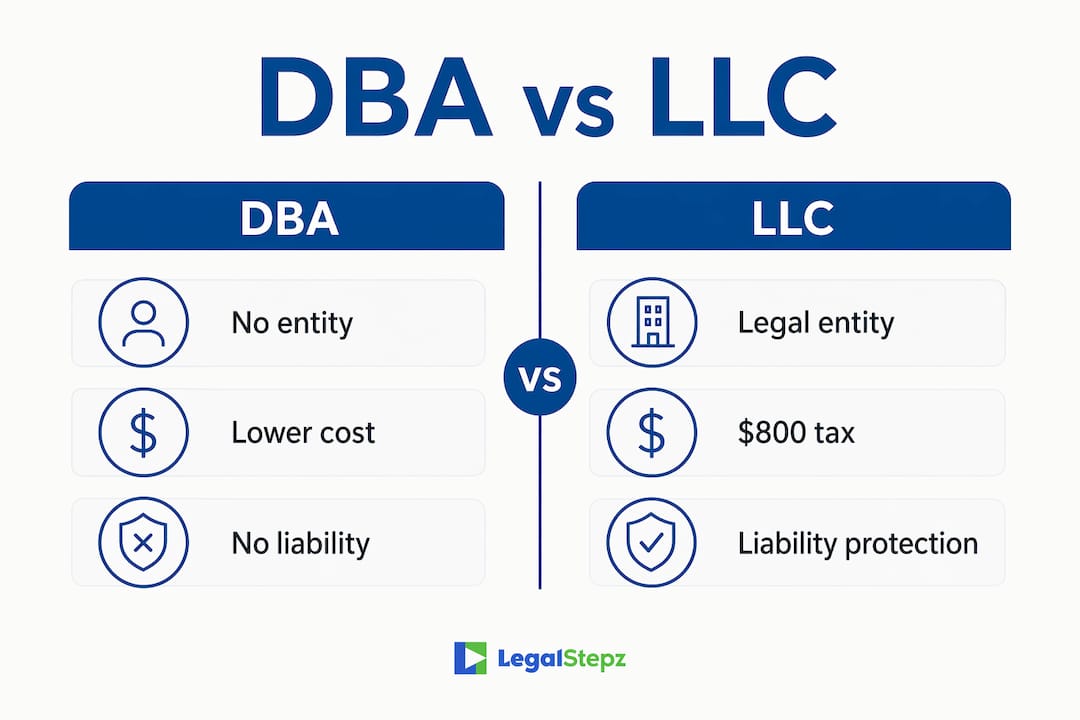
The DBA vs LLC California comparison comes down to three things: liability, cost, and legal status.
| Feature | DBA (Fictitious Business Name) | LLC |
|---|---|---|
| Creates a legal entity | No | Yes |
| Personal liability protection | No | Yes |
| Annual California franchise tax | No | $800 minimum |
| Filing location | County clerk | California Secretary of State |
| Name exclusivity | County level only | Statewide |
| Trademark protection | No | No (separate filing required) |
A DBA costs far less upfront and carries no annual franchise tax. An LLC incurs an $800 annual franchise tax in California, regardless of revenue. For a side business generating modest income, that tax burden changes the math significantly.
The liability gap is where the real risk lives. A sole proprietor operating under a DBA has zero separation between personal and business assets. One lawsuit can wipe out personal savings. An LLC creates a legal wall between the business and the owner's personal wealth. The benefits of an LLC go well beyond branding.
An LLC can also hold a DBA. Many California business owners form an LLC for liability protection and then register a DBA under that LLC to operate under a consumer-friendly brand name. This combination gives you both legal protection and marketing flexibility.
Pro Tip: If your business carries any real financial or legal risk, form an LLC first. Then file a DBA under the LLC if you want a separate brand name. The $800 franchise tax is cheap compared to a single lawsuit.
Common challenges and best practices for California DBAs
California's DBA process has several traps that catch business owners off guard.
- The newspaper publication requirement surprises most first-time filers. Many owners do not realize this step exists until after they have filed. Budget $100–$200 for publication costs, which vary by county and newspaper.
- Banks will not open an account without a certified copy. A receipt from the county clerk is not enough. Certified copies of the DBA registration are what banks require, so request them at filing.
- Name conflicts are more common than expected. DBA registration is county-specific, so another business in a different county can legally register the same name. If your brand matters, file a federal trademark through the USPTO.
- Trademark conflicts can force expensive rebranding. Businesses should not assume DBA registration prevents trademark conflicts. If another party holds a federal trademark on your chosen name, you may be forced to rebrand regardless of your FBN filing.
- Renewal deadlines are easy to miss. California FBN registrations expire every five years. An expired registration means you are technically operating under an unregistered name, which creates the same legal exposure as never filing at all.
- Operating in multiple counties requires multiple filings. If your business has locations in Los Angeles County and San Diego County, you need a separate FBN filing in each county.
Review your common business name mistakes before you file. Many of the most expensive errors are entirely avoidable with a 30-minute review.
Key Takeaways
A DBA in California registers a trade name at the county level but creates no legal entity, provides no liability protection, and grants no exclusive name rights statewide.
| Point | Details |
|---|---|
| Official California term | A DBA is legally called a Fictitious Business Name, governed by Business and Professions Code §§ 17900–17930. |
| Publication is mandatory | You must publish the FBN statement weekly for four weeks and file the affidavit or the registration is void. |
| No liability protection | A DBA does not shield personal assets; only an LLC or corporation provides that separation. |
| County-level name rights only | Another business in a different county can register the same name; trademark filing is the only way to secure exclusivity. |
| Certified copy is required | Banks and contract partners require a certified copy of the FBN statement, not just a filing receipt. |
Why most California entrepreneurs misread their DBA
The most common mistake I see is treating a DBA as a business formation step. It is not. It is a disclosure step. California created the FBN system so consumers can trace any business name back to a real person or entity. That is the entire purpose.
What surprises me most is how often business owners skip the trademark search before filing their FBN. They spend weeks building a brand around a name, file the DBA, print business cards, and then discover someone else holds a federal trademark on that exact name. The DBA filing gave them false confidence. A 20-minute search on the USPTO database would have caught the conflict before it became expensive.
My honest take: a DBA makes sense for a solo freelancer testing a business concept, or for an established LLC that wants to run a second brand without forming a new entity. For anyone else, especially anyone taking on clients, signing leases, or hiring employees, the liability exposure of operating as a sole proprietor under a DBA is a risk that the $800 LLC franchise tax easily justifies avoiding. The cost comparison only looks favorable for the DBA until the first lawsuit arrives.
— Peter
How Legalstepz can help with your California DBA
Filing a DBA in California involves more steps than most business owners expect. Legalstepz handles the paperwork so you do not miss a deadline or void your registration.
Legalstepz supports California entrepreneurs with fictitious business name filings, registered agent services, annual minutes, bylaws, and statement of information filings. Whether you are registering your first DBA or adding a trade name to an existing LLC, Legalstepz walks you through each required step. Visit legalstepz.com to get started with your California DBA filing today.
FAQ
What does DBA mean in California?
DBA stands for "Doing Business As." In California, the official legal term is Fictitious Business Name (FBN), governed by Business and Professions Code §§ 17900–17930 and filed at the county clerk's office.
Does a DBA protect my personal assets in California?
No. A DBA does not create a separate legal entity and provides no personal liability protection. Only forming an LLC or corporation separates your personal assets from business debts.
How long does a California DBA registration last?
A California Fictitious Business Name registration is valid for five years. You must renew it before it expires to continue operating legally under that name.
Can two businesses have the same DBA in California?
Yes. DBA registration is county-specific, so two businesses in different counties can legally register the same fictitious name. A federal trademark is the only way to secure exclusive rights to a business name.
Do I need a DBA if I already have an LLC in California?
Not automatically. Your LLC can operate under its registered name without a DBA. You only need a DBA if you want to conduct business under a name that differs from your LLC's official registered name.