

Liability protection is the legal separation between your personal assets and your business's debts and legal obligations. For California entrepreneurs, understanding this concept is the difference between losing a lawsuit and losing your home. Without it, a single contract dispute or customer injury claim can reach directly into your personal savings, investments, and real estate. Two primary tools create this separation: the right business entity structure and liability insurance coverage.
What does liability protection mean for your personal assets?
Liability protection means a court cannot force you to pay business debts from your personal bank account, home equity, or retirement savings. The business stands as its own legal person. Its debts belong to it, not to you.
California sole proprietorships provide zero liability protection, leaving owners fully exposed to business debts and lawsuits. That means a vendor who sues your business can garnish your personal wages or put a lien on your house. The risk is not theoretical. It is the default legal position for anyone who starts a business without forming a separate entity.
The assets most commonly at risk include your primary home, personal savings accounts, brokerage accounts, and vehicles. California courts treat these as fair game when a sole proprietor or general partner owes a business debt. Forming a legal entity changes that equation entirely.

How business structures create liability protection
An LLC (Limited Liability Company) and a corporation are both separate legal entities under California law. They can own property, sign contracts, and be sued. When they are sued, the liability stays inside the entity.
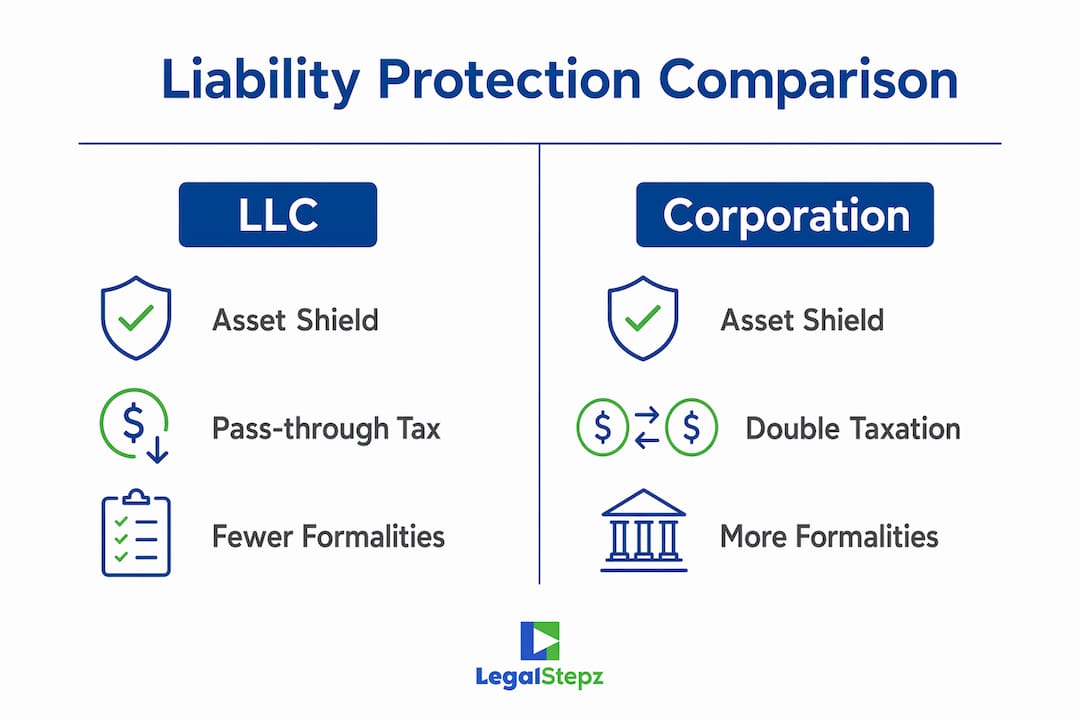
California Corporations Code Section 17703.04 governs LLC member liability and makes clear that members are not personally liable for the debts, obligations, or liabilities of the LLC. That statutory shield is the foundation of LLC liability protection. Corporations offer the same shield under a different legal framework, with more formal governance requirements.
LLCs in California offer pass-through taxation, liability protection, and fewer formalities than corporations. Single-member LLCs are taxed as sole proprietorships by default, and multi-member LLCs default to partnership taxation. That means no double taxation, which is a real advantage over C corporations.
The cost difference between a sole proprietorship and an LLC is real but manageable. Sole proprietors pay 15.3% self-employment tax on the first $176,100 of profit and face unlimited personal liability. LLC owners pay an $800 annual California franchise tax but gain legal separation of their personal assets. For most California entrepreneurs, that trade-off is straightforward.
Here is how the two main entity types compare on key protection factors:
| Feature | LLC | Corporation |
|---|---|---|
| Personal asset protection | Yes, statutory shield | Yes, statutory shield |
| Pass-through taxation | Yes, by default | No (C corp is double-taxed) |
| Formal governance required | Minimal | Annual meetings, board required |
| Annual California franchise tax | $800 minimum | $800 minimum |
| Best for | Small to mid-size businesses | Businesses seeking outside investors |
Pro Tip: If you are currently operating as a sole proprietor in California, the cost to form an LLC is almost always less than the financial exposure you carry without one.
What is liability insurance and how does it complement entity protection?
Liability insurance is a financial product that pays for legal defense costs and settlements when a third party claims your business caused them harm. It is not the same as the entity shield. The two tools serve different functions and work best together.
Liability insurance covers defense costs and settlements for third-party injuries or property damage up to policy limits. The "duty to defend" clause in most commercial general liability policies requires the insurer to pay for legal counsel even when the claim is groundless. That matters because defense costs alone can reach tens of thousands of dollars before a case ever goes to trial.
Liability insurance is reactive, protecting against claims after they arise. Entity-based legal protection is proactive, involving structure and compliance to limit risk before a claim ever happens. You need both because insurance has limits and exclusions, while the entity shield has no dollar cap.
Common coverage types California business owners should know:
- Commercial general liability (CGL): Covers bodily injury and property damage claims from third parties
- Professional liability (E&O): Covers claims of negligence or errors in professional services
- Umbrella coverage: Extends limits above your primary policy when a claim exceeds base coverage
- Product liability: Covers injury or damage caused by products you sell or manufacture
Insurance does not cover your own property damage or losses. It also does not protect you from claims arising from your personal fraud or intentional misconduct. That is where the entity shield picks up.
Pro Tip: Review your policy limits annually. A business that grew from $200,000 to $1 million in revenue likely needs higher coverage limits than it carried in year one.
When does liability protection fail?
The entity shield is not automatic or permanent. California courts can pierce the corporate veil and hold owners personally liable when the business and the owner behave as one and the same.
California applies a two-prong "alter ego" test to pierce the corporate veil. Courts require unity of interest that dissolves entity separation, plus an inequitable result if the acts were treated as the entity's alone. Undercapitalization alone is usually not enough. Courts look at the full picture.
"The corporate veil is a fragile firewall that requires discipline and active maintenance to withstand creditor claims. Owners who treat the business as an extension of their personal finances give courts exactly the evidence they need to pierce it."
Common triggers that invite veil piercing in California:
- Commingling personal and business funds in the same bank account
- Failing to maintain an operating agreement or corporate bylaws
- Skipping annual meetings or failing to document major decisions
- Undercapitalizing the business so it cannot pay ordinary debts
- Using the business to commit fraud or misrepresentation
Personal liability also survives the entity shield in specific situations. An LLC does not shield against personal negligence, fraud, or personal guarantees. If you personally guarantee a business loan, the lender can pursue your personal assets regardless of your LLC status. If you personally commit malpractice or fraud, the entity offers no cover.
Pro Tip: Never sign a contract in your personal name for a business obligation. Always sign as "Your Name, Member/Manager of [LLC Name]" to keep the liability inside the entity.
Steps to maintain strong liability protection in California
Forming an LLC or corporation creates the shield. Maintaining it requires ongoing discipline. Limited liability requires ongoing compliance including filings, recordkeeping, and operating agreement adherence to remain effective.
The most important maintenance steps for California business owners:
- Open a dedicated business bank account and never mix personal and business funds
- File your Statement of Information with the California Secretary of State on time (due within 90 days of formation, then every two years for LLCs)
- Pay the $800 annual franchise tax to the California Franchise Tax Board to avoid administrative dissolution
- Draft and follow an operating agreement that reflects how the business actually operates
- Document major business decisions in writing, including meeting minutes and member resolutions
- Review insurance coverage annually to match your current revenue, headcount, and risk exposure
Maintaining separate personal and business records is non-negotiable for legal defense. Courts look at financial records first when evaluating veil-piercing claims. A clean paper trail is your best evidence that the entity is real and separate.
The comparison below shows the difference between a protected and an unprotected business posture:
| Practice | Protected business | Unprotected business |
|---|---|---|
| Bank accounts | Separate business account | Shared personal/business account |
| Annual filings | Filed on time, every year | Missed or late filings |
| Operating agreement | Current and followed | Nonexistent or ignored |
| Insurance coverage | Reviewed and updated annually | Set once, never revisited |
| Decision documentation | Written records kept | Verbal decisions only |
Key Takeaways
Liability protection requires both a properly maintained legal entity and adequate insurance coverage, because neither tool alone covers every risk a California business owner faces.
| Point | Details |
|---|---|
| Entity shield basics | An LLC or corporation legally separates your personal assets from business debts and lawsuits. |
| Insurance fills the gap | Liability insurance pays defense costs and settlements up to policy limits when claims arise. |
| Veil piercing is real | California courts can remove entity protection when owners commingle funds or ignore formalities. |
| Ongoing compliance is required | Skipping franchise tax payments or annual filings can dissolve your entity and erase the shield. |
| Personal acts stay personal | Fraud, personal negligence, and personal loan guarantees bypass entity protection entirely. |
Why liability protection is not a one-time checkbox
Most entrepreneurs I work with treat entity formation as a finish line. They file the articles, pay the $800, and assume they are protected forever. That assumption is the most expensive mistake a California business owner can make.
The corporate veil is not a wall you build once. It is more like a fence you have to maintain every year. Miss a filing, blend your personal and business expenses, or skip documenting a major decision, and you hand opposing counsel the evidence they need to pierce it. I have seen well-intentioned business owners lose personal assets not because they did anything fraudulent, but because they got sloppy with paperwork.
The other misunderstanding I see constantly is treating insurance and entity protection as substitutes for each other. They are not. Insurance pays the claim. The entity protects what is left after the claim. You need both layers working together, and you need to review both every year as your business grows.
My honest advice: treat liability protection as infrastructure, not paperwork. The $800 franchise tax and the time spent on annual minutes are not bureaucratic overhead. They are the price of keeping your home and savings out of reach of a business dispute.
— Peter
How Legalstepz supports California entrepreneurs
Forming an entity is step one. Keeping it compliant is what actually protects you.

Legalstepz helps California entrepreneurs file their Statement of Information, draft annual minutes, prepare bylaws, and maintain registered agent services. These are the exact compliance tasks that keep your corporate veil intact and your personal assets protected. Whether you are forming a new LLC or catching up on missed filings for an existing one, Legalstepz provides the tools and guidance to stay current with California's requirements. Protecting your business starts with getting the paperwork right.
FAQ
What does liability protection mean for a small business owner?
Liability protection means your personal assets, such as your home and savings, cannot be seized to pay business debts or lawsuit judgments. It requires forming a legal entity like an LLC or corporation and maintaining it properly.
Does an LLC automatically protect all personal assets?
An LLC protects personal assets from most business liabilities, but not from personal guarantees, fraud, or your own negligence. The protection also disappears if you fail to maintain corporate formalities or commingle personal and business funds.
What is the difference between liability insurance and entity protection?
Liability insurance pays defense costs and settlements when a claim arises. Entity protection prevents personal assets from being reached at all. Both work as a two-layer defense, with insurance as the first line and the entity as the backstop.
How does California's alter ego test work?
California courts pierce the corporate veil when they find unity of interest between the owner and the business, plus an inequitable result from treating acts as the entity's alone. Commingling funds and ignoring formalities are the most common triggers.
What annual filings does a California LLC need to maintain liability protection?
A California LLC must file a Statement of Information with the Secretary of State and pay the $800 annual franchise tax to the Franchise Tax Board. Skipping these filings risks administrative dissolution and loss of liability protection.