

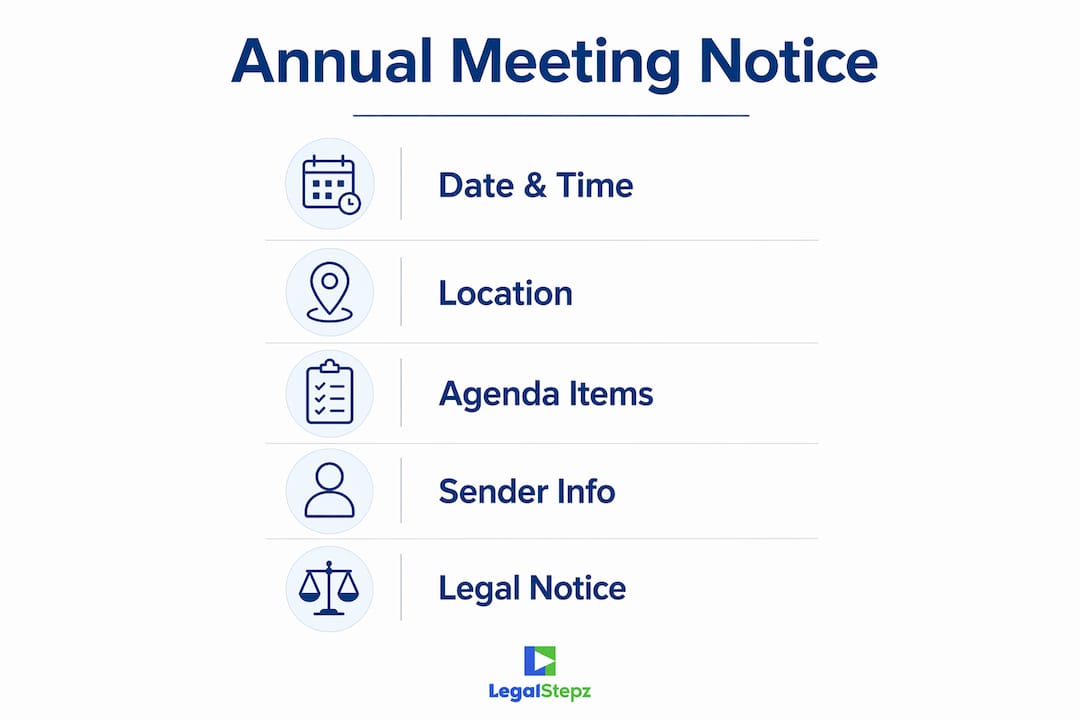
A notice of annual meeting is the official written or electronic announcement sent to shareholders or organization members to inform them about an upcoming annual meeting. It tells recipients when and where the meeting will happen, and it outlines the key business to be conducted. Without it, shareholders have no formal basis to prepare, vote, or hold leadership accountable. Here is what the notice must include at minimum:
- The date, time, and physical location of the meeting
- Virtual access details (video link, phone bridge) when remote participation is offered
- The agenda, including items like board elections, bylaw amendments, or executive compensation votes
- Any special purpose statements required for non-routine agenda items
- Proxy voting instructions or enclosed ballot forms, particularly for HOA and association meetings
The notice is not just a calendar reminder. It is a legal document that triggers shareholder rights and sets the boundaries of what the meeting can lawfully decide.
Table of Contents
- Why the notice of annual meeting matters for corporate governance
- What a notice of annual meeting typically contains
- How much notice is legally required before an annual meeting?
- What does a real notice of annual meeting look like?
- Who prepares and signs the notice of annual meeting?
- California corporate compliance and annual meeting notices
- Legalstepz helps you get your annual meeting notice right
- Key Takeaways
Why the notice of annual meeting matters for corporate governance
The annual meeting notice is a cornerstone of corporate transparency, giving shareholders the information they need to engage meaningfully before voting on major company matters. Without advance notice, shareholders cannot research candidates for the board, review proposed bylaw changes, or arrange to vote by proxy if they cannot attend in person.
Under frameworks like the Model Business Corporation Act, notice requirements exist precisely to prevent leadership from catching shareholders off guard. The notice creates a window of preparation time that is legally protected. Courts have unwound board elections over inadequate notice, which shows how seriously the law treats this obligation.
"Annual general meetings are important for the transparency they provide and the ability to include shareholders, as well as bringing management to accountability." — Investopedia
The notice also draws a meaningful line between annual and special meetings. Annual meetings are scheduled, routine events where governance happens on a predictable cycle. Special meetings are called outside that cycle to address a specific issue, and their notices must state the meeting's purpose explicitly. Business conducted at a special meeting that goes beyond what the notice described can be challenged and invalidated.
What a notice of annual meeting typically contains
Every valid notice must cover the basics: date, time, and location. When the meeting is virtual or hybrid, the notice must include access details such as a video conferencing link or phone bridge number. That requirement has grown more detailed as virtual and hybrid annual meetings have become standard practice.
Beyond logistics, the notice carries the agenda. For a routine annual meeting, that usually means:
- Election of board directors
- Review and approval of financial statements
- Appointment or ratification of auditors
- Executive compensation votes (for public companies)
- Any proposed amendments to the bylaws or charter
When the agenda includes something non-routine, such as a merger vote or a significant assessment change in an HOA, the notice must describe that item specifically. A vague agenda line is not enough.
| Notice Element | What It Covers |
|---|---|
| Date, time, and location | When and where the meeting takes place |
| Virtual access details | Video link or phone bridge for remote attendees |
| Agenda items | Business to be voted on or discussed |
| Purpose statement | Required for special or non-routine items |
| Proxy/ballot forms | Voting materials for members who cannot attend |
| Sender name and title | Identifies the issuing officer for legal validity |
Pro Tip: If your notice includes a bylaw amendment or a special assessment vote, write a brief plain-language summary of the proposed change directly in the notice body. Shareholders who understand what they are voting on are far more likely to return their proxies, which helps you reach quorum.
How much notice is legally required before an annual meeting?
Most US states require the notice to arrive no fewer than 10 days and no more than 60 days before the meeting date. That window comes from the Model Business Corporation Act and is tracked by the majority of state corporate statutes. The floor stops leadership from calling a meeting with no preparation time; the ceiling prevents a notice sent so far in advance that circumstances change before anyone shows up.
Nonprofit corporations sometimes face a wider window. In some states, notices sent by regular mail for nonprofit meetings must go out 30–60 days in advance to account for slower delivery and member availability.
Acceptable delivery methods include:
- First-class US mail to the address on record
- Electronic delivery (email or posting to a member portal) when the recipient has consented
- Hand delivery, where permitted by bylaws
- Website or community board posting for HOA board meetings, often with a 48-hour minimum
One nuance worth knowing: failure of an individual member to actually receive the notice does not automatically invalidate the meeting, as long as the organization made a good-faith effort using the correct delivery method and current address records. Statutory compliance with the delivery process matters more than confirmed individual receipt.
Failing to follow notice timing or delivery rules carries real consequences. Courts can and do void meeting decisions, including board elections, when notice was defective.
Statistic callout: The Model Business Corporation Act sets the baseline notice window at 10 to 60 days before a meeting. Getting any piece of this wrong can void the decisions made at the meeting.
What does a real notice of annual meeting look like?
A sample notice for a small California corporation might read like this:
NOTICE OF ANNUAL MEETING OF SHAREHOLDERS Acme Holdings, Inc. You are hereby notified that the Annual Meeting of Shareholders of Acme Holdings, Inc. will be held on Tuesday, March 18, 2026, at 10:00 AM Pacific Time, at 1234 Commerce Street, Suite 200, Los Angeles, California 90001. Virtual attendance is available via Zoom at [meeting link]. The agenda includes: (1) election of directors, (2) ratification of the independent auditor, and (3) any other business properly brought before the meeting. Shareholders of record as of February 14, 2026 are entitled to vote. A proxy form is enclosed. Dated: February 10, 2026 Jane Smith, Corporate Secretary, Acme Holdings, Inc.
That example reflects the core statutory requirements: a specific date and time, a physical address, virtual access details, a clear agenda, a record date for voting eligibility, and a signed sender line. Notice how the proxy form is mentioned directly, which is critical for achieving quorum when shareholders cannot attend in person.
| Sample Element | Why It Is Included |
|---|---|
| Meeting date and time | Satisfies statutory notice requirement |
| Physical and virtual location | Ensures equitable access for all shareholders |
| Agenda items numbered | Limits business to what was properly noticed |
| Record date | Establishes who is eligible to vote |
| Proxy form reference | Enables absentee voting and quorum formation |
| Secretary's signature | Ties the notice to corporate authority |
Who prepares and signs the notice of annual meeting?
The corporate secretary typically drafts and signs the notice. In smaller companies or associations, an authorized managing agent may handle it instead. The corporate secretary or authorized agent serves as the formal issuer, and their name and title on the notice connect it to the company's governance structure.

For public companies, the notice is usually incorporated into the proxy statement filed with the SEC and distributed to shareholders under federal rules. The Securities and Exchange Commission voted in 2007 to require all public companies to post annual meeting materials online, with large accelerated filers complying by January 1, 2008.
Key responsibilities tied to the notice include:
- Confirming the record date with the board before drafting
- Verifying the shareholder address list is current
- Coordinating with legal counsel when non-routine agenda items require a purpose statement
- Retaining proof of mailing or electronic delivery for the corporate records
Signing authority is not a formality. A notice signed by someone without proper authority can be challenged, which puts every decision made at the meeting at risk.
California corporate compliance and annual meeting notices
California's corporate statutes set stricter requirements than many other states, and annual meeting compliance in California ties directly to a company's good standing. The notice is not a standalone document; it connects to the annual minutes, the Statement of Information filed with the Secretary of State, and the broader record-keeping obligations that California corporations must maintain.
Failing to issue proper notice in California can trigger more than a voided meeting. It can create gaps in the corporate record that complicate future transactions, financing, or regulatory reviews. California courts take notice defects seriously, particularly when shareholder voting rights are at stake.
Best practices for California corporations include:
- Keeping a current shareholder or member address list and updating it before each notice cycle
- Documenting the delivery method and date in the corporate minute book
- Including all required agenda items, especially for votes on annual corporate filings or officer elections
- Retaining a copy of the notice with the annual minutes as part of the permanent corporate record
Pro Tip: California corporations should draft the annual meeting notice at the same time they prepare the annual minutes template. Doing both together reduces the chance of a mismatch between what the notice promised and what the minutes record as having been discussed.
Proxy voting depends entirely on a properly issued notice. Shareholders who receive a defective notice may have grounds to challenge any proxy votes cast, which can unravel a quorum and void the meeting's business entirely.
Legalstepz helps you get your annual meeting notice right
Annual meeting compliance is one of those things that looks simple until something goes wrong. A missed deadline, a vague agenda line, or a notice sent to an outdated address can put your entire meeting at risk.

Legalstepz handles the paperwork that keeps California corporations in good standing: drafting annual minutes, preparing notices, filing Statements of Information, and providing registered agent services. You get documents prepared to California's specific statutory standards, without needing to track every rule change yourself. If you want your next annual meeting to be legally sound from the notice forward, start with Legalstepz today.
Key Takeaways
A valid notice of annual meeting must include the date, time, location, agenda, and sender's name, and must be delivered within the 10-to-60-day window required by most US state statutes.
| Point | Details |
|---|---|
| Core legal requirement | The notice must state the date, time, and location, plus virtual access details when applicable. |
| Statutory timing window | Most US states require delivery no fewer than 10 days and no more than 60 days before the meeting. |
| Consequences of defects | Courts can void board elections and other decisions when notice timing or delivery was inadequate. |
| Who signs the notice | The corporate secretary or authorized agent signs and issues the notice to tie it to corporate authority. |
| Legalstepz | Legalstepz drafts annual meeting notices, annual minutes, and Statements of Information for California corporations. |