

A California LLC is a legal business entity that combines partnership flexibility with corporate liability protection, giving owners personal asset separation from business debts and lawsuits. The California Secretary of State registers these entities under the Revised Uniform Limited Liability Company Act (RULLCA), while the Franchise Tax Board governs their tax obligations. Unlike a sole proprietorship or general partnership, a California LLC shields its members from personal liability for business obligations. The IRS classifies single-member LLCs as disregarded entities and multi-member LLCs as partnerships by default, but California maintains its own consistent state-level classification regardless of federal treatment.
What is a California LLC and how does it work legally?
A California LLC is a hybrid entity. Members own it, managers run it, and an operating agreement governs how both groups interact. This structure gives you far more flexibility than a corporation, where rigid bylaws and board requirements dictate nearly every decision.
The operating agreement is the backbone of any California LLC. This internal document controls ownership percentages, profit distributions, voting rights, and what happens when a member wants to leave. It is not filed with the California Secretary of State, but California law requires it to be maintained in writing at the LLC's principal office. Skipping it or leaving it generic is one of the most common and costly mistakes new LLC owners make.

California operates under RULLCA, which means default rules apply if your operating agreement is silent on a topic. Those defaults do not always favor your situation. A well-drafted agreement overrides them and gives you control over outcomes that matter, from dispute resolution to succession planning.
For federal tax purposes, the IRS treats your LLC based on how many members it has. A single-member LLC is a disregarded entity, meaning its income flows directly to your personal return. A multi-member LLC files as a partnership. California, however, applies its own classification framework through the Franchise Tax Board regardless of what the IRS does.
Key formation steps for a California LLC:
- Choose a unique business name that complies with California naming rules
- File Articles of Organization through bizfile Online, the California Secretary of State's filing portal
- File an initial Statement of Information within 90 days of formation
- Draft and store a written operating agreement at your principal office
- Obtain an EIN from the IRS if you have employees or multiple members
- Register with the Franchise Tax Board for tax purposes
Pro Tip: Update your operating agreement every time ownership or management changes. Practitioners consistently recommend this to preserve legal enforceability and prevent disputes from escalating.
What are the annual tax and fee obligations for a California LLC?
California's tax structure for LLCs is more demanding than most states, and underestimating it has derailed more than a few early-stage businesses. The minimum $800 annual franchise tax applies to every California LLC, regardless of whether it earned a dollar or operated at a loss. This is a privilege tax for the right to do business in California, not an income tax.
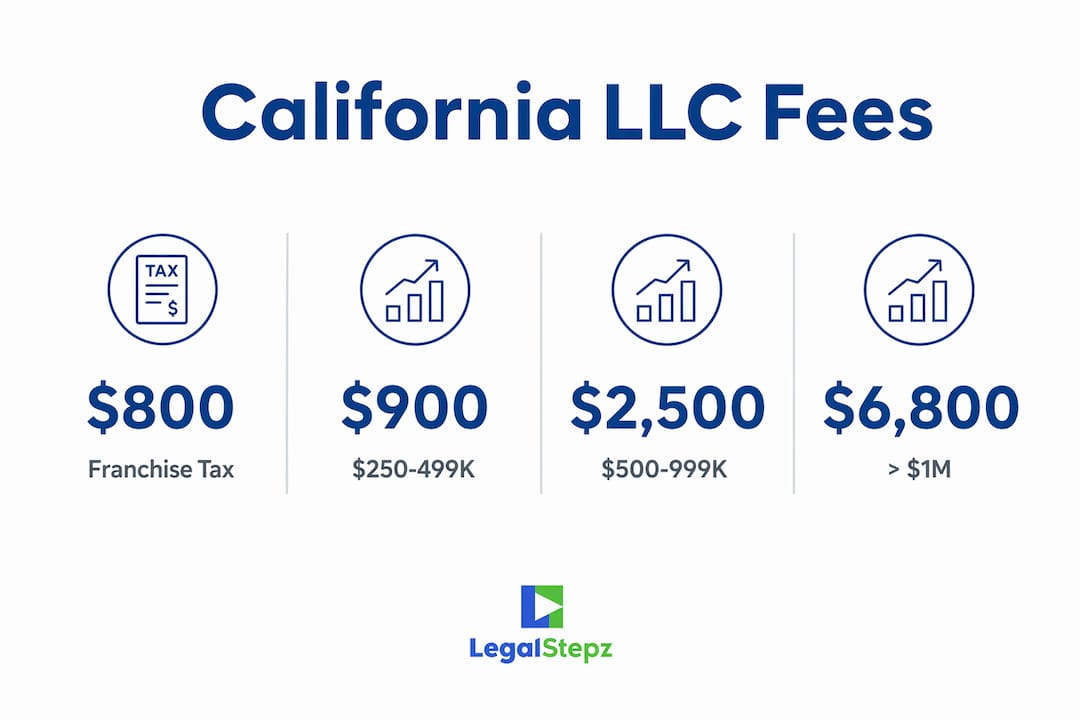
On top of the flat $800, California charges a gross receipts fee once your LLC's total California income crosses $250,000. These fees are tiered and separate from the franchise tax.
| California income | Annual LLC fee |
|---|---|
| $250,000 to $499,999 | $900 |
| $500,000 to $999,999 | $2,500 |
| $1,000,000 to $4,999,999 | $6,000 |
| $5,000,000 or more | $11,790 |
These gross receipts fee tiers mean a mid-sized LLC generating $1.5 million in California revenue owes $6,800 annually before any income tax. Budget for this from day one.
The LLC's annual tax return is filed on Form 568. Form 568 is due on the 15th day of the 4th month after your fiscal year ends. That is April 15 for calendar-year LLCs. The franchise tax payment itself has a separate due date, which catches many owners off guard. Missing either deadline triggers penalties and interest from the Franchise Tax Board.
One critical point: the Franchise Tax Board does not send reminder invoices. Failure to pay the franchise tax or file required forms can result in LLC suspension, tax liens, and loss of liability protection. A suspended LLC cannot legally conduct business, enforce contracts, or defend itself in court.
The Statement of Information, filed with the California Secretary of State, costs $20 and is due every two years after the initial filing. It is a simple update of your address, registered agent, and management structure, but missing it contributes to suspension.
Pro Tip: Separate your franchise tax payment calendar from your Form 568 filing calendar. They have distinct due dates, and treating them as one deadline is a common compliance error that generates avoidable penalties.
How does a California LLC compare to other business structures?
Understanding the difference between an LLC and a corporation shapes every major decision you make about your business. The difference between LLC and corporation structures comes down to three factors: liability protection, taxation, and operational complexity.
| Feature | California LLC | S Corp | C Corp |
|---|---|---|---|
| Personal liability protection | Yes | Yes | Yes |
| Pass-through taxation | Yes (default) | Yes | No (double taxation) |
| Self-employment tax on all income | Yes | No (salary + distributions) | No |
| Formation complexity | Low | Medium | High |
| Annual compliance burden | Medium | High | High |
| Investor-friendly structure | Limited | Limited | Yes |
The California S corp vs. C corp differences matter most when you are thinking about investors or exit strategy. C corps attract venture capital because they can issue multiple classes of stock. S corps limit shareholders to 100 U.S. residents. LLCs sit outside both categories but can elect S corp tax treatment through the IRS, which lets owner-operators reduce self-employment taxes by splitting income between salary and distributions.
Here is what that means practically. If your LLC generates $200,000 in net profit and you elect S corp status, you pay yourself a reasonable salary of $80,000, pay payroll taxes on that amount only, and take the remaining $120,000 as a distribution. Without the S corp election, the entire $200,000 is subject to self-employment tax. The savings are real and worth modeling with a CPA once your net income consistently exceeds $50,000.
One thing the LLC vs. corporation comparison often glosses over: California applies its franchise tax to both LLCs and corporations, so the $800 minimum is not unique to LLCs. What is unique is the gross receipts fee, which corporations do not pay in the same tiered structure.
What practical steps should you follow when forming a California LLC?
Formation is straightforward if you follow the steps in order and avoid the shortcuts that create problems later.
-
Search and reserve your LLC name. Use the California Secretary of State's business search tool to confirm your name is available. Names must include "LLC," "L.L.C.," or "Limited Liability Company." You can reserve a name for 60 days by filing a Name Reservation Request.
-
Appoint a registered agent. Every California LLC must designate a registered agent with a physical California address to receive legal documents. This can be an individual or a registered agent service. Using a professional service keeps your personal address off public records.
-
File Articles of Organization. Submit Form LLC-1 through bizfile Online. The filing fee is $70. Processing times vary, but online filings are typically faster than paper submissions.
-
File your initial Statement of Information. This is due within 90 days of formation and costs $20. It establishes your official address, management structure, and registered agent on the public record.
-
Draft your operating agreement. Do this before you start operating, not after a dispute arises. Cover capital contributions, profit splits, voting thresholds, and exit procedures. Legalstepz provides operating agreement guidance tailored to California requirements.
-
Register with the Franchise Tax Board. Obtain your California tax ID and set up your account for annual franchise tax payments and Form 568 filings.
-
Open a dedicated business bank account. This is not a legal requirement, but commingling personal and business funds is the fastest way to lose your liability protection in court.
Pro Tip: Even if your LLC is dormant or pre-revenue, the $800 franchise tax still applies. Budget for it in year one and every year after. Entrepreneurs who form LLCs in Delaware or Nevada to avoid California fees still owe California taxes if they conduct business here.
Key takeaways
A California LLC requires the $800 annual franchise tax, a written operating agreement, and timely Form 568 filings to maintain liability protection and good standing.
| Point | Details |
|---|---|
| Core definition | A California LLC blends partnership flexibility with corporate liability protection for its members. |
| Annual tax floor | Every LLC owes $800 minimum franchise tax yearly, regardless of revenue or profit. |
| Gross receipts fees | LLCs earning over $250,000 in California income pay additional tiered fees up to $11,790. |
| Operating agreement | This internal document governs your LLC and must be kept in writing at your principal office. |
| Compliance risk | Missing franchise tax or Form 568 deadlines can suspend your LLC and void liability protection. |
Why California LLC compliance deserves more respect than most entrepreneurs give it
Most articles on California LLCs spend their energy on formation and skip past the part that actually determines whether your LLC survives year two. The $800 franchise tax is not the problem. The problem is the compounding effect of missing deadlines, skipping operating agreement updates, and treating the LLC as a formality rather than a legal structure that requires active maintenance.
I have seen entrepreneurs form LLCs in other states thinking they are outsmarting California's fee structure. They are not. If you operate in California, sell to California customers, or have employees here, the Franchise Tax Board considers you subject to California taxes and registration requirements. The savings evaporate, and you end up paying fees in two states plus the cost of a foreign qualification filing.
The operating agreement is the document I would never skip or use a generic template for. It is not just about governance. It is your first line of defense when a co-founder dispute turns legal, when a creditor challenges your liability protection, or when you need to bring in a new member without triggering a dissolution. Legalstepz covers annual compliance requirements in detail, and I recommend reviewing them every year, not just at formation.
One more thing worth saying directly: the Franchise Tax Board does not remind you when taxes are due. It suspends you. Treat your LLC compliance calendar the way you treat your most important client deadline.
— Peter
Start your California LLC the right way with Legalstepz
Forming a California LLC correctly from the start saves you from costly corrections later. Legalstepz offers a dedicated LLC formation course that walks you through every 2026 California-specific requirement, from Articles of Organization and operating agreements to franchise tax obligations and Statement of Information filings. The course is built for entrepreneurs who want to understand what they are setting up, not just check a box.

Legalstepz also handles registered agent services, Statement of Information filings, annual minutes, and bylaws drafting so your LLC stays in good standing year after year. If you are ready to form your California LLC with confidence, the course is the clearest path forward.
FAQ
What is the minimum cost to form a California LLC?
The California Secretary of State charges a $70 filing fee for Articles of Organization, plus a $20 Statement of Information fee due within 90 days. Add the $800 annual franchise tax, and your first-year minimum cost is $890 before any professional fees.
Does a California LLC have to pay the $800 tax if it made no money?
Yes. The $800 minimum franchise tax applies to every California LLC regardless of income, revenue, or activity level. A dormant LLC with zero revenue still owes $800 each year to the Franchise Tax Board.
What is the difference between an LLC and a corporation in California?
An LLC offers pass-through taxation and simpler compliance, while a corporation faces potential double taxation but provides a more investor-friendly structure. Both provide personal liability protection, but corporations carry higher formation and ongoing compliance costs.
Do I need an operating agreement for a California LLC?
California law requires every LLC to maintain a written operating agreement at its principal office, even though it is not filed with the state. Without one, California's default RULLCA rules govern your LLC, which may not reflect your actual intentions.
What happens if my California LLC is suspended?
A suspended LLC loses the right to conduct business, enforce contracts in court, and maintain liability protection for its members. Reinstatement requires paying all back taxes, penalties, and filing any overdue documents with the Franchise Tax Board and California Secretary of State.