

An incorporator is the person who signs and files the Articles of Incorporation to legally create a corporation. This role is the starting point of every corporation's legal existence. Without a valid filing, the corporation simply does not exist in the eyes of the state. For California entrepreneurs, understanding this role prevents costly governance mistakes down the road.
What is an incorporator and what do they actually do?
An incorporator is defined as the individual or entity who executes and submits the Articles of Incorporation to the California Secretary of State. That single act creates the corporation as a legal entity. The role is procedural by design, not managerial. The incorporator holds no ownership stake, no voting rights, and no ongoing authority once the filing is accepted.
The incorporator's duties are strictly limited to the formation phase. Once the state accepts the Articles of Incorporation, the incorporator's job is nearly done. If the filing names initial directors, the incorporator's role ends at that moment. If no directors are named, the incorporator must take one additional step: hold an organizational meeting to elect the board and adopt the corporate bylaws.

That additional step produces a document called the "Incorporator Action." This written record formally appoints the first board of directors and confirms the incorporator's resignation. The Incorporator Action document is not filed with the state, but it is critical for the corporation's internal chain of title. Investors and attorneys will ask for it during due diligence.
Here is the sequence of incorporator duties in order:
- Prepare the Articles of Incorporation. Draft the document with the corporation's name, registered agent, and purpose.
- Sign and file with the state. Submit to the California Secretary of State with the required filing fee.
- Respond to state corrections. The incorporator must correct any errors or rejections the state identifies.
- Execute the Incorporator Action. If directors are not named in the filing, appoint the initial board and adopt bylaws.
- Formally resign. Sign a written resignation to confirm the handoff to the board.
Pro Tip: Draft the Incorporator Action on the same day the state approves your Articles. Waiting weeks creates a gap in your corporate records that can slow down future funding rounds.
How does an incorporator differ from a registered agent or founder?
These three roles are frequently confused, and mixing them up creates real compliance problems. Each role has a distinct scope, duration, and legal authority.
The registered agent is a state-mandated, ongoing position. This person or entity receives legal documents, lawsuits, and official state notices on behalf of the corporation. The registered agent must maintain a physical California address and be available during business hours. That obligation never ends as long as the corporation exists.
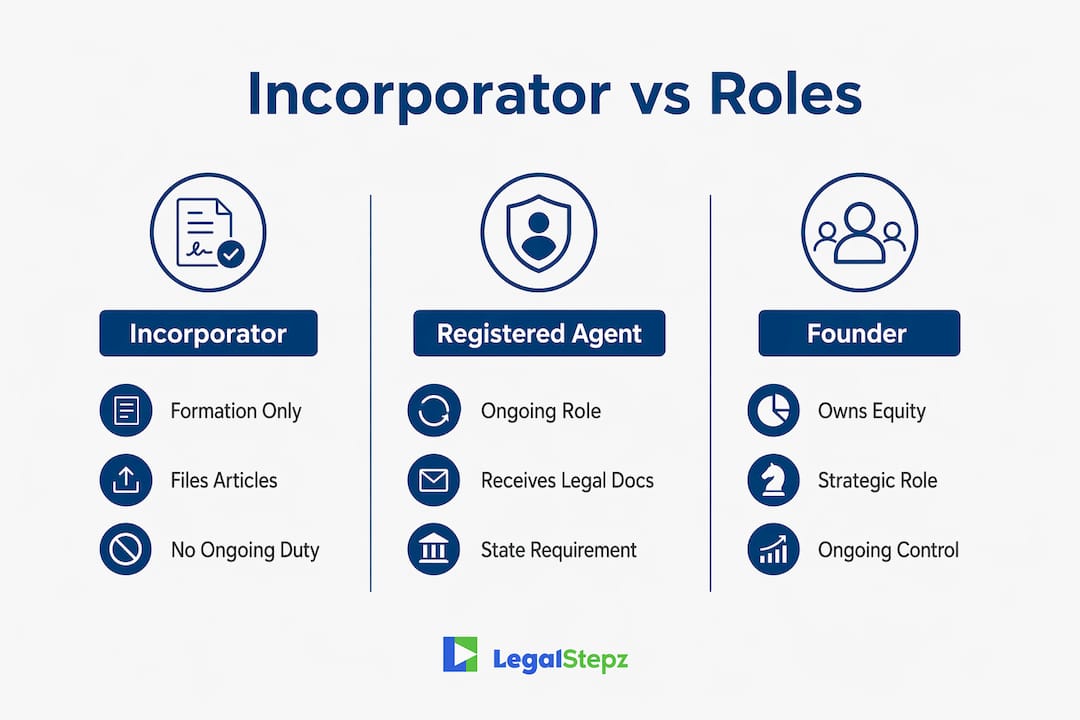
The incorporator, by contrast, acts once during formation and then steps away. There is no ongoing duty, no required address, and no continuing legal connection to the firm after the handoff is complete.
A founder is different again. Founders are the people who build the business, own equity, and make strategic decisions. A founder can also serve as the incorporator, but those are two separate functions. The founder's authority comes from share ownership and board membership. The incorporator's authority comes only from the act of filing.
| Role | Duration | Core duty | Legal authority |
|---|---|---|---|
| Incorporator | Formation only | File Articles, execute Incorporator Action | Ends at board handoff |
| Registered agent | Ongoing | Receive legal and state documents | Continuous, state-mandated |
| Founder | Ongoing | Build and own the business | Comes from equity and board seat |
The key distinction: once the first board is established, the incorporator has no further legal connection to the corporation. Any role after that point is held as a director, officer, or shareholder, not as an incorporator.
Who can be an incorporator in California?
California law sets a low bar for incorporator eligibility. The requirements are straightforward:
- The incorporator must be at least 18 years old and legally competent to enter contracts.
- No California residency is required. An out-of-state individual or entity can serve.
- A single incorporator is sufficient. California does not require multiple signatories.
- Individuals, law firms, and other legal entities can all serve as incorporators.
These eligibility rules mean that a founder in another state can incorporate a California company without relocating. They also mean that a law firm can handle the entire filing on a client's behalf.
Why founders often use a professional incorporator
Many startups appoint law firms or professional services as incorporators rather than handling the filing themselves. The reason is procedural accuracy. A professional incorporator knows exactly what the California Secretary of State requires, reduces the chance of rejection, and produces clean corporate records from day one.
The best state to file your incorporation also matters. Some founders choose Delaware for its established corporate law, even if they operate in California. In that case, the incorporator files in Delaware and the company registers as a foreign corporation in California. The incorporator's duties are the same either way, but the paperwork differs.
Common pitfalls to avoid:
- Failing to execute a written Incorporator Action after the state approves the filing.
- Never formally resigning, which leaves the corporation's governance in a gray area.
- Naming the wrong registered agent address in the Articles, which triggers a state rejection.
Pro Tip: If you are a solo founder acting as your own incorporator, create a simple checklist: file, receive approval, draft Incorporator Action, appoint yourself as director, and sign the resignation. That five-step sequence takes under an hour and protects your corporate records permanently.
What are the legal consequences of mishandling incorporator duties?
The incorporator role is brief, but the consequences of doing it wrong are long-lasting. Entrepreneurs often underestimate this. A clean handoff from incorporator to board is the foundation of every corporate governance structure that follows.
Skipping the Incorporator Action is the single most common formation mistake. Without it, the corporation technically has no appointed board, no adopted bylaws, and no clear authority to act. That gap surfaces during investor due diligence, bank account openings, and contract signings, often at the worst possible moment.
When a corporation lacks a properly documented board appointment, investors and their attorneys flag it immediately. A governance void can delay or kill a funding round. Banks may refuse to open a business account without proof of board authority. Contracts signed without board authorization can be challenged.
The incorporator also carries legal responsibility for the accuracy of the Articles of Incorporation. If the filing contains false information, the incorporator is the named party who submitted it. That is a real legal exposure, not a technicality.
Proper execution of incorporator duties also affects how the corporation handles its statement of information filings and annual minutes going forward. California requires corporations to file a Statement of Information within 90 days of incorporation and annually after that. A corporation without a properly appointed board cannot validly authorize that filing.
For entrepreneurs who want to avoid these risks, understanding the reasons company formations get rejected before filing saves time and money. Most rejections trace back to errors the incorporator could have caught before submission.
Key Takeaways
The incorporator is the most consequential actor in the first hour of a corporation's life, and the Incorporator Action document is the single most overlooked step in California business formation.
| Point | Details |
|---|---|
| Incorporator definition | The person who signs and files the Articles of Incorporation to legally create the corporation. |
| Role duration | The role ends once the board is appointed and the Incorporator Action is signed. |
| Incorporator vs. registered agent | The registered agent is an ongoing state-mandated role; the incorporator acts only at formation. |
| California eligibility | Any person 18 or older, regardless of residency, can serve as incorporator in California. |
| Biggest risk | Skipping the Incorporator Action leaves the corporation without a valid board and creates governance gaps. |
The part most founders get wrong
I have reviewed hundreds of California corporate formation packages, and the same mistake appears more than any other. The founder files the Articles, gets the state approval email, and then moves on to building the business. The Incorporator Action never gets drafted. The bylaws never get formally adopted. Six months later, a bank or investor asks for the corporate records and the whole formation has to be reconstructed.
The incorporator role feels trivial because it lasts about ten minutes. That brevity is exactly why people skip the final steps. They assume the state approval is the finish line. It is not. The finish line is a signed Incorporator Action, an appointed board, and adopted bylaws sitting in a corporate records binder.
My advice for California founders is direct: do not act as your own incorporator unless you are willing to follow through on every step, including the paperwork that happens after the state says yes. If you are not confident in the process, use a professional service. The cost of getting it right the first time is far lower than the cost of cleaning it up before a Series A.
The incorporation course approach works well for founders who want to understand the full process before delegating it. Knowledge of what the incorporator must do makes you a better client and a better founder.
— Peter
How Legalstepz supports California incorporations
Legalstepz handles the procedural work that trips up most California founders, from filing the Articles of Incorporation to drafting bylaws and managing registered agent services.

The Legalstepz team prepares and files your formation documents accurately, reducing the risk of state rejection. Legalstepz also drafts the annual minutes and Statement of Information filings that keep your corporation in good standing after formation. For founders who want a clean corporate record from day one, Legalstepz incorporation services cover every step from initial filing through the board handoff. California entrepreneurs can get started without needing a law firm on retainer.
FAQ
What is the incorporator definition in simple terms?
An incorporator is the person who signs and files the Articles of Incorporation to legally create a corporation. The role is temporary and ends once the initial board of directors is appointed.
Does the incorporator have ownership or control of the corporation?
No. The incorporator holds no ownership stake, voting rights, or management authority. Once the board is appointed, the incorporator has no further legal connection to the corporation.
Can a founder also be the incorporator in California?
Yes. A founder can serve as the incorporator, but the two roles are legally separate. The founder's ongoing authority comes from equity and board membership, not from the act of filing.
What is the Incorporator Action and why does it matter?
The Incorporator Action is a written document that appoints the initial board of directors and confirms the incorporator's resignation. It is not filed with the state but is required for clean corporate records and investor due diligence.
Is a registered agent the same as an incorporator?
No. The registered agent is an ongoing, state-mandated role that receives legal documents on behalf of the corporation. The incorporator acts only during formation and has no continuing obligations.