

Business formation is the legal process of creating a distinct business entity that operates separately from its owner, with its own rights, obligations, and tax identity. For aspiring entrepreneurs in California, understanding this process is not optional. The structure you choose on day one shapes your taxes, your personal liability, and your ability to raise money for years to come. California adds its own layer of requirements, from franchise taxes to registered agent rules, that make local knowledge a real advantage.
What is business formation and why does it matter?
Business formation is the act of registering a new legal entity with state authorities, giving your business a formal identity separate from you as an individual. The U.S. Chamber of Commerce confirms that treating a business as a separate legal person is critical for signing contracts, raising funds, and opening bank accounts. Without formal formation, you and your business are legally the same. That means your personal savings, car, and home are all exposed if your business faces a lawsuit or debt.
The importance of business formation goes beyond paperwork. Your chosen structure acts as a blueprint that guides operations, legal exposure, and taxation, so choosing carefully impacts long-term success. A freelance graphic designer who stays a sole proprietor faces very different risks than one who forms an LLC. Formation also signals credibility to banks, vendors, and clients who want to work with a recognized legal entity.

What are the main types of business structures in California?
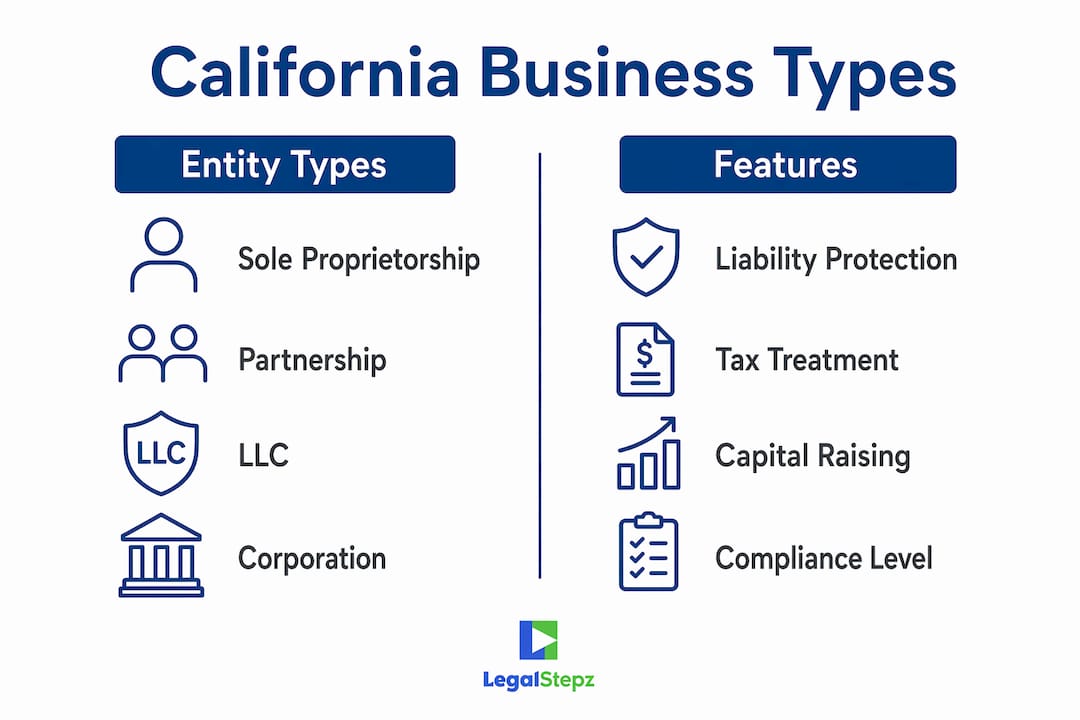
Four primary legal business structures exist for U.S. entrepreneurs: sole proprietorship, partnership, LLC, and corporation. Each carries different liability protections and tax treatments. California entrepreneurs need to understand not just the federal differences but also the state-specific costs attached to each.
| Business entity type | Liability protection | Tax treatment | Best for |
|---|---|---|---|
| Sole proprietorship | None | Personal income tax | Solo freelancers, low-risk work |
| Partnership | Limited or none | Pass-through to partners | Two or more co-founders, early stage |
| LLC | Strong | Pass-through (default) | Most small businesses |
| Corporation (C or S) | Strong | Corporate or pass-through | Startups seeking investors |
Sole proprietorship is the default structure. If you start selling services without filing anything, California treats you as a sole proprietor automatically. You report business income on your personal tax return, but you also carry full personal liability for every business debt and lawsuit.
Partnerships work similarly for tax purposes, with income passing through to each partner's personal return. General partners carry unlimited personal liability. A limited partnership adds limited partners who invest but do not manage the business, capping their liability at their investment.
LLCs are the most popular choice for California small businesses. They combine liability protection with pass-through taxation, avoiding the double taxation that C corporations face. The tradeoff is California's annual $800 franchise tax, which applies even if the LLC earns no profit. That cost surprises many first-time founders. For a detailed breakdown of what forming an LLC actually costs in California, the 2026 cost breakdown from Legalstepz covers state fees and additional expenses clearly.
Corporations offer the strongest structure for raising outside capital. Venture capital firms and angel investors typically require a C corporation, usually incorporated in Delaware even if the business operates in California. S corporations offer pass-through taxation but cap shareholders at 100 and restrict foreign ownership.
Pro Tip: If you are unsure whether an LLC or corporation fits your goals, the LLC vs. corporation comparison from Legalstepz breaks down the protection and tax differences side by side.
What are the legal steps to form a business in California?
The business registration process in California follows a clear sequence. Skipping or rushing any step creates compliance gaps that can cost you later.
-
Choose your business entity type. Your choice of LLC, corporation, or other structure determines which forms you file and what ongoing obligations apply.
-
Select and verify your business name. Search the California Secretary of State's business name database to confirm your chosen name is available. LLCs must include "LLC" or "Limited Liability Company" in the name.
-
File your formation documents. LLCs file Articles of Organization (Form LLC-1). Corporations file Articles of Incorporation. Both go to the California Secretary of State. State filing fees for LLCs and corporations range from about $50 to several hundred dollars, not counting optional expedited processing.
-
Appoint a registered agent. California requires every LLC and corporation to designate a registered agent with a physical California address for receiving legal documents. A P.O. Box does not qualify. The agent must be available during normal business hours. Legalstepz provides registered agent services that meet this requirement. For a full explanation of what this role involves, the registered agent guide from Legalstepz is worth reading before you file.
-
Draft internal governance documents. LLCs need an operating agreement. Corporations need bylaws. California does not always require these documents to be filed publicly, but they are legally important for maintaining liability protection.
-
File your Statement of Information. California LLCs must file a Statement of Information within 90 days of formation and then every two years. Corporations file annually. This keeps your entity in good standing with the state.
-
Obtain an EIN and open a business bank account. The IRS issues Employer Identification Numbers for free at IRS.gov. An EIN lets you open a business bank account, hire employees, and file business taxes separately from your personal return.
The formation process typically takes 6–8 weeks depending on state processing times and the accuracy of your filings. California offers expedited processing for an additional fee if you need faster turnaround.
Pro Tip: File online through the California Secretary of State's bizfile portal. Online submissions process faster than paper filings and reduce the risk of errors that delay approval.
How does your business structure affect taxes, liability, and growth?
Choosing a business structure dictates your tax obligations, liability exposure, and ability to raise capital. These three factors interact in ways that are not always obvious at the start.
Tax treatment varies significantly across entity types. Sole proprietors and LLC members pay self-employment tax on all business profits, currently 15.3% on the first $160,200 of net earnings. C corporations pay a flat 21% federal corporate tax rate, but profits distributed as dividends get taxed again at the shareholder level. S corporations and LLCs taxed as S corps let owners take a salary and receive remaining profits as distributions, which avoids self-employment tax on the distribution portion.
Liability protection is the clearest reason most entrepreneurs choose an LLC or corporation over a sole proprietorship. A properly maintained LLC separates your personal assets from business debts and lawsuits. That separation only holds if you keep the entity compliant. Mixing personal and business finances, missing filings, or failing to maintain governance documents can cause courts to "pierce the corporate veil" and hold you personally responsible.
Capital raising depends heavily on structure. Banks and investors want to see a formal entity before committing money. LLCs can accept investment through membership interest, but most institutional investors prefer the stock-based structure of a C corporation. If you plan to seek venture capital or go through an accelerator like Y Combinator, forming a Delaware C corporation early is the standard path.
Changing structures as your business grows is common and possible, but it creates legal and tax complexity. Starting with the right structure saves time and money later.
What mistakes do California entrepreneurs make during formation?
Formation errors are common and often expensive to fix. These are the ones that show up most frequently.
-
Skipping the registered agent requirement. Using an out-of-state agent or a P.O. Box violates California law. If legal documents cannot reach your registered agent, you may miss lawsuits or government notices entirely.
-
Ignoring the $800 annual franchise tax. California's franchise tax applies to LLCs regardless of profit. New founders who do not budget for this cost face a surprise bill in their first year.
-
Failing to maintain required filings. Missing a Statement of Information deadline or letting your entity fall into suspended status can result in administrative dissolution. Compliance lapses can strip away the liability protection you formed the entity to get.
-
Operating without an operating agreement or bylaws. These documents define how decisions get made, how profits are split, and what happens if a co-founder leaves. Without them, California's default rules apply, which may not match what you actually want.
-
Starting as a sole proprietor without realizing it. Many California entrepreneurs begin taking clients and earning income before they file anything. That period of unregistered activity carries full personal liability with no protection.
Pro Tip: Set a calendar reminder for your Statement of Information due date the day you form your entity. Missing it is one of the most common and avoidable compliance mistakes California founders make.
Key Takeaways
Business formation in California requires choosing the right entity type, filing with the Secretary of State, appointing a registered agent, and maintaining ongoing compliance to keep your liability protection intact.
| Point | Details |
|---|---|
| Formation creates legal separation | A formal entity protects your personal assets from business debts and lawsuits. |
| California adds specific costs | The $800 annual franchise tax applies to LLCs regardless of whether the business earns a profit. |
| Registered agent is mandatory | California requires a physical in-state address for your registered agent, not a P.O. Box. |
| Compliance is ongoing | Filing Statements of Information and maintaining governance documents keeps your entity in good standing. |
| Structure affects growth options | C corporations attract investors more easily; LLCs suit most small businesses starting out. |
What I have learned from watching California founders get this wrong
Most founders I have worked with treat business formation as a one-time checkbox. File the paperwork, get the EIN, open the bank account, done. That mindset is where the problems start.
The California market is unforgiving about compliance. The $800 franchise tax catches people off guard every year, not because it is hidden, but because founders assume a new business with no revenue should not owe taxes. California disagrees. Budget for it from day one.
The registered agent requirement is another area where founders cut corners. Using a personal address sounds fine until you realize that address becomes a public record. Using a professional registered agent service keeps your home address off public filings and makes sure legal documents actually reach someone who knows what to do with them.
My honest recommendation: start simple, but plan for where you want to be in three years. An LLC works for most early-stage California businesses. If you know you will seek outside investment, talk to a formation professional before you file anything. Changing structures later is possible, but it costs more than getting it right the first time. And whatever you choose, treat the ongoing compliance requirements with the same seriousness you gave the initial filing.
— Peter
How Legalstepz can help you form your California business
Starting a business in California involves real legal requirements, and getting them right from the start protects everything you build.

Legalstepz offers step-by-step formation courses, registered agent services, and compliance tools built specifically for California entrepreneurs. Whether you need to form a California LLC, draft bylaws, file annual minutes, or stay current on your Statement of Information obligations, Legalstepz covers the full formation process. The Legalstepz homepage connects you to formation resources, compliance services, and expert guidance so you can build your business on a solid legal foundation from day one.
FAQ
What is business formation in simple terms?
Business formation is the legal process of registering a new business entity with state authorities. It gives your business a separate legal identity from you as an individual.
How long does it take to form a business in California?
The formation process takes 6–8 weeks on average, depending on processing times and filing accuracy. California offers expedited processing for an additional fee.
Does every California LLC pay the $800 franchise tax?
Yes. California charges an $800 annual franchise tax on every LLC, even if the business earns no revenue that year.
Do I need a registered agent to form an LLC in California?
California requires every LLC and corporation to appoint a registered agent with a physical California street address. A P.O. Box does not satisfy this requirement.
Can I change my business structure after I form it?
Yes, changing structures is possible and common as businesses grow. However, it creates legal and tax complexity, so starting with the right structure saves significant time and cost later.