

Annual minutes are formal written records of a company's most significant decisions, and they are the primary legal evidence that your business operates as a separate entity from you personally. For California entrepreneurs, understanding why annual minutes matter is not optional. Courts, the IRS, lenders, and regulators all treat these records as proof that your corporation or S Corp is real, governed, and distinct. Without them, the legal wall between your business debts and your personal bank account can collapse entirely.
Why annual minutes matter for protecting your personal assets
The corporate veil is the legal boundary that separates your personal finances from your business liabilities. Annual minutes are the single strongest piece of evidence that this boundary exists. When a plaintiff's attorney files a lawsuit against your company, missing corporate minutes are often the first documents they request. That request is not accidental. It is a direct attempt to prove you and your business are legally indistinguishable.
California courts apply a multi-factor test when deciding whether to pierce the corporate veil. One of the most heavily weighted factors is whether the company maintained proper governance records. Courts treat absent records as evidence that the business and its owner operated as a single unit. That finding can expose your home, savings, and personal investments to a business judgment or creditor claim.

The financial stakes are not abstract. Claims in commercial litigation routinely reach six and seven figures. A missing binder of annual minutes can be the deciding factor in whether a judge allows a creditor to come after your personal assets. The importance of annual minutes for California corporations is not a technicality. It is the foundation of the liability protection you formed your entity to receive.
Pro Tip: Store your annual minutes in a dedicated corporate records binder, separate from your operating files. Courts and auditors expect to find them organized and accessible, not buried in a general folder.
Key risks when minutes are missing or outdated include:
- Personal liability for business debts and judgments
- Loss of the corporate veil protection in litigation
- Weakened position in disputes with creditors or partners
- Reduced credibility with lenders reviewing your governance history
- Difficulty proving the business operated independently during an audit
How do annual minutes protect S Corps from IRS scrutiny?
The IRS uses annual meeting minutes as primary evidence when auditing S Corporations. The agency specifically reviews minutes to verify that officer compensation and profit distributions follow Subchapter S tax rules. When S Corp distributions lack documentation, the IRS can reclassify those payments as wages, triggering employment taxes that the business tried to avoid by electing S Corp status in the first place.
The financial consequences of reclassification are significant. Employment taxes include both the employer and employee share of Social Security and Medicare. Reclassification also opens the door to penalties and interest on the underpaid amounts. The entire tax advantage of the S Corp structure depends on properly documented distributions, and that documentation lives in your minutes.
The IRS also looks at accountable plans, which are reimbursement arrangements that allow officers to receive tax-free expense reimbursements. Board resolutions must include specific deadlines, such as 60 days to submit receipts and 120 days to return excess funds, to qualify under IRS rules. If those resolutions are not in your minutes, the reimbursements become taxable income.
Pro Tip: Document every distribution resolution in your minutes with the exact dollar amount, the date, and confirmation that distributions are proportional to each shareholder's ownership percentage. This single habit prevents the most common S Corp audit trigger.
A complete set of S Corp annual minutes should address these items in order:
- Confirm the election and continuation of S Corp status
- Record officer compensation amounts and the rationale for each salary
- Document all shareholder distributions with amounts and proportionality confirmation
- Approve or ratify the accountable plan for expense reimbursements
- Record any loans between the corporation and shareholders, including interest terms
- Approve the prior year's financial statements and tax return filing
- Elect or re-elect officers and directors for the coming year
For California S Corps, the annual report requirements layer state obligations on top of federal IRS expectations. Staying current on both is non-negotiable.
Are annual minutes necessary if you are the only owner?
Many sole owners believe that holding a meeting with yourself is unnecessary theater. This belief is one of the most expensive compliance misconceptions in small business ownership. Skipping formality because it is "just me" is a primary trigger for courts to pierce the corporate veil and expose personal assets to liability. The law does not grant an exemption for single-member corporations.
A sole owner acting in all corporate roles, including director, officer, and shareholder, must still hold formal meetings or document written consents. A formal self-meeting or written consent recorded in minutes is legally binding and confirms the separation between your personal affairs and your business. California law recognizes written consents in lieu of meetings, which makes this process practical even for a one-person operation.
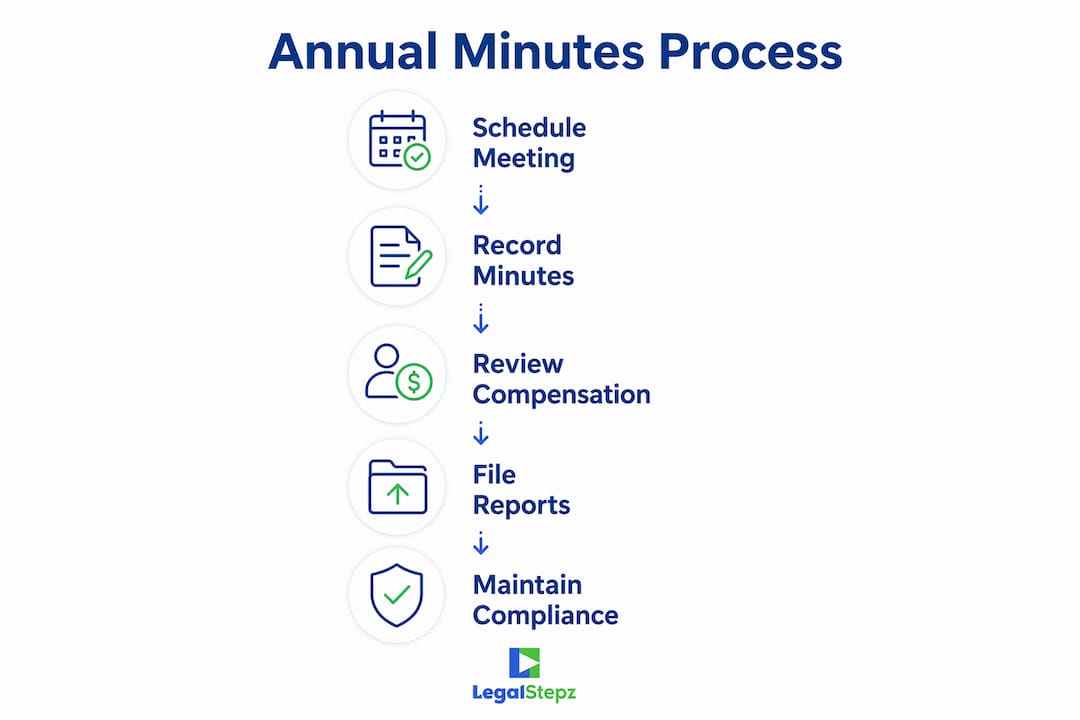
The practical steps for a solo owner to document annual minutes correctly are straightforward:
- Set a fixed date each year for your annual meeting, typically within the month after your fiscal year ends
- Prepare a written agenda covering officer elections, financial review, and any major decisions from the prior year
- Sign a written consent or hold a brief self-meeting and record the date, location, and decisions made
- Document resolutions in plain language, including any salary decisions, distributions, or major contracts approved
- Sign the minutes in your capacity as both director and officer, then file them in your corporate records binder
Many California entrepreneurs learn about annual meeting requirements only after a dispute arises. Getting ahead of this requirement costs almost nothing. Fixing the problem after litigation begins is a different matter entirely.
What should comprehensive annual minutes include?
Annual board meeting minutes are the most consequential records your organization produces each year. They require precise documentation of decisions, votes, and financial figures. Routine meeting minutes capture operational updates. Annual minutes capture the decisions that define the company's direction, leadership, and financial posture for the entire year ahead.
Core components every set of annual minutes must contain
Every complete set of annual minutes should record the names of all attendees, the date and location of the meeting, confirmation that a quorum was present, and a list of all resolutions passed with the vote count for each. Financial reports reviewed during the meeting should be referenced by name and date. Officer and director elections must be recorded with the names of those elected and the terms they will serve.
How minutes support business continuity and ownership transitions
Well-documented minutes improve accountability and directly support business continuity. When a business changes ownership, is acquired, or brings in investors, the buyer's attorney will conduct due diligence that includes a full review of corporate records. Gaps in the minutes history raise red flags that can delay a deal, reduce the purchase price, or kill the transaction entirely.
Annual minutes also have a wider audience than most owners realize. Auditors, lenders, regulators, and potential investors all review annual minutes when evaluating a business. A bank underwriting a commercial loan will often request the last two to three years of corporate minutes as part of the credit review. Clean, organized records signal that the business is governed professionally.
Pro Tip: Use a consistent template for every year's annual minutes. Consistency makes it easier for lenders, auditors, and attorneys to review your records quickly, and it reduces the chance that you accidentally omit a required element.
The table below outlines the difference between routine meeting minutes and annual meeting minutes:
| Element | Routine meeting minutes | Annual meeting minutes |
|---|---|---|
| Officer elections | Not required | Required every year |
| Financial report review | Optional | Required |
| Shareholder distributions | As needed | Required for S Corps |
| Accountable plan approval | As needed | Recommended annually |
| Audience | Internal only | Lenders, auditors, regulators |
| Legal weight | Moderate | High |
Keeping your business records current is one of the lowest-cost risk management practices available to a small business owner. The time investment is measured in hours per year. The protection it provides is measured in the full value of your personal assets.
Key Takeaways
Annual minutes are the legal backbone of your corporate protection, and skipping them puts your personal assets directly at risk.
| Point | Details |
|---|---|
| Corporate veil protection | Missing minutes give courts grounds to hold owners personally liable for business debts. |
| S Corp IRS compliance | Minutes must document officer salaries, distributions, and accountable plan terms to avoid reclassification. |
| Solo owner obligation | Single-member corporations must still hold formal meetings or sign written consents each year. |
| Annual vs. routine minutes | Annual minutes carry higher legal weight and serve lenders, auditors, and regulators, not just internal teams. |
| Business continuity | Clean minute records support ownership transitions, loan approvals, and investor due diligence. |
Annual minutes are stewardship, not paperwork
I have worked with California entrepreneurs across industries, and the pattern is consistent. Owners who treat annual minutes as a checkbox eventually face a moment when those records are the only thing standing between them and a personal financial loss. The ones who treat minutes as stewardship, as the company's institutional memory, never have that moment.
The mindset shift matters. Good record-keeping is stewardship that protects the business entity over its full life. When you document decisions formally, you are not doing busywork. You are proving that your company is real, governed, and worthy of the legal protections it was designed to receive.
The owners who skip minutes often tell me they were too busy. I understand that. But a two-hour annual records session is not a burden. It is the cheapest insurance policy your business can buy. Lenders notice clean records. Partners notice them. And courts absolutely notice when they are missing.
— Peter
How Legalstepz helps California businesses stay compliant
California's compliance requirements move fast, and keeping up with annual minutes on top of everything else a small business demands is a real challenge.

Legalstepz offers annual minutes drafting and corporate governance support built specifically for California entrepreneurs. The service covers the full picture: preparing annual minutes that meet California and IRS standards, filing statements of information, drafting bylaws, and providing registered agent services. Owners who use Legalstepz avoid the most common compliance gaps that lead to personal liability exposure and IRS scrutiny. Getting your records in order does not require a law firm retainer. It requires the right process, applied consistently every year.
FAQ
What are annual minutes for a corporation?
Annual minutes are formal written records of the decisions made at a corporation's yearly meeting, including officer elections, financial approvals, and major resolutions. They serve as legal evidence that the business operates as a separate entity from its owners.
Are annual minutes necessary for a single-owner LLC or corporation?
Yes. Even a sole owner must hold a formal meeting or sign a written consent each year. Skipping this step is a primary reason courts pierce the corporate veil and expose personal assets to business liabilities.
How do annual minutes help with IRS compliance?
The IRS reviews annual minutes to verify that S Corp officer compensation and distributions follow Subchapter S rules. Without documented resolutions, the IRS can reclassify distributions as wages and assess additional employment taxes and penalties.
How do you write annual minutes for a small business?
Record the meeting date, attendees, a quorum confirmation, all resolutions passed with vote counts, financial reports reviewed, and officer elections. Sign the minutes in your official capacity and store them in a dedicated corporate records binder.
What happens if a California business skips annual minutes?
Courts can treat the absence of minutes as evidence that the business and its owner are legally indistinguishable, removing personal liability protection. Lenders and investors may also flag missing records during due diligence, which can delay or block financing and ownership transitions.