

Legal compliance is the active practice of meeting all applicable laws, regulations, and internal policies that govern how your business operates. Understanding why business owners need legal compliance is not optional knowledge. It is the foundation of every decision that protects your assets, your employees, and your ability to stay open. Nearly 40% of small businesses struggle with regulatory compliance, often paying the price in fines and damaged reputations. The U.S. Small Business Administration, OSHA, and the IRS each enforce distinct requirements that touch every business, regardless of size or industry.
What key legal compliance requirements do business owners face?
Business legal requirements fall into two categories: external obligations and internal obligations. Both carry real consequences when ignored, and both require consistent attention.
External obligations are the requirements imposed by government agencies. These include:
- Registering your business entity with your state
- Obtaining an Employer Identification Number (EIN) from the IRS
- Filing state and federal tax returns on schedule
- Securing the correct business licenses and permits for your industry and location
- Renewing those licenses before expiration dates
Internal obligations are the requirements you owe to your own corporate structure. The SBA compliance guide identifies maintaining corporate records, including bylaws and annual meeting minutes, as a core requirement for any LLC or corporation. Skipping these steps is not a minor oversight. It can expose your personal assets to business debts, a legal concept called "piercing the corporate veil."
California is a strong example of how state-level complexity multiplies these demands. The state requires a Statement of Information filed with the Secretary of State, specific labor law postings, and industry-specific permits that vary by county. Choosing the wrong entity type in California can also trigger unexpected tax obligations. Legalstepz covers the full range of California entity types and their compliance implications in detail.

Compliance areas also extend to labor law (minimum wage, overtime, anti-discrimination), data protection (CCPA, HIPAA where applicable), and environmental rules for businesses that handle physical goods or waste.
Pro Tip: Set a master calendar at the start of each year listing every filing deadline, license renewal date, and required corporate meeting. Review it quarterly. Missing a single deadline can trigger penalties that cost far more than the filing fee itself.
What risks do business owners face without legal compliance?
Ignoring legal compliance does not simply create paperwork problems. The consequences are financial, operational, and personal.
- Monetary penalties. The IRS, state tax boards, and regulatory agencies all impose fines for late or missing filings. These fines compound over time and can reach amounts that threaten a small business's cash flow.
- License suspensions. Operating without a valid license can shut your business down immediately. Regulators do not always send warnings before suspending a license.
- Lawsuits and civil liability. Noncompliance with labor law, data protection rules, or contract requirements opens the door to employee lawsuits and class actions.
- Criminal charges. In cases involving tax fraud, environmental violations, or securities law, executives face personal criminal liability, not just corporate fines.
- Reputational damage. A public enforcement action or lawsuit signals to customers, partners, and investors that your business cannot be trusted.
Noncompliance consequences include all of the above, and they often arrive together. A single missed filing can trigger a cascade: a fine, a license review, and a news story.
"Many business owners incorrectly believe compliance is only about paying taxes. Internal record-keeping failures often lead to piercing the corporate veil, exposing personal assets to liability." — SBA Business Guide
The personal liability risk deserves special attention. When a court determines that an LLC or corporation failed to maintain proper records, it can hold the owner personally responsible for business debts. That means your personal bank accounts, home, and other assets are at risk. This is not a theoretical scenario. It happens to business owners who treat their corporate formalities as optional.
Reputational damage compounds the financial pain. Customers research businesses before buying. A public enforcement action or lawsuit appears in search results and review platforms. Rebuilding trust after a compliance failure costs far more than maintaining compliance in the first place.
How does embedding compliance as a strategy benefit your business?
Compliance is a strategic enabler, not just a cost center. Effective compliance management systems build trust with stakeholders and create sustainable business value. That is the shift every business owner needs to make: from viewing compliance as a burden to treating it as a competitive asset.
Here is what that shift produces in practice:
- Customer and investor confidence. Businesses with documented compliance programs signal reliability. Investors and lenders conduct due diligence before committing capital. A clean compliance record accelerates that process.
- Market access. Many government contracts, enterprise partnerships, and regulated industries require proof of compliance before you can even bid. Compliance opens doors that noncompliant competitors cannot enter.
- Lower insurance costs. Insurers price risk based on documented controls. A business with a formal compliance program typically qualifies for lower premiums on liability and directors-and-officers coverage.
- Operational efficiency. Compliance forces you to document processes, assign responsibilities, and review outcomes. Those habits reduce errors and improve accountability across the entire organization.
- Reduced enforcement risk. Proactive documented compliance reduces penalty severity when regulators do investigate. Courts and agencies treat businesses with active compliance programs more favorably than those with no program at all.
A culture of compliance also changes how your team behaves. Employees who feel safe reporting problems without fear of retaliation surface issues before they become enforcement actions. That early warning system is worth more than any single policy document.
Pro Tip: Assign a compliance owner inside your organization, even if it is you as the founder. Someone must be accountable for tracking changes in law, updating policies, and confirming that filings are submitted. Shared responsibility often means no responsibility.
What practical steps can business owners take to ensure ongoing compliance?
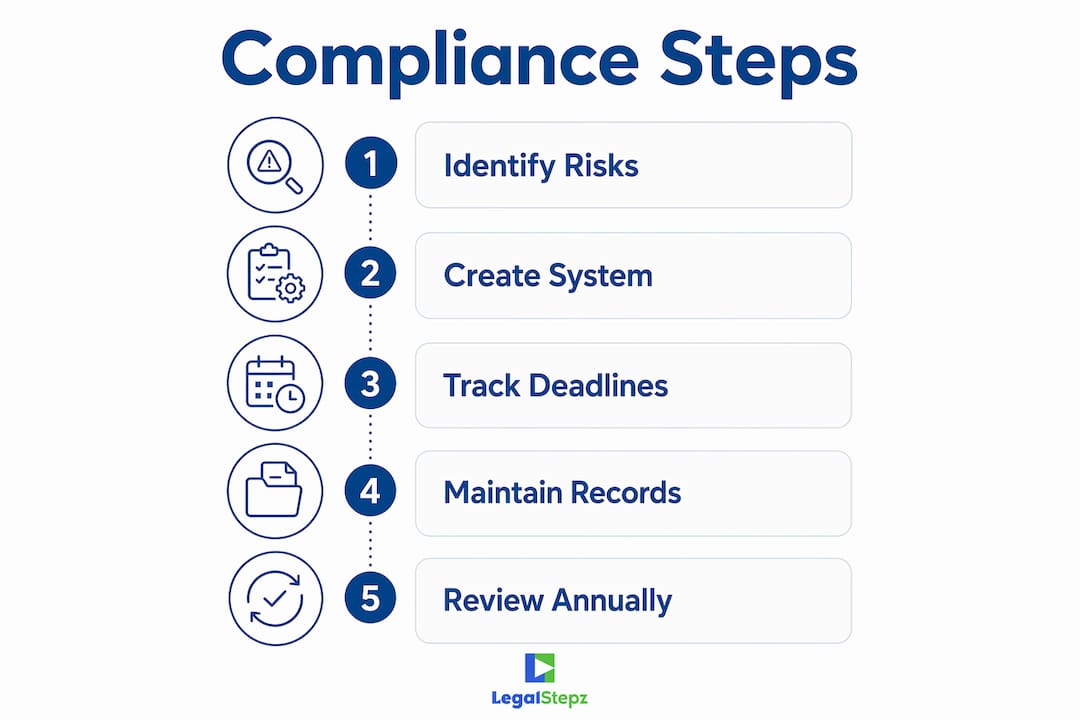
Building a compliance program does not require a legal department. It requires a system, consistent habits, and the right tools.
Build a compliance management system
A compliance management system (CMS) is the structured set of policies, procedures, and controls your business uses to meet its legal obligations. Regulators expect a CMS that is actively used, not just documented on paper. A CMS that exists only as a binder on a shelf will not protect you during an investigation.
Your CMS should cover:
- A written compliance policy tailored to your industry and entity type
- A schedule of all required filings, renewals, and internal meetings
- Assigned ownership for each compliance task
- A process for employees to report concerns without retaliation
- Regular reviews to update the program as laws change
Use technology to track deadlines
License renewal deadlines are one of the most common compliance failures for small businesses. Automatic renewals are rare. Most licenses expire on a fixed date, and the government does not send reminders. A centralized tracking tool, whether a dedicated compliance platform or a well-maintained calendar system, prevents accidental suspensions.
The table below compares two approaches to compliance tracking:
| Approach | Best for | Key advantage | Main risk |
|---|---|---|---|
| Manual calendar system | Solo owners, early-stage businesses | Low cost, easy to set up | Human error, easy to neglect |
| Dedicated compliance software | Growing businesses with multiple licenses | Automated alerts, audit trail | Requires setup and ongoing maintenance |
Maintain corporate records consistently
Annual meeting minutes, updated bylaws, and current registered agent information are not optional formalities. They are the evidence that your business structure is legitimate. Legalstepz provides running a business resources that walk you through exactly what records to maintain and when.
Conduct a compliance risk assessment at least once per year. Review any new laws in your state or industry, check that all licenses are current, and confirm that your corporate records are up to date. Pair that review with employee training so your team understands the rules that apply to their roles.
Key takeaways
Legal compliance is the single most effective way business owners protect their assets, maintain operations, and build long-term credibility with customers and investors.
| Point | Details |
|---|---|
| Compliance has two tracks | Meet both external filings and internal record-keeping requirements to stay fully protected. |
| Noncompliance carries personal risk | Failing to maintain corporate records can expose your personal assets through piercing the corporate veil. |
| Compliance builds competitive advantage | Documented programs attract investors, lower insurance costs, and open regulated markets. |
| A CMS must be actively used | Regulators penalize paper-only programs; your system must be practiced daily to count as a defense. |
| Technology prevents missed deadlines | Centralized tracking tools stop license suspensions caused by overlooked renewal dates. |
What I have learned after years of watching businesses get this wrong
Most business owners treat compliance as a finish line. They form the entity, get the EIN, file the first tax return, and consider the job done. That mindset is the single most common reason I see otherwise well-run businesses face avoidable penalties.
Compliance is a continuous process. Laws change. License categories expand. States add new reporting requirements with little notice. California alone has updated its LLC disclosure rules, wage theft prevention requirements, and data privacy obligations multiple times in the past three years. A business that was fully compliant in 2023 may have gaps today without anyone noticing.
The "set it and forget it" trap is especially dangerous with corporate records. I have seen business owners lose the liability protection of their LLC because they never held a single annual meeting or drafted a set of bylaws. The corporate veil exists to protect you, but courts will not honor it if you never treated your business like a separate legal entity.
Leadership tone matters more than any written policy. When founders and executives treat compliance as a priority, employees follow. When leadership cuts corners, the culture reflects that too. The businesses I have watched scale successfully all share one trait: the owner treats compliance as part of running the business, not as a task for someone else to handle someday.
Looking ahead to 2026 and beyond, regulatory expectations are rising, not falling. Data privacy, AI governance, and labor classification rules are all expanding. The business owners who build compliance habits now will adapt to those changes far more easily than those who are still catching up on the basics.
— Peter
How Legalstepz helps you stay compliant
Running a compliant business takes more than good intentions. It takes the right documents, filed correctly, on time.
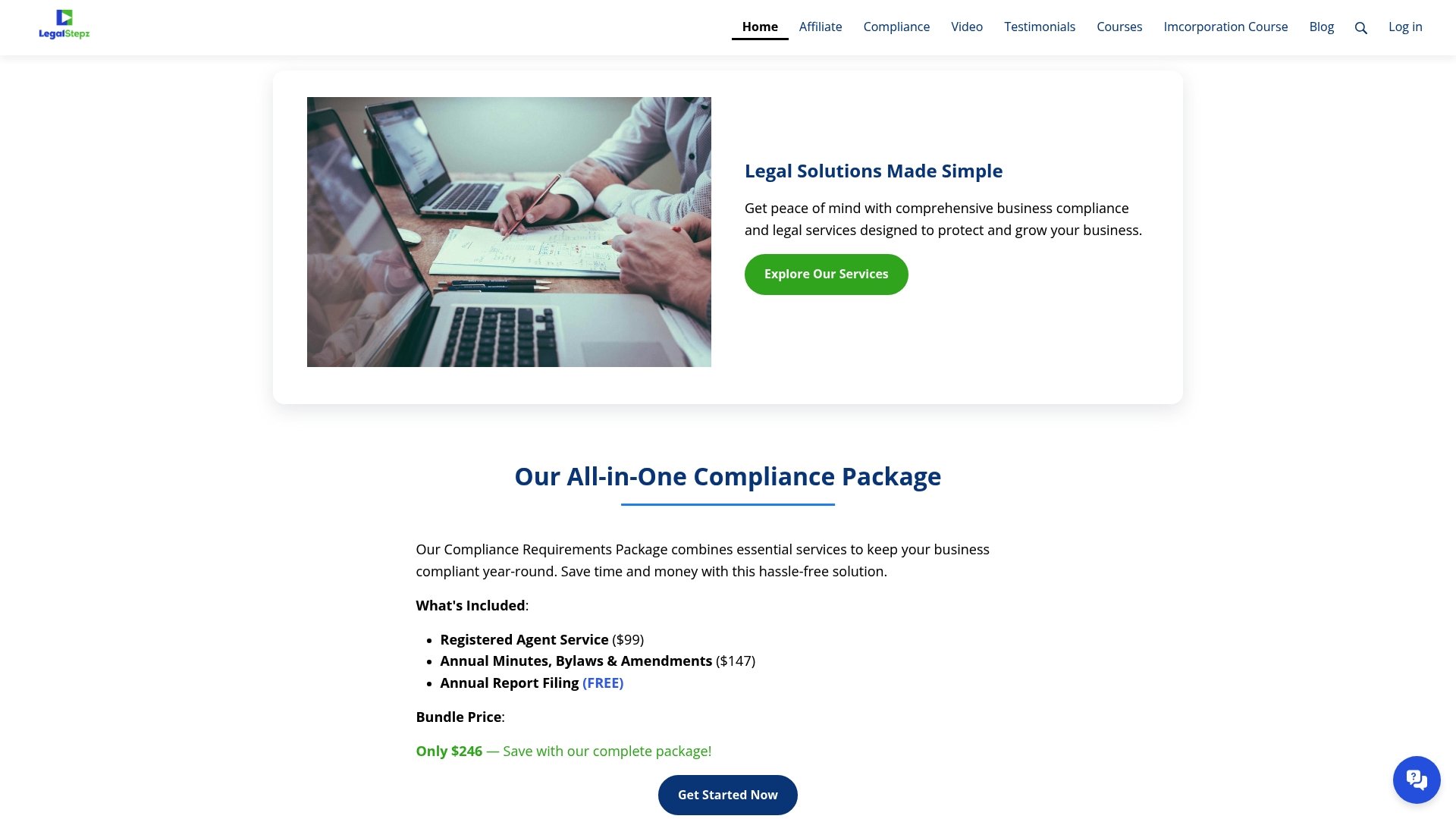
Legalstepz is built for business owners who want to handle their legal requirements without the overhead of a full legal team. From drafting annual meeting minutes and bylaws to filing your Statement of Information and providing registered agent services, Legalstepz covers the compliance tasks that protect your corporate structure. Start with the Incorporation Course to build a solid compliance foundation from day one, or explore the full Legalstepz platform to manage your ongoing filings and records in one place.
FAQ
What is legal compliance for a business?
Legal compliance is the practice of meeting all laws, regulations, and internal policies that apply to your business operations. It covers tax filings, licensing, labor law, data protection, and corporate record-keeping.
What happens if a small business ignores compliance requirements?
Noncompliance results in monetary fines, license suspensions, lawsuits, and in serious cases, criminal liability for business owners. Reputational damage often follows enforcement actions and is difficult to reverse.
How do I protect my personal assets as a business owner?
Maintain your corporate records, including bylaws and annual meeting minutes, to preserve the legal separation between you and your business. Failing to do so allows courts to pierce the corporate veil and hold you personally liable for business debts.
What is a compliance management system?
A compliance management system is a structured set of policies, procedures, and controls that a business uses to meet its legal obligations. Regulators evaluate whether the system is actively used, not just documented.
How often should a business review its compliance program?
Conduct a full compliance review at least once per year and after any significant change in law, business structure, or operating state. Quarterly check-ins on license renewal dates and filing deadlines reduce the risk of missed obligations.