

The SI-550 Statement of Information is a mandatory filing for California corporations to maintain accurate records with the Secretary of State and stay in good legal standing. Every domestic and registered foreign corporation operating in California must submit this form on a set schedule. Missing it triggers financial penalties and, eventually, suspension of your business. Understanding why California businesses file SI-550 is the first step to protecting your company from preventable legal problems.
Why California businesses file SI-550
California corporations file the SI-550 to keep the state's official records current and satisfy a direct legal requirement under California law. The Secretary of State uses this filing to track who runs each corporation, where it operates, and who can be served legal papers on its behalf. Without this information on file, the state has no reliable way to contact or regulate your business. The SI-550 is a governance filing, not a tax form. It has nothing to do with the Franchise Tax Board or your annual tax obligations.
The legal mandate behind SI-550 exists because California requires corporations to be transparent about their leadership and location. This protects creditors, customers, and courts who need to know who is responsible for a company's actions. Keeping that record accurate is your responsibility as a business owner, not the state's.

Who must file the SI-550 and when is it due?
California corporations, both domestic and registered foreign, are required to file the SI-550. LLCs and nonprofits file different forms, specifically the SI-200 and SI-100 respectively, so the SI-550 applies only to corporations.
The filing schedule works like this:
- Initial filing: Due within 90 days of formation, starting from the date of incorporation or registration.
- Subsequent filings: Required biennially, in the anniversary month of your incorporation year.
- No-change filings: If your business details have not changed, you can file a Statement of Information SI-550NC to satisfy the obligation at the same $25 fee.
- Foreign corporations: Registered foreign corporations follow the same biennial schedule as domestic corporations.
Missing the initial 90-day window is one of the most common mistakes new founders make. Many are focused on launching their product and assume compliance filings can wait. They cannot.
Pro Tip: Set a calendar reminder for your incorporation anniversary month every other year. Treat it the same way you treat a tax deadline.
What information does the SI-550 report require?
The SI-550 collects specific, current information about your corporation's leadership and location. The Secretary of State needs this data to maintain an accurate public record.
The form requires:
- Agent for service of process: The name and California street address of the person or registered agent authorized to receive legal documents on behalf of your corporation.
- Principal executive office address: The main address where your corporation conducts business, which can be outside California.
- Principal California office address: A California-specific address if your principal office is located outside the state.
- Officer names and addresses: The CEO, Secretary, and CFO must each be identified by name and business address.
- Director names and addresses: Every director on your board must be listed.
Every piece of information on the form must be accurate at the time of filing. Submitting outdated officer names or a wrong address does not satisfy the requirement and can create liability if legal notices go to the wrong place.
Pro Tip: Review your officer and director list before every filing cycle. Leadership changes are easy to overlook, and an outdated SI-550 can cause serious problems if your company is ever served with a lawsuit.
How SI-550 filing differs from paying California business taxes
This is where most founders get tripped up. The SI-550 and your annual franchise tax are two completely separate obligations managed by two different state agencies.
Many founders confuse the SI-550 with the annual franchise tax, which leads to unexpected delinquency notices from the wrong agency. Paying your taxes does not satisfy your SI-550 obligation. Filing your SI-550 does not satisfy your tax obligation. These are parallel tracks.
| Filing | Agency | Fee | Frequency |
|---|---|---|---|
| SI-550 Statement of Information | California Secretary of State | $25 | Biennial (every 2 years) |
| Annual Franchise Tax | California Franchise Tax Board | $800 minimum | Annual |
| Initial Franchise Tax | California Franchise Tax Board | $800 | First year of incorporation |
The $25 SI-550 filing fee is small compared to the $800 minimum annual franchise tax. That size difference is part of why founders sometimes overlook it. A small fee can feel optional. It is not.
Compliance experts note the importance of clearly separating governance filings like SI-550 from fiscal filings managed by the Franchise Tax Board. Tracking both the Secretary of State's SI-550 filings and the Franchise Tax Board's annual tax obligations is required to maintain Good Standing in California. Failures in either can compound penalties and suspension risks.
For a full breakdown of how these filing responsibilities divide between agencies, the 2026 California annual report guide covers both tracks in detail.
What are the penalties for failing to file SI-550?
The consequences of missing your SI-550 deadline escalate quickly. The state does not send multiple warnings before acting.
- $250 late penalty. The Secretary of State imposes a $250 penalty for failure to file on time. This is separate from any Franchise Tax Board penalties.
- Suspension of your corporation. Sustained failure to file leads to the Secretary of State suspending your corporation. Suspension is not a warning. It is an immediate change in your legal status.
- Loss of contract enforcement rights. A suspended corporation loses the ability to enforce contracts or engage in official corporate acts. You cannot sue, defend a lawsuit, or sign binding agreements on behalf of the company.
- Inability to conduct corporate actions. Board votes, stock issuances, and other formal corporate actions are legally questionable while suspended.
- Multi-agency revival process. Getting reinstated requires curing defaults with both the Secretary of State and the Franchise Tax Board. You must pay all outstanding penalties and file every missing Statement of Information before revival is granted.
Non-filing consequences are often underestimated. Suspension effectively paralyzes corporate legal capabilities, which can be catastrophic for businesses in the middle of a contract dispute or fundraising round. Avoiding this situation costs $25 and ten minutes of your time.
To understand how these penalties compare to LLC-specific compliance risks, the guide on avoiding California LLC penalties is worth reading alongside this one.
How to file the SI-550 using California's online portal
The California Secretary of State's online portal, bizfileOnline.sos.ca.gov, is the correct and only accepted method for filing the SI-550. Paper filings are no longer accepted.
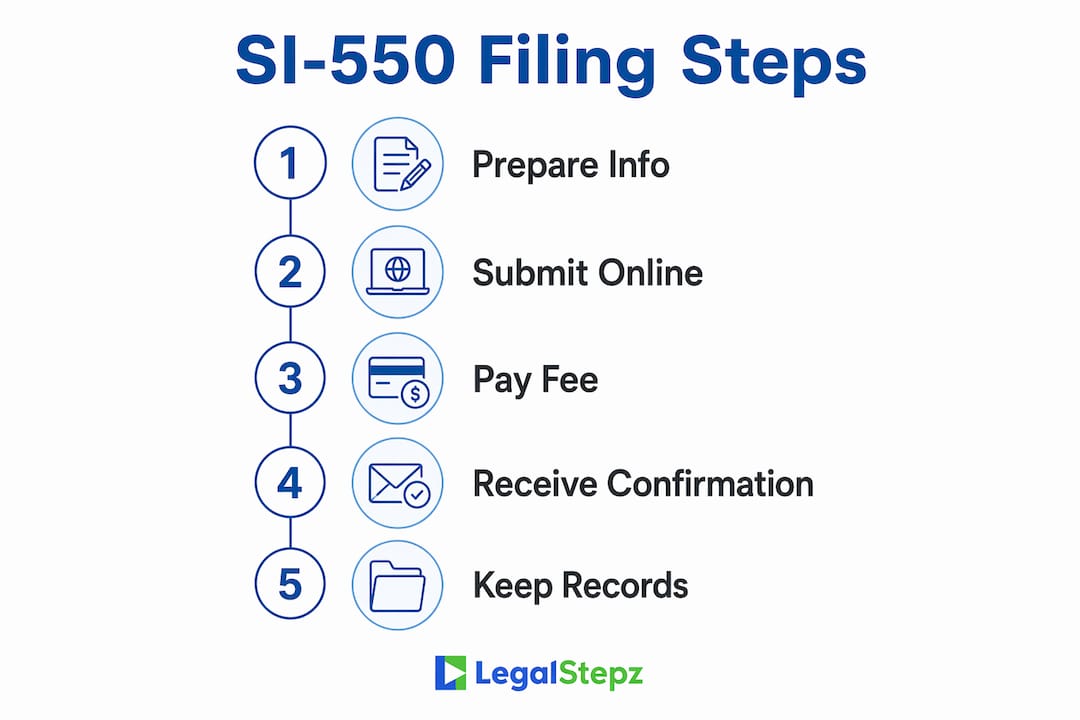
The filing process follows these steps:
- Log in or create an account on the bizfile portal using your corporation's information.
- Enter your entity ID. The portal now supports the new 12-character entity ID format starting with "B," which the state introduced in late 2025 to improve record standardization.
- Review and update your information. Enter current officer names, director names, addresses, and your agent for service of process.
- Pay the $25 filing fee by credit card through the portal's secure payment system.
- Download your confirmation receipt. The portal provides instant confirmation and an approved copy of your filing immediately after payment.
Business owners can complete the entire filing in under 10 minutes using the online portal. That speed makes it one of the least burdensome compliance requirements California imposes on corporations.
Pro Tip: Save your filing confirmation as a PDF and store it in a dedicated compliance folder. If your Good Standing status is ever questioned by a bank, investor, or court, that receipt is your proof.
For a detailed walkthrough of the full process, the step-by-step SI-550 guide on the Legalstepz blog covers each screen of the portal.
Key Takeaways
California corporations must file the SI-550 biennially with the Secretary of State to maintain Good Standing, avoid a $250 penalty, and prevent suspension that strips the company of its legal rights.
| Point | Details |
|---|---|
| SI-550 is a governance filing | It updates leadership and address records with the Secretary of State, not the Franchise Tax Board. |
| Initial filing deadline is 90 days | New corporations must file within 90 days of incorporation or face immediate penalties. |
| Biennial schedule applies after that | Subsequent filings are due every two years in your corporation's anniversary month. |
| Non-filing leads to suspension | A suspended corporation cannot enforce contracts, sue, or conduct formal corporate actions. |
| Online filing takes under 10 minutes | The bizfile portal accepts payment and issues instant confirmation for a $25 fee. |
What I've learned from watching California founders miss this filing
Most of the SI-550 compliance failures I see are not caused by negligence. They are caused by confusion. Founders assume that because they paid their $800 franchise tax, they are fully compliant. They are not. The Secretary of State and the Franchise Tax Board operate independently. Satisfying one does not satisfy the other.
The second pattern I see is founders who file their initial SI-550 correctly within the 90-day window and then forget the biennial cycle entirely. Two years pass, the anniversary month comes and goes, and the $250 penalty arrives before they realize anything is wrong. By the time suspension happens, the company is often in the middle of something critical: a contract negotiation, a bank loan application, or a funding round. That is the worst possible time to discover your corporation has lost its legal standing.
My advice is simple. Build SI-550 compliance into your annual calendar alongside your tax deadlines, even though it only files every two years. Treat it as a fixed operational task, not a one-time setup item. The bizfile portal makes the actual filing fast and straightforward. The hard part is remembering to do it. A two-minute calendar entry solves that problem permanently.
— Peter
How Legalstepz helps with California SI-550 filings
California compliance requirements are straightforward when you know what to do and when to do it. Legalstepz provides step-by-step guidance for completing and submitting your SI-550 Statement of Information correctly the first time.

Legalstepz handles the details that trip up busy founders: confirming your officer list is current, verifying your registered agent information, and walking you through the bizfile portal process. The goal is a clean filing with no errors and no missed deadlines. Visit Legalstepz to get filing support for your California corporation and keep your business in Good Standing year after year.
FAQ
What is the SI-550 form?
The SI-550 is the Statement of Information form that California corporations file with the Secretary of State to keep their official records current. It reports officer names, director names, addresses, and the agent for service of process.
How often do California corporations file the SI-550?
Corporations file the SI-550 biennially, in their anniversary month of incorporation. The initial filing is due within 90 days of formation.
What happens if a California corporation does not file SI-550?
Failure to file triggers a $250 penalty from the Secretary of State. Continued non-filing leads to suspension, which strips the corporation of its right to enforce contracts or defend lawsuits.
Is the SI-550 the same as paying the California franchise tax?
No. The SI-550 is filed with the Secretary of State for a $25 fee. The annual franchise tax is a separate $800 minimum payment made to the Franchise Tax Board. These are independent obligations.
Can I file the SI-550 on paper?
Paper filings are no longer accepted. All SI-550 filings must be submitted through the California Secretary of State's online portal at bizfileOnline.sos.ca.gov.