

California annual filings are mandatory submissions of updated business information that keep your company in good standing with state regulators. Every corporation, LLC, and nonprofit operating in California must comply with California filing requirements set by two agencies: the Secretary of State (SOS) and the Franchise Tax Board (FTB). Missing these filings triggers penalties, suspension, and loss of legal protections. Understanding why california requires annual filings is not optional knowledge for any serious business owner. It is the foundation of staying legally operational in the state.
What are california annual filings and who must file?
California annual filings cover two distinct obligations: the Statement of Information and the franchise tax payment. These are separate filings handled by different state agencies, and confusing them is one of the most common compliance mistakes California business owners make.
The Statement of Information is filed with the California Secretary of State. It updates the state's public records with your current business address, officer names, registered agent, and contact details. Corporations file annually, while California LLCs file biennially after an initial filing due within 90 calendar days of formation. That distinction matters because many LLC owners assume they follow the same schedule as corporations and miss their actual deadline.

The franchise tax is a separate payment made to the Franchise Tax Board. Every corporation and LLC registered in California owes an $800 minimum annual franchise tax, due by the 15th day of the 4th month of the taxable year. New corporations may qualify for a first-year exemption. New LLCs do not. That asymmetry catches many first-time LLC owners off guard.
Here is a quick comparison of the core filing obligations:
| Filing Type | Entity | Frequency | Fee | Penalty for Late Filing |
|---|---|---|---|---|
| Statement of Information | Corporation | Annual | $25 | $250 |
| Statement of Information | LLC | Biennial | $20 | $250 |
| Franchise Tax | Corporation | Annual | $800 minimum | 5% of unpaid tax |
| Franchise Tax | LLC | Annual | $800 minimum | 5% of unpaid tax |
| Initial Statement of Information | LLC | Within 90 days | $20 | $250 |
Pro Tip: Set two separate calendar reminders for your SOS filing and your FTB payment. They have different deadlines, different agencies, and different consequences. Treating them as one task is how businesses end up with double penalties.
Why does california require these annual filings?
California mandates these filings for three concrete reasons: public transparency, tax accountability, and legal integrity. Each reason has a direct impact on how your business operates and how protected you are as an owner.
State regulations prioritize public transparency through mandatory annual filings, ensuring business data accuracy for stakeholders. That means anyone, including potential partners, lenders, or customers, can look up your business on the SOS website and verify that it is active, who runs it, and how to contact it. Outdated records damage trust before a conversation even starts.
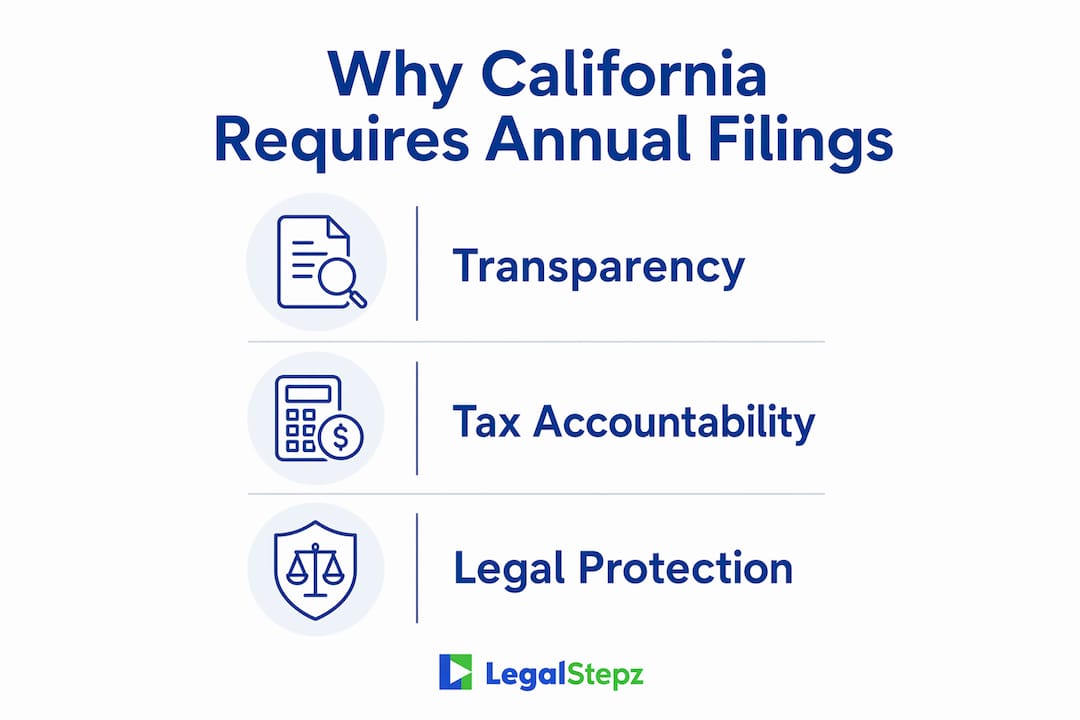
Tax accountability is the second driver. The FTB uses filing data to assess minimum franchise tax obligations and verify that businesses are paying what they owe. California generates significant revenue from business taxes, and the annual filing cycle is the mechanism that keeps that system functioning. Without it, the state would have no reliable way to track active businesses versus dissolved ones.
The third reason is legal protection for you personally. Maintaining required corporate records protects the corporate veil, the legal boundary between your personal assets and your business debts. When you skip filings, that boundary weakens. Courts have ruled that failure to observe corporate formalities, including timely filings, is grounds for piercing the corporate veil and holding owners personally liable. Annual filings are not just paperwork. They are a legal shield.
What happens if you miss california's filing requirements?
The consequences of noncompliance with California filing requirements escalate quickly. What starts as a missed deadline becomes a legal and financial problem within months.
Here is what you face when you fail to file:
- $250 penalty for a late or missing Statement of Information, applied immediately regardless of how long you have been in business
- Franchise tax penalties of 5% of the unpaid tax amount, plus interest that compounds over time
- Suspension or forfeiture of your business entity by the Secretary of State, which means you legally cannot operate, sign contracts, or sue to enforce agreements
- Loss of the corporate veil, exposing your personal assets to business creditors and lawsuits
- Damaged credit and loan eligibility, since lenders verify good standing before approving financing
Missing filings exclude businesses from good standing, which directly impacts financing, legal contracts, and operational credibility. A suspended LLC cannot enforce a contract in California court. That means if a client refuses to pay you, you may have no legal recourse until you reinstate the business and pay all back fees and penalties.
Reinstatement is possible but expensive and time-consuming. You must file all overdue statements, pay all penalties, and submit a separate application for reinstatement. The SOS does not fast-track these requests. The smarter path is to never miss the deadline in the first place.
How to manage california annual filings and stay compliant
Staying current with annual business filings in California requires a system, not just good intentions. The California SOS does not always send automated reminders for biennial Statements of Information. The burden of tracking deadlines falls entirely on you.
Follow these steps to build a reliable compliance process:
- Record your formation date. Your initial Statement of Information deadline is 90 calendar days from that date. Your biennial filing window opens 2 months before your anniversary month and closes on the last day of that month.
- Separate your SOS and FTB obligations. File your Statement of Information at bizfile.sos.ca.gov. Pay your franchise tax obligations at ftb.ca.gov. These are two different portals, two different deadlines, and two different agencies.
- Set calendar alerts 60 days out. The filing window opens 2 months before your anniversary month. Use that window. Filing early eliminates the risk of a last-minute technical issue causing a missed deadline.
- Keep your registered agent current. If your registered agent's address changes and you do not update your Statement of Information, official state notices go to the wrong address. You may not learn about a suspension until it is too late.
- Use a compliance service for growing businesses. As your business adds employees, locations, or revenue, tracking multiple filing deadlines manually becomes a liability. Services like Legalstepz handle Statement of Information preparation, registered agent updates, and deadline reminders so nothing slips.
A common misconception is that the Statement of Information and the franchise tax are the same filing. They are not. The Statement of Information is filed with the SOS, while the franchise tax is paid to the FTB. Conflating them leads to missed deadlines at one agency while the other is handled correctly.
Pro Tip: When you form a California LLC, note the exact formation date in a shared document or calendar that every key person in your business can access. One missed handoff when a founder leaves can wipe out years of clean compliance history.
Key takeaways
California annual filings are a legal requirement that protects your business standing, your personal assets, and your ability to operate in the state.
| Point | Details |
|---|---|
| Two separate filings exist | The Statement of Information (SOS) and franchise tax (FTB) have different deadlines and agencies. |
| LLCs file biennially, corporations annually | Know your entity type to track the correct filing frequency and avoid missed deadlines. |
| The $800 franchise tax applies to all | Every California LLC and corporation owes $800 minimum annually, with no first-year waiver for LLCs. |
| Noncompliance risks suspension | A missed filing can result in a $250 penalty, business suspension, and loss of contract rights. |
| Deadline tracking is your responsibility | The SOS does not reliably send reminders, so a personal calendar system is the only reliable safeguard. |
What years of watching california filings taught me
I have worked with California business owners long enough to see the same mistake repeat itself with painful consistency. A founder launches an LLC, handles the initial paperwork correctly, then completely forgets that the biennial Statement of Information exists. Two years later, they discover their business has been suspended, often when a bank flags it during a loan review or a client's attorney runs a good standing check before signing a contract.
The frustrating part is that the fix is simple. A single calendar reminder, set on the day of formation, prevents the entire chain of consequences. Yet most entrepreneurs treat compliance as something to handle reactively, after a problem surfaces. California's regulatory structure does not reward that approach.
What I have also seen is that the corporate veil argument is not theoretical. These filings are legal safeguards that prevent creditors from pursuing owners personally by ensuring continued corporate formalities. I have seen business owners lose personal assets in disputes that should have been limited to the business entity, simply because they could not demonstrate consistent compliance with state filing requirements. That is a hard lesson that no one should learn firsthand.
My honest advice: treat your annual filings the same way you treat your tax return. Put them on the calendar, assign ownership to a specific person, and verify completion. If your business is growing past the point where you can track this manually, bring in a compliance service before you miss a deadline, not after.
— Peter
How Legalstepz helps you stay compliant
California's filing requirements are manageable when you have the right support in place. Legalstepz specializes in exactly the tasks that trip up busy business owners.
Legalstepz handles Statement of Information preparation and filing, registered agent services, annual minutes drafting, and bylaw preparation for California businesses. The team tracks your deadlines so you do not have to rely on memory or hope that the SOS sends a reminder. Whether you are filing for the first time or catching up after a lapse, Legalstepz provides the structure to keep your business compliant with California corporate regulations year after year. For business owners who want to understand the full picture from formation to ongoing compliance, the Incorporation Course covers every filing obligation in plain language.
FAQ
What is the statement of information in california?
The Statement of Information is a filing submitted to the California Secretary of State that updates your business's address, officer names, and registered agent. Corporations file it annually; LLCs file it biennially after an initial filing within 90 days of formation.
How much is the california franchise tax for an LLC?
Every California LLC owes a minimum of $800 per year in franchise tax, paid to the Franchise Tax Board. Unlike corporations, LLCs do not receive a first-year exemption, so the payment is due from the moment the business is formed.
What happens if i miss my statement of information deadline?
A late filing triggers a $250 penalty and can result in suspension or forfeiture of your business by the Secretary of State. A suspended business cannot legally operate, sign contracts, or pursue legal action in California courts.
Are the statement of information and franchise tax the same filing?
No. The Statement of Information is filed with the Secretary of State, while the franchise tax is paid to the Franchise Tax Board. They have separate deadlines, separate portals, and separate penalty structures. Treating them as one obligation is a common and costly mistake.
Does california send reminders for annual filings?
The California SOS does not reliably send automated reminders for Statements of Information. Tracking your own deadlines through a personal calendar system or a compliance service like Legalstepz is the only dependable way to avoid missing your filing window.