

If you own a California corporation and you've received a notice about a Statement of Information, you may have assumed it was another tax bill. You'd be in good company. Many California business owners confuse biennial filings with tax obligations, and that confusion costs them. Understanding why corporations file biennial statements is not just a compliance checkbox. It's the difference between a corporation that can sign contracts, secure loans, and operate freely, and one that gets suspended by the state with no warning.
Table of Contents
- Key takeaways
- Why corporations file biennial statements: the legal foundation
- The real reasons corporations must file: compliance and consequences
- California vs. other states: how biennial filing rules compare
- How to file your California biennial statement correctly
- My take on why this filing matters more than most owners realize
- How Legalstepz helps you stay compliant
- FAQ
Key takeaways
| Point | Details |
|---|---|
| Not a tax filing | The biennial Statement of Information is separate from the $800 Franchise Tax and serves a recordkeeping function. |
| Legal authority is clear | California Corporations Code § 1502 requires corporations to file, with the first SOI due within 90 days of formation. |
| Non-filing has real consequences | Missing your filing window can trigger a $250 penalty, loss of good standing, and suspension of your corporation. |
| Other states have similar rules | New York requires biennial filings too, with nonfiling blocking certain business transactions. |
| Filing protects your operations | Current records protect against default judgments and keep your registered agent and address legally valid. |
Why corporations file biennial statements: the legal foundation
The California Statement of Information (SOI) is a periodic filing that updates your corporation's public record with the Secretary of State. It is not a tax return. It does not calculate what you owe the government. Its sole purpose is to keep official state records accurate and current.
The legal authority comes directly from California Corporations Code § 1502, which requires every domestic and foreign corporation doing business in California to file this statement on a regular schedule. Your first SOI is due within 90 days of your corporation's formation. After that, you file every two years during a six-month window that corresponds to your original formation month.
Here is what the Statement of Information actually captures:
- Registered agent name and address: The person or entity authorized to receive legal documents on your behalf
- Principal office address: Where your corporation physically operates
- Officers and directors: Names and addresses of the people running your company
- Business activity: A brief description of what your corporation does
- Mailing address: If different from the principal office
Pro Tip: Even if nothing has changed in your corporation since your last filing, you are still required to submit the SOI. The state does not assume continuity. You must confirm it.
The SOI is distinct from tax reporting obligations. California LLCs pay an $800 Franchise Tax annually, and that fee is completely separate from the $20 SOI filing fee. Treating them as the same thing is one of the most common and costly mistakes California business owners make. You can file your SOI through the California Secretary of State's BizFile online portal, and the process takes under 15 minutes when your information is ready.
The real reasons corporations must file: compliance and consequences
The benefits of biennial filings go well beyond satisfying a government form requirement. Biennial statements maintain current public-facing corporate data relied on by banks, counterparties, and regulators. When a lender wants to verify your corporation before approving a loan, they check the Secretary of State's database. When a vendor wants to confirm you're a legitimate entity before signing a contract, they check the same place. Outdated or missing records create friction at exactly the wrong moment.
Here is what is actually at stake when you skip your biennial filing:
- Loss of good standing: Your corporation can be suspended or face forfeiture if the SOI is not filed on time
- Blocked transactions: A suspended corporation cannot legally enter into contracts, open bank accounts, or pursue litigation
- Late penalties: California assesses a $250 penalty after a 60-day grace period for late SOI filings
- Default judgment risk: If your registered agent information is outdated, legal notices may not reach you, and a court can enter a judgment against your corporation without your knowledge
- License complications: Certain state and local business licenses require proof of good standing, which depends on current SOI filings
The purpose of biennial statements is not punitive. The state wants accurate records because periodic filings are gates to legal and operational privileges for corporations. Think of your SOI as the metadata layer of your business. It tells the world who is responsible for this entity, where to find them, and what the entity does. When that metadata goes stale, your corporation starts to look unreliable to the institutions and partners you need most.
Pro Tip: Set a calendar reminder six months before your filing window opens. This gives you time to confirm your registered agent is still active, verify officer addresses, and file without rushing.
The annual requirements to maintain good standing in California involve multiple obligations, and the SOI is one of the most overlooked. Entrepreneurs often focus on taxes and payroll while letting recordkeeping filings slip. That is a mistake with compounding consequences.

California vs. other states: how biennial filing rules compare
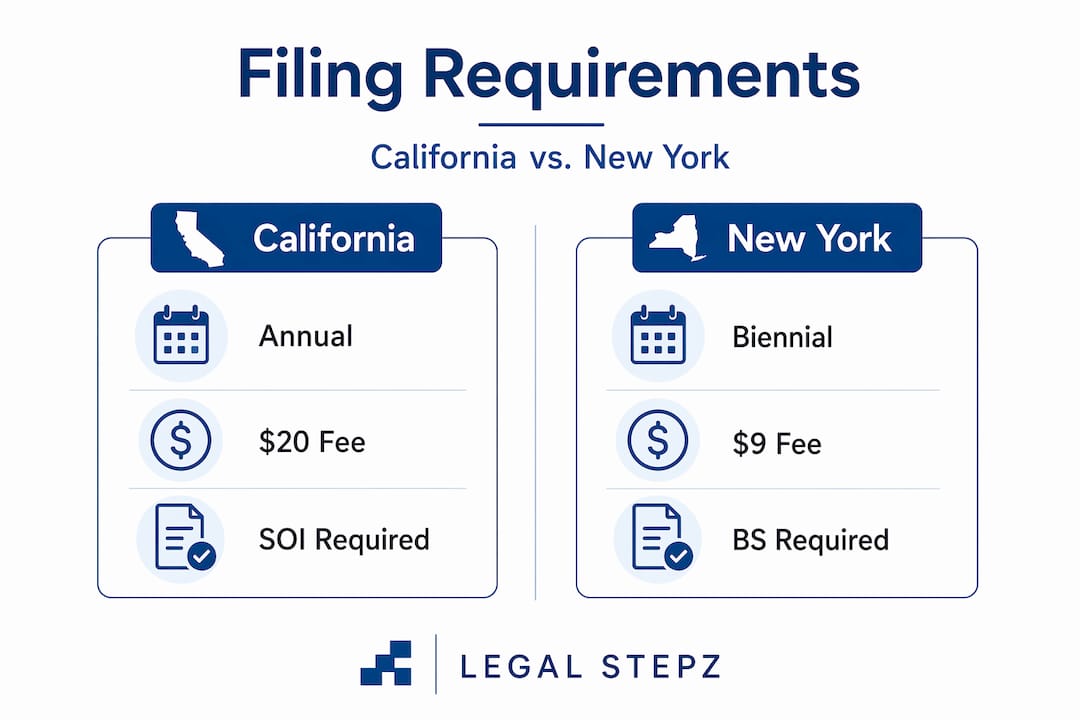
California is not unique in requiring periodic corporate filings, but the specifics matter. Understanding how your state compares to others helps you appreciate the structure of the requirement and avoid confusion if you operate in multiple states.
| State | Filing frequency | Fee | Filing window | Penalty for nonfiling |
|---|---|---|---|---|
| California (corporations) | Annual (SOI) | $25 | 6-month window tied to formation month | $250 penalty, suspension |
| California (LLCs) | Biennial (SOI) | $20 | 6-month window tied to formation month | $250 penalty, suspension |
| New York (corporations) | Biennial | $9 | Calendar month of original filing anniversary | Blocked transactions |
| New York (LLCs) | Biennial | $9 | Calendar month of original filing anniversary | Blocked transactions |
In New York, business corporations must file a Biennial Statement every two years during their original filing month. The fee is low at $9, but the consequences of nonfiling are significant. Failing to file can block the corporation's ability to complete business transactions, which mirrors the operational consequences California imposes through suspension.
Annual report requirements vary by state, with some requiring annual filings and others biennial. Fees range from under $10 to over $500 depending on the state and entity type. What stays consistent across all of them is the core purpose: keeping public corporate records accurate so that governments, banks, and business partners can rely on them.
For California business owners with operations in New York or other states, this means you may have multiple filing deadlines on different schedules. Missing one because you confused it with another is a real risk. Tracking each state's requirements separately is not optional. It is part of operating a multi-state corporation responsibly.
How to file your California biennial statement correctly
Getting this right is straightforward once you know the process. Here is how to handle your California SOI filing from start to finish:
- Confirm your filing window. Your six-month window opens on the first day of the month that matches your corporation's formation month, every two years. If your corporation was formed in March 2024, your next window opens March 1, 2026.
- Gather your information. Collect your registered agent's name and address, your principal office address, and the names and addresses of all current officers and directors.
- Log in to BizFile. Go to the California Secretary of State's BizFile portal and locate your corporation by name or entity number.
- Complete the SOI form. Fill in all required fields. Even if nothing has changed, you must confirm the existing information is accurate.
- Pay the $20 filing fee. Payment is processed online. Keep your confirmation number as proof of filing.
- Store your confirmation. Save a copy of the filed statement and confirmation for your corporate records.
Common mistakes to avoid include missing the initial 90-day deadline after formation, assuming your accountant handles this as part of tax preparation (they usually do not), and failing to update your registered agent when you change service providers.
Pro Tip: If you miss your filing window and your corporation gets suspended, you can apply for reinstatement through the Secretary of State. You will need to file the overdue SOI, pay all penalties, and submit a separate reinstatement application. The process works, but it takes time and costs more than simply filing on schedule.
Understanding the California Statement of Information requirements in detail before your deadline is far better than learning them after a suspension notice arrives. The costs to form and maintain an LLC or corporation in California include these recurring compliance fees, and budgeting for them from day one removes any surprise.
My take on why this filing matters more than most owners realize
I've worked with enough California business owners to know that the biennial Statement of Information rarely gets the attention it deserves until something goes wrong. A client once tried to close a commercial real estate deal only to discover their corporation had been suspended for two years because the SOI was never filed after formation. The deal nearly collapsed. The reinstatement process took three weeks and cost far more in attorney fees than the original $20 filing would have.
What I've learned is that entrepreneurs treat biennial statements as administrative noise. They're focused on revenue, hiring, and product. A state filing that doesn't feel like it generates anything tangible gets pushed to the back of the queue. That framing is the problem.
Periodic filings keep official records current regardless of operational changes. Your registered agent address is not just a formality. It is the legal channel through which courts, regulators, and creditors communicate with your corporation. When that channel goes dark because you didn't file, you lose legal visibility at the exact moments when visibility matters most.
My advice is to treat your biennial SOI the same way you treat renewing your business insurance. You don't skip insurance because nothing bad happened last year. You maintain it because the cost of not having it when you need it is catastrophic. File on time, keep your records current, and let your corporation operate without unnecessary legal exposure.
— Peter
How Legalstepz helps you stay compliant
Staying on top of corporate filing requirements is easier when you have the right support from the start. Legalstepz offers practical guidance for California business owners who want to understand their biennial filing obligations and meet them without stress.

Whether you are forming a new corporation or catching up on missed filings, Legalstepz provides the tools and education you need to keep your business in good standing. The LLC compliance course covers biennial filing requirements, registered agent obligations, and the full scope of what it takes to maintain a legally sound California entity. You get step-by-step guidance without the legal jargon, so you can file confidently and on time. Avoid the $250 penalty, protect your good standing, and keep your corporation ready for every contract, loan, and transaction that comes your way.
FAQ
What is a biennial statement for a California corporation?
A biennial Statement of Information is a periodic filing required by California Corporations Code § 1502 that updates the state's records with your corporation's registered agent, officers, directors, and business address. It is not a tax return and is filed separately from any tax obligations.
What happens if a California corporation doesn't file its SOI?
California assesses a $250 penalty after a 60-day grace period and can suspend or forfeit your corporation, blocking it from entering contracts, filing lawsuits, or completing business transactions until reinstated.
How is the biennial statement different from the Franchise Tax?
The $20 SOI filing fee and the $800 California Franchise Tax are completely separate obligations. The SOI maintains your public corporate records, while the Franchise Tax is a state tax on business income and privilege.
How often do California corporations file a Statement of Information?
California corporations file a Statement of Information annually, not biennially. California LLCs file biennially. Both have a six-month filing window tied to the entity's original formation month.
Do other states require biennial statements too?
Yes. New York requires corporations and LLCs to file a Biennial Statement every two years during their original filing month, with nonfiling potentially blocking certain business transactions.