

Corporations maintain corporate records to protect their legal standing, preserve limited liability, and prove compliance with IRS and state law. Without documented evidence of decisions, ownership, and financial activity, a corporation risks losing the very protections that make the corporate structure worth using. Here is what that means in practice:
- Legal compliance: State corporation laws and IRS requirements mandate specific records, including minutes, shareholder registers, and financial statements.
- Liability protection: Documented corporate formalities separate personal assets from business obligations, preserving the corporate shield.
- Accountability: Records prove that boards and shareholders acted within their authority and followed company bylaws.
- Business operations: Accurate records support audits, investor due diligence, and lender reviews.
- Litigation defense: Up-to-date documentation reduces exposure in regulatory investigations and legal disputes.
What corporate records are and what they typically contain
Corporate records are the official documents that capture a company's legal existence, governance decisions, ownership structure, and financial activity. Think of them as the paper trail that proves your corporation is real, compliant, and properly run.
The core documents fall into four functional categories:
- Governance records: Articles of incorporation, bylaws, board and shareholder meeting minutes, and written resolutions.
- Ownership records: Stock ledgers, stock certificates, capitalization tables, and records of transfers.
- Compliance records: State filings, registered agent designations, annual reports, and licenses.
- Financial records: Tax returns, financial statements, bank records, and records of major transactions.
These documents do not stay static. As your business grows, takes on investors, changes officers, or navigates regulatory shifts, the record book expands. Centralizing records in a secure digital or physical corporate record book keeps everything accessible and consistent, especially as the regulatory environment grows more complex. A corporation that cannot produce its own bylaws during a dispute or a board resolution during due diligence has a real problem, and it is a preventable one.
Why corporate records are so important
The most direct reason to maintain corporate records is to keep the corporate shield intact. Courts can pierce the corporate veil and hold shareholders personally liable when a company fails to observe basic corporate formalities. Documented minutes, resolutions, and ownership records are the evidence that those formalities were followed.
Beyond liability protection, records serve several other critical functions:
- Governance proof: They demonstrate that directors fulfilled their fiduciary duties and that decisions were made through proper processes.
- Risk management: Documented conflict-of-interest disclosures and board deliberations reduce exposure to shareholder claims.
- Transaction readiness: Investors and lenders review corporate records during due diligence; missing or incomplete records can delay or kill a deal.
- Regulatory defense: Regulators examining potential compliance failures will request these records first.
- Stakeholder confidence: Transparent, well-organized records signal that leadership runs the company with discipline.
Corporate records also function as strategic governance assets, documenting the rationale behind decisions and enabling sustainable growth. A board that records not just what it decided but why it decided it is far better positioned to defend those decisions later.
What U.S. law requires for corporate record-keeping

Every U.S. state has its own corporation statute specifying which records must be kept and for how long; for guidance on compliance and records retention policies relevant to international business, see Israeli Legal Compliance For English-Speaking Clients. The IRS adds a separate layer of federal requirements tied to tax compliance. Together, these rules create a mandatory floor that no corporation can ignore.
Key legal requirements include:
- Articles of incorporation and bylaws: Required to be maintained for the life of the corporation under virtually every state statute.
- Board and shareholder minutes: Mandated by state law; Delaware's General Corporation Law (Title 8) and California Corporations Code Section 1500 both require corporations to keep minutes of all meetings.
- Stock registers: A complete record of all shareholders, share classes, and transfers is a statutory requirement in every state.
- Financial statements: The SEC requires public companies to retain audit-related records; private companies face state-level requirements.
- Tax records: The IRS audit window is generally three years, extending to six years when income is substantially underreported.
Failure to maintain required records can trigger penalties, expose the corporation to heightened scrutiny during audits, and strip away the liability protections that justify the corporate structure in the first place.
| Record type | Governing authority | Requirement |
|---|---|---|
| Articles of incorporation | State corporation law | Permanent retention |
| Board and shareholder minutes | State law (e.g., Delaware Title 8, CA Corp. Code §1500) | Permanent or life of corporation |
| Tax and financial records | IRS | 3–7 years depending on issue type |
| Audit-related records | SEC (public companies) | Varies by rule |
| Licenses and regulatory orders | 18 CFR § 368.3 | 6 years after final non-appealable order |
How long corporations must keep their records
There is no single universal retention period. The right answer depends on the document type, the industry, and the applicable law.
A practical framework:
- Permanent retention: Formation documents (articles of incorporation, bylaws, stock certificates), ownership records, and board minutes should never be destroyed.
- 7 years: Tax returns, financial statements, and records supporting deductions. The IRS audit window is generally three years but can extend up to six years for substantial underreporting, so seven years is the standard safe harbor.
- 3–7 years: General contracts, correspondence, and routine financial records.
- Industry-specific: HIPAA requires healthcare entities to retain certain records for six years from creation or last effective date. Personnel records carry their own timelines under federal and state employment law.
Under 18 CFR § 368.3, deeds, leases, and property-related contracts must be kept for six years after the property is disposed of, and service contracts must be retained until any related disputes are fully resolved.
| Document type | Recommended retention |
|---|---|
| Articles of incorporation / bylaws | Permanent |
| Board and shareholder minutes | Permanent |
| Tax returns and supporting records | 7 years |
| General contracts | 3–7 years |
| Healthcare records (HIPAA) | 6 years |
| Property deeds and leases | 6 years after disposal |
| Service contracts | Until disputes resolved |
A formal records retention policy removes the guesswork. It builds consensus across departments on what to keep, how long to keep it, and when disposal is defensible.
Who is responsible for maintaining corporate records
Responsibility for corporate records does not fall on one person. It is distributed across the organization, with specific roles carrying specific duties.
- Corporate secretary or designated officer: The primary custodian of the minute book, stock ledger, and official filings. In smaller corporations, this is often the CEO or a founding officer.
- Board of directors: Responsible for approving minutes and resolutions, and for overseeing that recordkeeping obligations are met.
- Shareholders: Hold inspection rights under state law, which creates an accountability check on whether records actually exist and are current.
- Legal counsel: Reviews records for compliance gaps, especially before transactions or regulatory reviews.
- Third-party service providers: Registered agents, compliance services, and platforms like Legalstepz assist with filing annual minutes, drafting bylaws, and maintaining registered agent designations.
Negligence by any of these parties creates gaps that surface at the worst possible time, typically during litigation, an audit, or a funding round. Shared accountability is not a nice idea; it is how compliant corporations actually operate.
Best practices for managing corporate records
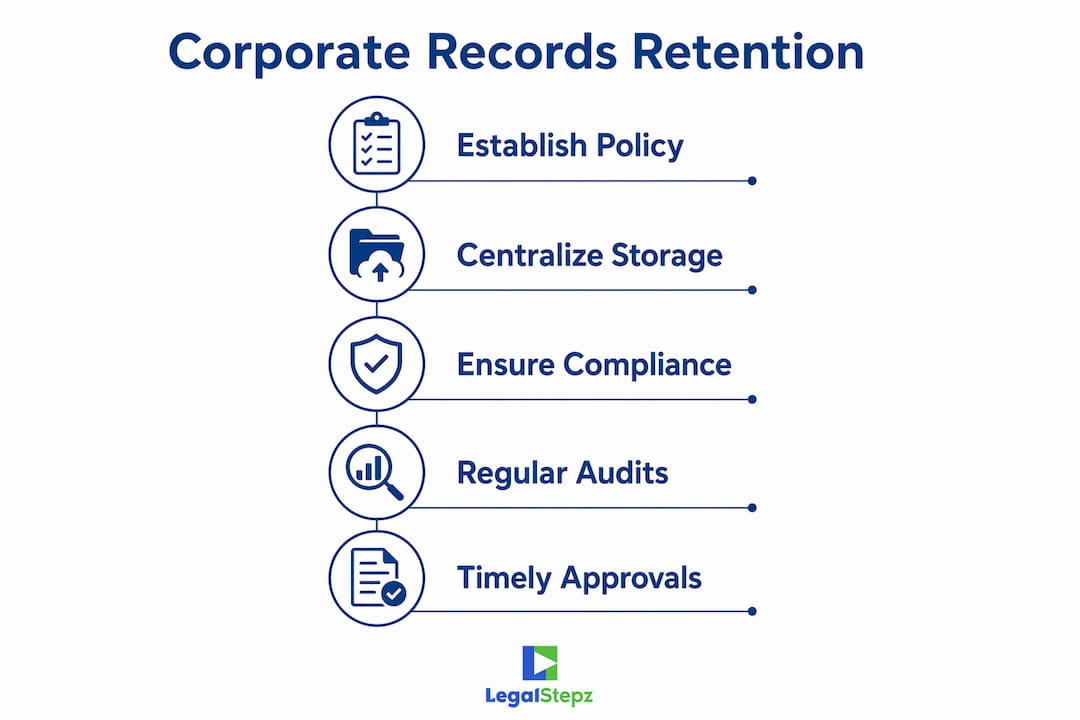
Build a formal records retention policy first. Without one, decisions about what to keep and what to discard are made ad hoc, which creates both gaps and unnecessary clutter. A good policy distinguishes high-value governance records from routine operational documents and sets clear timelines for each category.

Centralize everything in a secure system. Physical binders work for small corporations, but digital repositories with controlled access and version tracking are far more practical as the company grows. The goal is that any authorized person can find any record within minutes, not hours.
Approve minutes at meetings, not months later. Courts treat timely board minutes as credible evidence of good-faith deliberation. Minutes drafted and approved in bulk after a transaction closes, or worse, after a complaint is filed, carry far less weight with judges. The habit of approving minutes while the meeting is fresh is one of the highest-value practices a board can adopt.
Use a compliance calendar. Recurring deadlines, state annual report filings, registered agent renewals, and shareholder meeting requirements are easy to miss without a system. Legalstepz offers registered agent services and statement of information filing support to keep these obligations on track.
Pro Tip: Document not just what the board decided, but why. Courts and regulators are far more interested in the reasoning behind a decision than the outcome. A minute that records the factors the board weighed, the alternatives it considered, and the advice it received is a far stronger legal shield than one that simply states the vote.
What happens when corporations fail to maintain records
The consequences of poor recordkeeping are not abstract. They show up in concrete, costly ways.
Piercing the corporate veil is the most severe outcome. When a corporation cannot demonstrate that it observed corporate formalities, courts may hold shareholders personally liable for corporate debts. This eliminates the primary reason most business owners choose the corporate structure.
IRS penalties and audit exposure increase when financial records are incomplete or missing. The IRS can extend its audit window and draw adverse inferences from gaps in documentation.
Litigation disadvantage is another direct cost. When formal records do not exist, courts allow plaintiffs to pursue broad discovery of informal communications like emails and text messages. That exposure is expensive and unpredictable. Formal documented board minutes serve as a shield against exactly this kind of intrusive discovery.
Failed transactions are a quieter but equally damaging consequence. Investors and lenders conduct due diligence before closing deals, and missing records can delay or derail a transaction entirely.
Regulatory penalties from state agencies for failure to file required documents, maintain a registered agent, or keep a current shareholder register can result in fines, suspension, or administrative dissolution of the corporation. Understanding why business records matter legally is the first step toward avoiding these outcomes.
How corporate records function in audits and litigation
Corporate records are the primary evidence in both tax audits and civil litigation. Their quality and completeness determine how much exposure a corporation faces.
In an IRS audit, financial records, tax returns, and supporting documentation are the baseline. The auditor's job is to verify that reported income and deductions are accurate. A corporation with organized, complete records can respond quickly and close the audit efficiently. One with gaps invites deeper scrutiny.
In litigation, the dynamic is different but equally consequential. Delaware courts, which govern a large share of U.S. corporations, have developed a clear pattern: when formal board documents exist that explain why the board acted as it did, courts generally refuse to allow plaintiffs access to informal communications. When those formal records are absent, courts require production of texts, emails, and other informal materials. That distinction shapes the entire cost and trajectory of a lawsuit.
Records also matter during insolvency reviews. Maintaining records is definitive proof of business operations, and that proof becomes critical when creditors, trustees, or courts examine how the company was run. The absence of records in that context is itself evidence of mismanagement.
How record-keeping requirements differ by corporate structure
Not every business entity faces the same documentation obligations. The requirements vary meaningfully depending on how the company is organized.
C corporations carry the most extensive requirements. They must maintain articles of incorporation, bylaws, board and shareholder meeting minutes, stock registers, and financial records. Public C corporations face additional SEC requirements for audit records and financial disclosures. State laws like Delaware's General Corporation Law and California's Corporations Code impose specific statutory duties on officers and directors.
S corporations share the same state-law recordkeeping obligations as C corporations. They also need to document shareholder eligibility carefully, since S corp status depends on meeting IRS criteria for shareholder count, citizenship, and share class. Losing track of those details can trigger an inadvertent termination of S corp status.
LLCs have more flexibility. Most states do not require LLCs to hold formal annual meetings or keep minutes unless the operating agreement requires it. However, LLCs that want to maintain their liability protection should still document major decisions, membership changes, and capital contributions. Treating an LLC as a formality-free zone is a common mistake that courts have penalized by piercing the LLC veil.
Nonprofits face their own layer of requirements tied to IRS Form 990 filings, board governance standards, and state charitable registration rules. Their records must also demonstrate that the organization operates consistently with its stated exempt purpose.
Understanding annual requirements for limited liability across these structures is where many business owners find the most practical guidance, since the consequences of getting it wrong are the same regardless of entity type: loss of the protections the structure was designed to provide.
Key Takeaways
Corporations that maintain complete, timely, and well-organized records preserve their legal protections, reduce litigation exposure, and stay ready for audits, transactions, and regulatory reviews.
| Point | Details |
|---|---|
| Liability protection depends on records | Courts pierce the corporate veil when corporations cannot prove they observed formal governance requirements. |
| IRS retention runs several years depending on issue type | Tax records need seven years for safety; formation documents must be kept permanently. |
| Minutes approved at meetings carry more weight | Courts treat timely, meeting-approved minutes as credible evidence; bulk-drafted minutes after the fact carry far less legal weight. |
| Entity type shapes your obligations | C corps face the strictest requirements; LLCs have flexibility but still need documented decisions to protect liability. |
| Shared responsibility prevents gaps | Corporate officers, boards, shareholders, and service providers like Legalstepz each play a role in keeping records current and complete. |