

Ongoing legal maintenance keeps a corporation in good standing, protects owners from personal liability, and makes financing or exits possible. Skip it, and you risk administrative dissolution, personal exposure to business debts, and a due diligence nightmare that can kill a deal at the worst possible moment.
Three things to do right now:
- Verify your registered agent is current with your state's Secretary of State.
- Locate your minute book and confirm the last annual meeting was documented.
- Check your next filing deadline (annual report, Statement of Information, or franchise tax) on your state's Secretary of State website.
Pro Tip: Set a calendar reminder for every recurring state deadline the moment you confirm it. One missed annual report can trigger significant penalties and loss of good standing in many states.
Table of Contents
- What corporate legal maintenance actually covers
- Core recurring legal tasks every corporation should track
- Concrete benefits of maintaining your corporation
- What happens when a corporation skips maintenance
- How to run an ongoing legal maintenance program
- When tasks recur and what to budget for in the U.S.
- State-specific rules and why California deserves special attention
- A step-by-step plan to build your maintenance program
- How clean records make financing, mergers, and acquisitions possible
- Federal compliance goes beyond state filings
- How legal maintenance protects your intellectual property
- Integrating legal maintenance into corporate governance and risk management
- Key Takeaways
- The case for treating maintenance as infrastructure, not insurance
- Legalstepz keeps your California corporation in good standing
- Official sources and further reading
What corporate legal maintenance actually covers
Corporate legal maintenance is the ongoing practice of meeting both external statutory requirements and internal governance obligations. Legal compliance is a two-fold process: it covers external statutory filings and internal controls, and both are required for audit preparedness and defense against enforcement actions.
External requirements include:
- Annual or biennial reports filed with the Secretary of State
- Registered agent designation and updates
- Business license and permit renewals
- Franchise tax payments and related filings
Internal governance obligations include:
- Annual board and shareholder meeting minutes
- Adopted and updated bylaws
- Capitalization table (cap table) records
- Board resolutions and written consents for major decisions
The distinction matters in practice. Regulators check your external filings. Courts and auditors check your internal records. A corporation that files its annual report but never documents board approvals can still lose a lawsuit or fail a financing review.
Core recurring legal tasks every corporation should track
The U.S. Small Business Administration lists meetings, minutes, bylaws, and filings as key steps to stay legally compliant. In practice, those tasks break into a predictable rhythm.

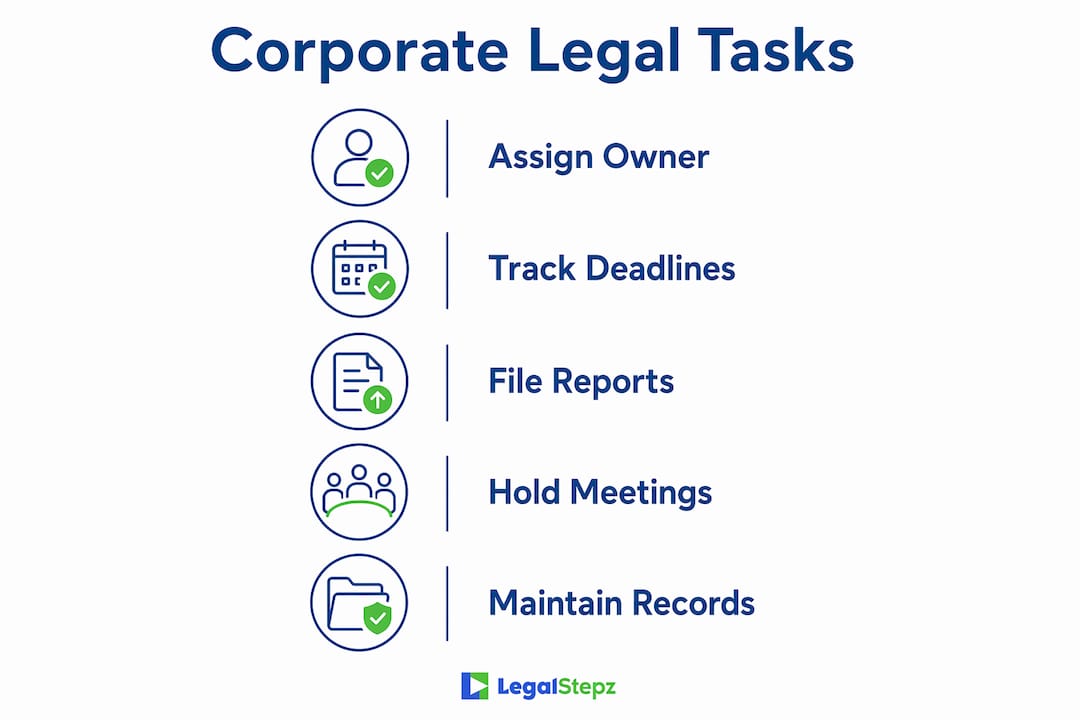
Who owns what matters as much as what gets done. The board owns meeting approvals. The corporate secretary owns minutes and records. Outside counsel or a compliance officer typically manages state filings and deadlines. Without clear ownership, tasks fall through the cracks.
| Task | Typical Frequency | Why It Matters |
|---|---|---|
| Annual/biennial state report | Annual or biennial | Preserves good standing; triggers fines if missed |
| Franchise tax payment | Annual | Required in most states; non-payment can cause dissolution |
| Board and shareholder meeting minutes | Annual (at minimum) | Documents corporate formalities; protects the veil |
| Registered agent renewal/update | Annual or as needed | Ensures legal notices reach the company |
| Business license renewals | Annual or biennial | Keeps operations legally authorized |
| Contract reviews | Annual or at renewal | Catches expired terms, auto-renewals, liability gaps |
| Cap table updates | As equity events occur | Accurate ownership records for investors and auditors |
| IP registrations (trademarks, patents) | Per USPTO/Copyright Office schedule | Maintains enforceable rights; prevents lapse |
Pro Tip: Assign a named owner to each row in this table. A task with no owner is a task that will not get done.
Keeping accurate corporate records in a central minute book is best practice and speeds any future diligence process considerably.
Concrete benefits of maintaining your corporation
Maintenance is not overhead. It is the mechanism that makes the corporate form worth having.
Liability protection. The corporate veil only holds when the entity is treated as genuinely separate from its owners. Regular minutes, updated bylaws, clear capitalization records, and documented board approvals are what courts look for when a plaintiff argues the owners should be personally liable. Without those records, the argument is hard to defend.
Transaction readiness. When investors or lenders perform due diligence, they request a full history of corporate actions. Missing records force costly reconstruction, ratification of past actions, and expensive counsel time — often far exceeding the annual maintenance spend. A well-maintained corporation moves through due diligence faster and commands more confidence from buyers and lenders.
Operational and insurance benefits:
- Clean records support insurance claims defense; undocumented decisions give insurers grounds to deny coverage.
- Audit-ready financials and corporate records reduce accounting costs and accelerate tax preparation.
- Documented contract reviews catch auto-renewal clauses and expired indemnities before they become liabilities.
- Preventive legal maintenance identifies small issues before they escalate and provides documentary evidence that reduces legal exposure after incidents.
A corporation with clean records is simply worth more — to buyers, to lenders, and to its own owners when a dispute arises.
What happens when a corporation skips maintenance
Neglect compounds. A single missed filing creates a cascade of problems that costs far more to fix than the original task would have.
State-level consequences:
- Loss of good standing, which can prevent the company from entering contracts in some states
- Administrative dissolution or revocation of authority to do business
- Late fees, penalties, and back taxes owed before reinstatement
- Inability to qualify in other states while out of good standing
Liability exposure:
- Courts pierce the corporate veil when formalities are missing. If a plaintiff shows the corporation was not treated as a separate entity — no minutes, no documented approvals, commingled funds — owners can be held personally liable for business debts.
- Undocumented maintenance is weak legal defense; courts and insurers require signed, dated documentation that formalities were observed.
Practical business damage:
- Lenders and investors walk away when records are incomplete or missing.
- Unsigned agreements and messy corporate records frequently force costly corporate clean-up during fundraising or sale processes.
- Insurance claims can be denied when the company cannot document that required procedures were followed.
- Contracts may be unenforceable if the signatory lacked documented board authorization.
Pro Tip: If your corporation has fallen behind, prioritize reinstatement with your Secretary of State before anything else. Most states allow reinstatement, but the longer you wait, the higher the back fees and the greater the risk of permanent dissolution.
How to run an ongoing legal maintenance program
A maintenance program does not require a large legal team. It requires clear ownership, a calendar, and a central place to store documents.
1. Designate an owner. Assign a compliance officer, corporate secretary, or outside counsel as the person responsible for tracking deadlines and maintaining records. Understanding why corporations need compliance officers is the first step toward building accountability into the program.
2. Centralize your documents. A minute book, cap table, contract repository, and license register should live in one place — physical binder, cloud folder, or dedicated software. Scattered records are nearly as bad as no records.
3. Build a compliance calendar. Map every recurring deadline: state report due dates, franchise tax payments, license renewals, board meeting dates, contract expiration dates, and IP maintenance deadlines. Add 30-day advance reminders for each.
4. Set review triggers. Beyond the calendar, certain events should automatically trigger a legal review:
- New hire or equity grant
- New contract above a defined dollar threshold
- Entry into a new state
- Any merger, acquisition, or financing discussion
5. Integrate with finance and HR. Legal maintenance does not live in a silo. Finance needs to know about franchise tax deadlines. HR needs to know about employment law updates. A quarterly cross-functional check-in keeps everyone aligned.
6. Run periodic spot audits. Once a year, pull the minute book and verify that every major board decision from the prior 12 months has a corresponding resolution or consent. Check that the cap table matches the stock ledger. Confirm that all licenses are current.
Pro Tip: Successful compliance programs use policies, training, monitoring, and reporting systems to catch issues before enforcement — not after. A 30-minute quarterly review is far cheaper than a corporate clean-up.
When tasks recur and what to budget for in the U.S.
Planning for legal maintenance spend prevents surprises and makes the case to leadership that this is routine infrastructure, not a discretionary expense.
Typical recurrence timeline:
- Annual: State annual reports, franchise tax, registered agent renewal, board meeting minutes, business license renewals, IP maintenance fees
- Biennial: Some states (including California for certain entities) require biennial reports rather than annual ones
- Quarterly: Contract review spot checks, compliance calendar review, cap table reconciliation
- As-needed: Bylaw amendments, equity issuances, new state qualifications, officer/director changes
U.S. cost ranges to budget for recurring items:
- State filing fees: typically $20–$800 per year depending on state and entity type
- Registered agent services: generally $50–$300 per year for a professional service
- Outside counsel for annual minutes and resolutions: varies by firm and complexity
- Corporate clean-up (reactive): can run into thousands of dollars in counsel time when records are missing
The annual requirements to maintain limited liability vary by state, but the pattern is consistent: small annual costs prevent large reactive ones.
Costs spike in three scenarios: multi-state qualification (each state charges its own fees), M&A or financing events (due diligence prep multiplies counsel hours), and corporate clean-up after years of neglect. Budgeting a modest annual line item for maintenance is the most cost-effective risk management a corporation can do.
State-specific rules and why California deserves special attention
Every U.S. state runs its own filing regime. Fee schedules, reporting cadence, franchise tax structures, and registered agent rules differ enough that a one-size approach will miss something.
Why states differ:
- Some states require annual reports; others (like California for LLCs) use a biennial schedule.
- Franchise tax calculations vary: flat fee, income-based, or net-worth-based.
- Registered agent rules differ on who qualifies and what address is required.
- Multi-state operators must qualify in each state where they do business and meet each state's requirements separately.
California specifics:
| Requirement | Details |
|---|---|
| Statement of Information | Corporations file within 90 days of formation, then every year by the end of the filing month |
| Franchise Tax | Minimum $800 per year for most corporations; paid to the California Franchise Tax Board |
| Registered Agent | Must have a California agent of service; address must be a physical California street address |
| Annual Meeting Minutes | Required annually; documents board and shareholder actions |
California's Statement of Information filing requirement catches many new business owners off guard. The $25 filing fee is low, but missing the deadline triggers a $250 penalty and can lead to suspension by the Secretary of State.
For California-specific deadlines and fee schedules, the California Franchise Tax Board (ftb.ca.gov) and the California Secretary of State are the primary sources. For multi-state operators, check each state's Secretary of State website directly.
A step-by-step plan to build your maintenance program
30-day start:
- Pull your current state filings and confirm good standing with your Secretary of State.
- Locate or create your minute book; verify the last annual meeting was documented.
- Confirm your registered agent is current and reachable. Review why corporations update their agent of service if you have not done so recently.
- Appoint a named owner for legal maintenance tasks.
60-day actions:
- Build a central document repository: minute book, cap table, executed contracts, license register.
- Create a compliance calendar with every known deadline for the next 12 months.
- Conduct an initial contract review: flag any agreements expiring in the next 90 days.
- Reconcile the cap table against the stock ledger and resolve any discrepancies.
90-day and ongoing:
- Establish a recurring quarterly review cadence with the designated owner.
- Integrate legal deadlines into the finance and HR calendars.
- Set up a relationship with outside counsel or a compliance service for annual minutes, filings, and spot audits.
- Review and update bylaws if the company has had any structural changes since they were last amended.
How clean records make financing, mergers, and acquisitions possible
A corporation's legal records are the first thing a buyer, investor, or lender examines. The due diligence process for a financing or acquisition is essentially a structured audit of everything the maintenance program produces: board minutes, equity records, executed contracts, state filings, and IP registrations.
Companies that maintain records consistently move through due diligence in weeks. Companies that do not spend months reconstructing history, ratifying undocumented decisions, and paying counsel to fix what should have been routine. That reconstruction work is expensive and signals risk to the other side of the table.
Building a sustained relationship with counsel to avoid reconstruction work during financings or exits is the approach that experienced operators take. The practical payoff: a clean data room, faster closing timelines, and fewer price adjustments driven by discovered deficiencies.
For M&A specifically, missing board approvals for prior equity issuances or asset sales can require court ratification, which adds time and cost. Lenders reviewing a credit facility want to see that the borrowing entity is in good standing and that the officers signing loan documents had proper board authorization. Neither of those is possible without a functioning maintenance program.
Federal compliance goes beyond state filings
State filings are the most visible part of corporate maintenance, but federal obligations run in parallel and carry their own consequences.
For private companies, the key federal obligations include:
- IRS requirements: Accurate EIN records, correct entity classification, timely tax filings, and compliance with employment tax obligations under the Internal Revenue Code.
- FTC rules: Advertising and marketing practices must comply with FTC guidelines regardless of entity size.
- Department of Labor: Workplace poster requirements and ERISA obligations for companies offering employee benefit plans apply at the federal level.
- Copyright Office: Registration of original works through the U.S. Copyright Office strengthens enforcement rights and is part of IP maintenance.
For public companies, the layer is substantially heavier. SEC reporting obligations include annual Form 10-K filings, quarterly Form 10-Q filings, current reports on Form 8-K for material events, and proxy statement requirements. Sarbanes-Oxley imposes internal control documentation and certification requirements on officers. Missing an SEC deadline triggers enforcement risk and reputational damage that private companies rarely face.
The practical point for private companies: federal compliance is not optional just because there is no SEC filing. Employment law, tax, and advertising obligations apply from day one.
How legal maintenance protects your intellectual property
A corporation's IP portfolio — trademarks, patents, copyrights, trade secrets — depreciates without maintenance. Registration is not a one-time event.

Trademark maintenance requires filing a Declaration of Use with the USPTO between the fifth and sixth year after registration, and a renewal every ten years. Missing either deadline cancels the registration. A lapsed trademark can be picked up by a competitor.
Patent maintenance requires paying maintenance fees to the USPTO at 3.5, 7.5, and 11.5 years after grant for utility patents. Missing a fee causes the patent to expire early.
Copyright registration through the U.S. Copyright Office is not required for protection, but it is required to sue for statutory damages and attorney's fees. Corporations that create original works and never register them lose significant enforcement leverage.
Trade secrets are protected only as long as the company takes reasonable steps to keep them confidential. That means documented confidentiality agreements, access controls, and policies — all of which are part of an internal compliance program.
IP maintenance belongs on the same compliance calendar as state filings. A missed USPTO deadline is just as damaging as a missed annual report, and the fix is rarely simple.
Integrating legal maintenance into corporate governance and risk management
Legal maintenance works best when it is not a standalone legal function but woven into the company's overall governance and risk management framework.
At the board level, the audit committee or a designated board member should receive a compliance status report at least annually. This creates accountability at the top and signals to management that maintenance is a governance priority, not just an administrative task.
At the operational level, legal maintenance connects directly to risk management. A risk register that includes regulatory, contractual, and IP risks — with named owners and review dates — turns maintenance from a checklist into a living management tool. Companies that integrate legal risk into their enterprise risk management process catch issues earlier and respond faster.
Practical integration points:
- Finance reviews franchise tax and filing fee accruals quarterly.
- HR flags employment law changes that require policy or handbook updates.
- Operations notifies legal of new vendor contracts above a defined threshold.
- The compliance owner reports status to the CEO or CFO monthly.
The Pitt Law blog notes that successful compliance programs use policies, training, monitoring, and reporting systems to catch issues before enforcement. That structure is exactly what an integrated governance approach produces.
Key Takeaways
Ongoing legal maintenance is the single most cost-effective way a corporation protects its limited liability, stays deal-ready, and avoids the compounding costs of neglect.
| Point | Details |
|---|---|
| Maintenance preserves the corporate veil | Regular minutes, bylaws, and board resolutions are what courts examine when personal liability is at stake. |
| State filings have hard deadlines | Missing an annual report or Statement of Information triggers penalties and can cause administrative dissolution. |
| Clean records accelerate transactions | Investors and lenders require a full history of corporate actions; missing records force expensive reconstruction. |
| Federal obligations run in parallel | IRS, FTC, DOL, and IP maintenance deadlines apply regardless of state filing status. |
| Legalstepz handles California compliance | Legalstepz files Statements of Information, prepares annual minutes, and provides registered agent services for California corporations. |
The case for treating maintenance as infrastructure, not insurance
Most business owners think about legal maintenance the way they think about insurance: something you buy hoping never to use, and something easy to defer when cash is tight. That framing is exactly wrong.
Insurance pays out after something goes wrong. Legal maintenance prevents the wrong thing from happening in the first place — and it produces assets. A well-maintained minute book is a document of value. A clean cap table is a transaction accelerator. A current registered agent is a litigation defense. These are not sunk costs; they are records that pay dividends when the company needs to raise money, sell, or defend itself.
The corporations that get into trouble are almost never the ones that tried to maintain records and failed. They are the ones that assumed maintenance could wait until something important was on the line. By then, the cost of fixing the past dwarfs the cost of the original task.
Treat legal maintenance the way you treat accounting: a recurring operational function with a named owner, a budget line, and a calendar. The companies that do this do not just avoid problems. They move faster when opportunities arrive.
Legalstepz keeps your California corporation in good standing
California corporations face some of the most specific compliance requirements in the country: annual Statement of Information filings, minimum franchise tax obligations, registered agent rules, and annual meeting minutes that must be documented and stored. Getting any one of these wrong triggers penalties that cost far more than the original filing.
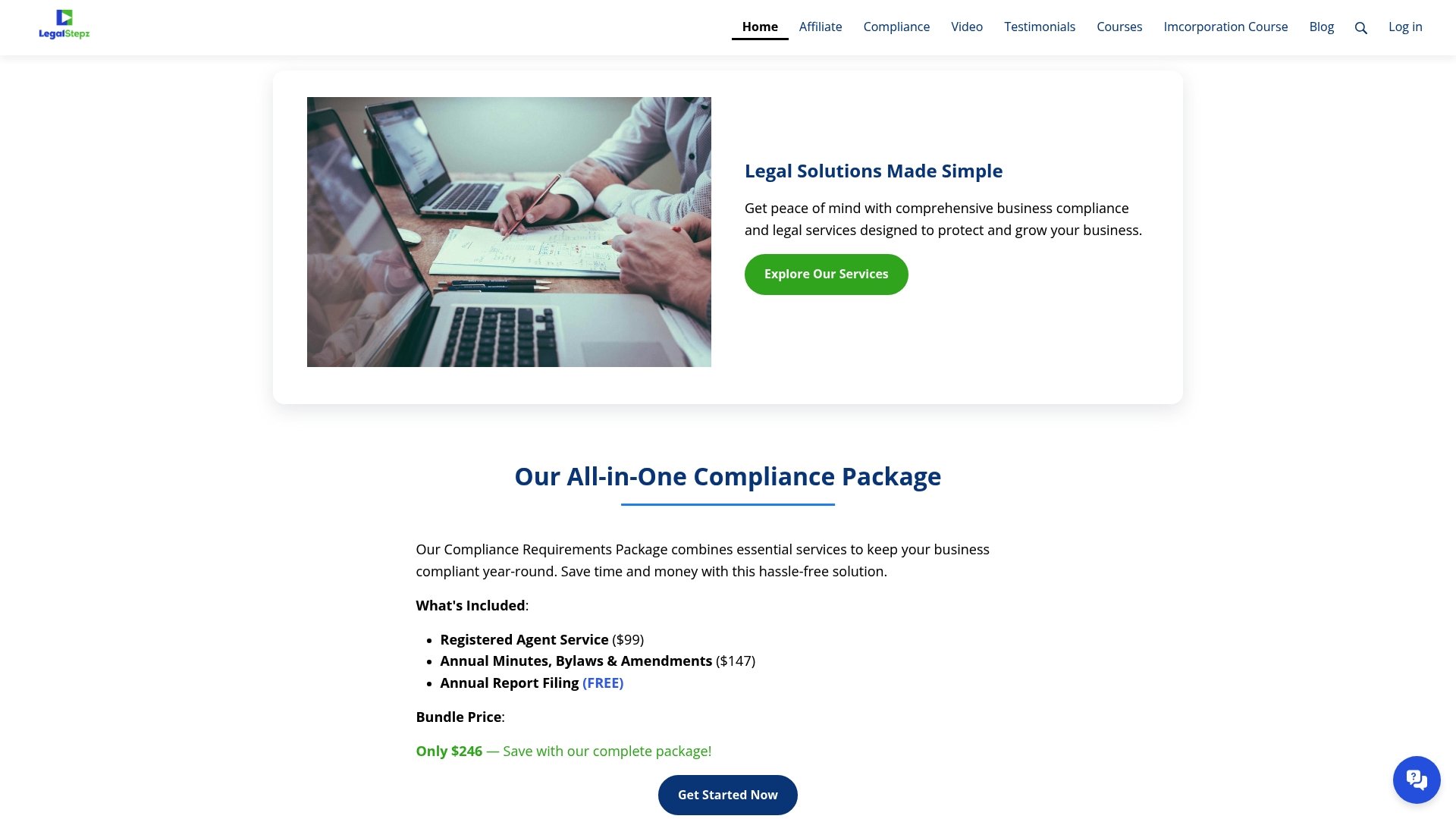
Legalstepz handles the tasks that keep California corporations compliant and protected. The services cover Statement of Information filing, annual corporate minutes preparation, registered agent services, and bundled compliance packages designed for small corporations and entrepreneurs who want to stay current without paying full law firm rates. For business owners who prefer to handle filings themselves, Legalstepz also offers step-by-step DIY courses on corporation formation and trademark registration.
Whether you need a single filing or a full annual compliance package, the process starts at legalstepz.com. Check the available packages and get your corporation's maintenance program on track this quarter.
Official sources and further reading
The sources below are authoritative starting points for confirming state rules, federal obligations, and best practices.
| Source | What It Covers |
|---|---|
| California Franchise Tax Board | California franchise tax requirements, minimum tax, and filing schedules for corporations |
| U.S. Small Business Administration | Federal and state compliance overview, meetings, minutes, and filings guidance |
| IRS — Business Tax Information | Federal tax obligations, EIN requirements, and entity classification rules |
| U.S. Copyright Office | Copyright registration procedures and maintenance for original works |
| Department of Labor | Federal workplace poster requirements and employee benefit plan obligations |
| FTC — Advertising and Marketing | Federal advertising compliance rules applicable to all business entities |
For state-specific filing pages: search "[your state] Secretary of State annual report" to find the official filing portal and current fee schedule. California corporations should also bookmark the California Secretary of State's business portal at bizfile.sos.ca.gov.
Legalstepz resources:
- Annual requirements to maintain limited liability — practical guide to California annual obligations
- Corporate compliance calendar for California businesses — deadline-by-deadline breakdown for California corporations
- Why business records matter legally for California entrepreneurs — connects record-keeping to legal outcomes
This article is general information, not legal advice. Confirm current rules with your state's Secretary of State, the California Franchise Tax Board, or a qualified attorney for your specific situation.