

An agent of service, formally called a registered agent, is the official point of contact designated to receive lawsuits, subpoenas, and government notices on behalf of a corporation. Corporations update their agent of service to stay compliant with California law, protect themselves from default judgments, and ensure legal documents reach the right hands without delay. The California Secretary of State requires every corporation to maintain a current, reachable agent at all times. Failing to do so puts your corporate good standing, and your legal rights, at serious risk.
Why corporations update agent of service: the legal reasons
California law does not give corporations a grace period when an agent becomes unavailable. The moment your registered agent stops functioning, your corporation is exposed to missed lawsuits and potential administrative dissolution.
The most common legal triggers for a corporate registered agent change include:
- Business relocation. When your corporation moves its principal office or your individual agent moves, the address on file with the California Secretary of State becomes invalid. An outdated address means legal documents go to the wrong location.
- Agent unavailability. If your agent resigns, retires, or becomes unresponsive, your corporation has no official channel for receiving service of process. Agent unavailability leading to lost good standing is one of the top legal reasons corporations file a change.
- Required state filing. California corporations must file a Statement of Change with the California Secretary of State to officially record any agent update. This filing is not optional. Skipping it means the old agent remains on record, regardless of any private arrangement you make.
- Maintaining good standing. California's Corporations Code requires a current, reachable agent as a condition of good standing. An agent who cannot be reached puts that status at risk immediately.
The Statement of Change filing is the mechanism California uses to keep corporate records accurate. Without it, no agent update is legally recognized by the state.
What practical reasons drive corporations to change their agent?
Beyond legal obligation, many California corporations update their agent for straightforward business reasons. These motivations are just as valid and often prevent problems before they become legal emergencies.
The most common practical reasons include:
- Privacy protection. Many small business owners initially list a personal home address as their agent address. That address becomes part of the public record. Switching to professional registered agents removes personal addresses from public filings, protecting owner privacy.
- Improved reliability. Individual agents, including attorneys or employees, are not always available during business hours. Professional agents handle service daily with established protocols, making them far more dependable than an individual who may be traveling or unavailable.
- Multi-state consolidation. Corporations expanding into other states often consolidate to a single professional service provider. Managing multiple individual agents across states creates administrative complexity that one provider eliminates.
- Cost and service quality. Registered agent fees range from $0 to $500 annually, and many corporations overpay significantly. Switching to a more cost-effective provider with better compliance monitoring is a sound business decision.
Pro Tip: Review your agent's address and availability every year when you file your Statement of Information with the California Secretary of State. Pairing both tasks prevents compliance gaps.
The importance of updating your service agent goes beyond paperwork. A reliable agent is your corporation's first line of defense when a lawsuit arrives.

What are the risks of not updating your agent of service?
The consequences of an outdated or unreliable agent are severe. They are not theoretical risks. They happen to California corporations every year.
The most dangerous outcome is a default judgment. If a plaintiff serves your corporation through an agent who no longer exists at that address, the court does not pause the case. Service defaults to the California Secretary of State, who may not forward documents reliably or promptly. Many states, including California, treat service delivered to the Secretary of State as legally valid service, even if your corporation never receives the notice. That means a judgment can be entered against you before you know a lawsuit was filed.
Reality check: Many business owners assume the Secretary of State will forward legal documents to them if their agent is unavailable. This misunderstanding leads to missed court deadlines and lost defense rights. The Secretary of State is a fallback mechanism, not a reliable mail forwarding service.
Administrative dissolution is the other major risk. California can dissolve a corporation that fails to maintain a valid agent. Reinstatement requires additional filings, fees, and time. During the dissolution period, the corporation loses its legal protections, including limited liability.
Failing to appoint a new agent before an old agent resigns creates an immediate gap in coverage. That gap is when your corporation is most vulnerable to both default judgments and dissolution proceedings.
How to update your agent of service in California
The process is straightforward when you follow it in order. Skipping steps creates gaps in your records that can surface during litigation.
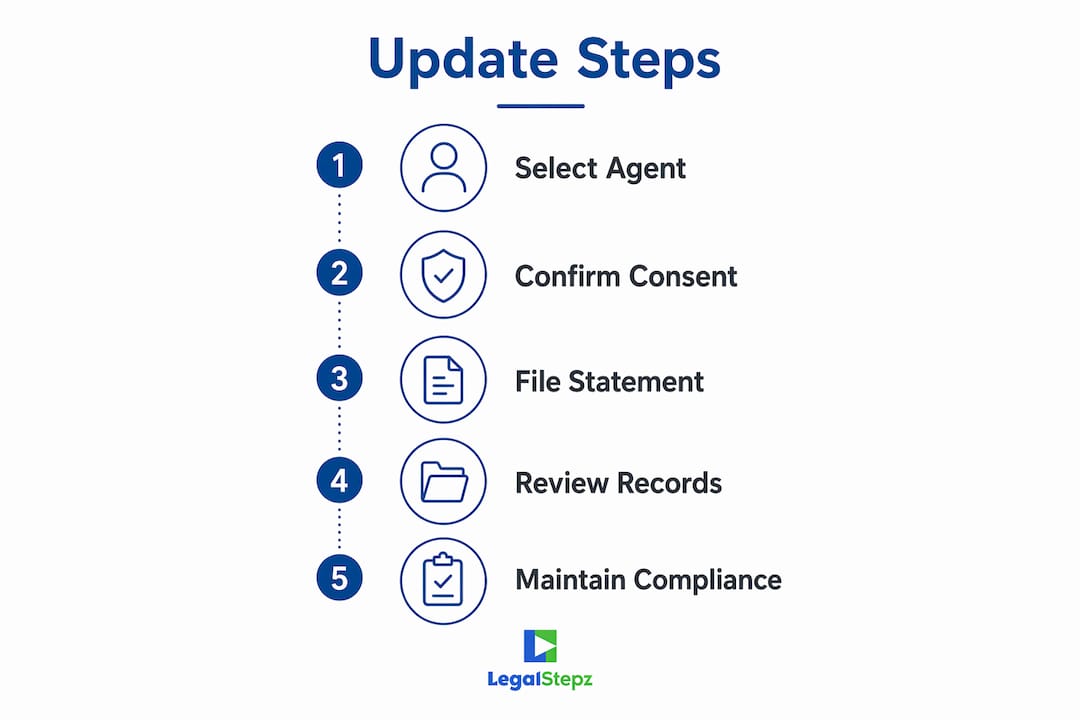
- Select your new agent. Confirm the agent is eligible under California law. An individual agent must be a California resident with a physical street address in the state. A professional service must be authorized to do business in California.
- Confirm the agent's consent. Your new agent must agree to serve before you file. Filing without confirmed consent creates a compliance problem if the agent later refuses service.
- File the Statement of Change. Submit the form to the California Secretary of State online, by mail, or in person. Filing fees generally range from $5 to $50, making this one of the least expensive compliance filings a corporation makes. Processing timelines vary by submission method.
- Update internal corporate records. Amend your bylaws and board resolutions to reflect the new agent. This internal documentation creates a protective paper trail if the agent change is ever disputed in litigation.
- Notify the previous agent. Inform your outgoing agent in writing. Cancel any service subscriptions tied to the old provider to avoid billing issues.
- Confirm the update on the Secretary of State's website. Search your corporation's record after processing to verify the new agent appears correctly.
| Step | Action | Cost |
|---|---|---|
| Select new agent | Confirm eligibility and consent | $0 |
| File Statement of Change | Submit to California SOS | $5–$50 |
| Update bylaws and board records | Amend internal documents | $0 (internal) |
| Notify outgoing agent | Written notice, cancel subscriptions | $0 |
| Verify state record | Check SOS database | $0 |
Pro Tip: File your Statement of Change at the same time as your Statement of Information. Both filings update the California Secretary of State's records, and handling them together reduces the chance of one being overlooked.
California corporations often skip bylaw amendments after agent changes. That omission increases liability risk if the agent's authority is ever challenged in court.
How to evaluate a registered agent service in California
Not every registered agent service delivers the same value. Choosing the wrong one creates the same compliance risks as having no agent at all.
The key factors to evaluate are:
- Cost relative to features. Annual fees range from $49 to $125 for comparable professional services. Paying more than $150 per year for a single-state service warrants a close look at what you are actually receiving.
- Compliance monitoring. The best providers alert you to filing deadlines, not just incoming legal documents. Passive agents who only accept service miss half the value of the role.
- Multi-state coverage. If your corporation operates in more than one state, a provider with national coverage simplifies management and reduces the risk of gaps in any single state.
- Responsiveness. An agent who takes days to forward a lawsuit notice defeats the purpose of having a professional service. Ask specifically how quickly documents are scanned and forwarded.
| Feature | Entry-level service | Professional service |
|---|---|---|
| Document forwarding | Mail only | Same-day digital scan |
| Compliance alerts | None | Filing deadline reminders |
| Multi-state coverage | Single state | Nationwide |
| Privacy protection | Varies | Standard |
| Annual cost | $0–$50 | $49–$125 |
The registered agent role in California carries specific legal obligations that generic or low-cost providers sometimes fail to meet. Verify that any provider you consider maintains a physical California street address and operates during regular business hours.
Key Takeaways
Corporations that maintain a current, reachable registered agent protect themselves from default judgments, administrative dissolution, and missed legal deadlines.
| Point | Details |
|---|---|
| Legal obligation is continuous | California law requires a valid agent at all times, not just at incorporation. |
| Default judgments are a real risk | Courts treat service to the Secretary of State as valid, even if you never receive notice. |
| Internal records matter | Amend bylaws and board resolutions every time you change agents to protect against disputes. |
| Filing costs are low | The California Statement of Change costs $5–$50, making updates affordable for any corporation. |
| Annual review prevents gaps | Reviewing your agent during your Statement of Information filing catches problems before they escalate. |
What I've learned from watching corporations ignore this
Most business owners treat their registered agent as a checkbox they filled out once during incorporation. That mindset is exactly what creates the problems I see repeatedly.
The scenario that concerns me most is the solo founder who listed their home address as the agent address three years ago and has since moved. They have not updated the California Secretary of State. A lawsuit gets served to the old address. The new tenant ignores it. A default judgment gets entered. By the time the founder finds out, the window to challenge the judgment has closed.
The fix costs $5 to $50 and takes 20 minutes. The failure costs tens of thousands of dollars and months of litigation to unwind, if it can be unwound at all.
The other pattern I see is corporations that switch to a professional agent but never update their bylaws. When a dispute arises about whether service was properly made, the internal records show the old agent. That inconsistency gives opposing counsel something to work with.
My recommendation is simple. Treat your registered agent review as an annual task, not a one-time setup. Pair it with your Statement of Information filing every year. Confirm the name, address, and contact details are current. Confirm your bylaws match. That 20-minute review is the cheapest legal protection your corporation can buy.
— Peter
How Legalstepz helps California corporations stay compliant
Keeping your registered agent information current is one piece of a larger compliance picture. California corporations also need accurate annual minutes, current bylaws, and timely Statements of Information to maintain good standing.
Legalstepz offers an Incorporation Course that walks California business owners through every compliance requirement, including how to select, update, and document your agent of service. The course covers the exact filings, internal record updates, and best practices covered in this article. If you want to understand how to find the right registered agent and keep your corporation in good standing year after year, Legalstepz gives you the tools to do it correctly.
FAQ
What is an agent of service for a corporation?
An agent of service, also called a registered agent, is the person or company designated to receive legal documents and government notices on behalf of a corporation. California law requires every corporation to maintain a current agent with a physical in-state address.
Why do corporations update their agent of service?
Corporations update their agent of service due to relocation, agent unavailability, privacy concerns, or the need for more reliable professional service. Failing to update the agent risks missed lawsuits and administrative dissolution.
How do you update your agent of service in California?
File a Statement of Change with the California Secretary of State, confirm the new agent's consent, and update your internal bylaws and board resolutions. Filing fees range from $5 to $50 depending on the submission method.
What happens if a corporation does not update its agent?
If a corporation's agent is unavailable, service of process defaults to the California Secretary of State. California treats that as valid service, meaning a default judgment can be entered even if the corporation never receives the lawsuit notice.
How often should a corporation review its registered agent?
Review your registered agent at least once per year, ideally when filing your Statement of Information with the California Secretary of State. Annual reviews catch address changes, agent availability issues, and outdated internal records before they create legal exposure.