

An LLC, or limited liability company, is a business structure that separates your personal assets from your business liabilities while offering flexible tax treatment and simpler management than a corporation. That combination is exactly why entrepreneurs choose LLC structure at a higher rate than any other formal business entity in the United States. The IRS defines an LLC as a state-law structure where both legal and tax considerations shape the choice of entity form. For California entrepreneurs specifically, the decision carries additional weight given the state's unique franchise tax rules, the California LLC Act, and the California Franchise Tax Board's oversight role.
Why entrepreneurs choose LLC structure over other business forms
The LLC blends corporation-like liability protection with partnership-like tax flexibility, making it the preferred starting point for most small business owners. A sole proprietorship offers zero separation between you and your business. A C-corporation offers strong separation but layers on double taxation and heavy compliance requirements. The LLC sits squarely between those two extremes, which is why starting an LLC is simpler than forming a corporation while still providing formal legal protection. For a California entrepreneur launching a consulting firm, a product brand, or a real estate holding company, that balance is hard to beat.
How does an LLC protect entrepreneurs' personal assets?
Limited liability protection means that business debts stay separate from your personal assets. If your LLC is sued or cannot pay its debts, creditors typically cannot seize your home, personal bank accounts, or car to satisfy those obligations. That protection is one of the core LLC advantages for entrepreneurs who want to take business risks without betting their personal finances on every decision.
The protection is real, but it is not automatic or unconditional. Courts may pierce the LLC veil if you commingle personal and business finances, which means using one bank account for both, paying personal bills from the business account, or failing to keep proper records. The practical requirements to maintain the liability shield include:
- Opening a dedicated business bank account and keeping it strictly separate from personal funds
- Signing all contracts and agreements in the LLC's name, not your personal name
- Maintaining accurate financial records and bookkeeping throughout the year
- Documenting major business decisions in writing, even for a single-member LLC
Pro Tip: Open your business bank account the same week you file your LLC formation documents. The longer you wait, the more likely you are to mix personal and business transactions, which is the single fastest way to lose your liability protection in a California court.
Compared to a sole proprietorship, the difference is stark. A sole proprietor has no legal separation at all. One lawsuit or unpaid vendor can reach every personal asset you own. The LLC creates a legal wall that, when properly maintained, holds up in California courts.
What tax benefits and options does an LLC offer entrepreneurs in California?
Tax flexibility is one of the strongest LLC tax benefits available to entrepreneurs. By default, a single-member LLC is treated as a disregarded entity by the IRS, meaning profits flow directly to your personal return via Schedule C without a separate federal business return. A multi-member LLC files a partnership return by default. Neither situation triggers corporate-level taxation.

The real power comes from the ability to elect a different tax classification. An LLC can elect to be taxed as an S-corporation or a C-corporation depending on the owner's income level and goals. The S-Corp election becomes financially attractive when net profits exceed roughly $60,000 to $80,000 annually, because it allows owners to split income between a salary and distributions, reducing self-employment tax exposure on the distribution portion.
Here is how the main federal tax options compare for a California LLC:
| Tax classification | Who files | Self-employment tax applies to |
|---|---|---|
| Disregarded entity (single-member) | Schedule C on personal return | All net profit |
| Partnership (multi-member) | Form 1065 partnership return | Each member's distributive share |
| S-Corporation election | Form 1120-S plus personal return | Salary only, not distributions |
| C-Corporation election | Form 1120 corporate return | N/A (separate entity pays tax) |
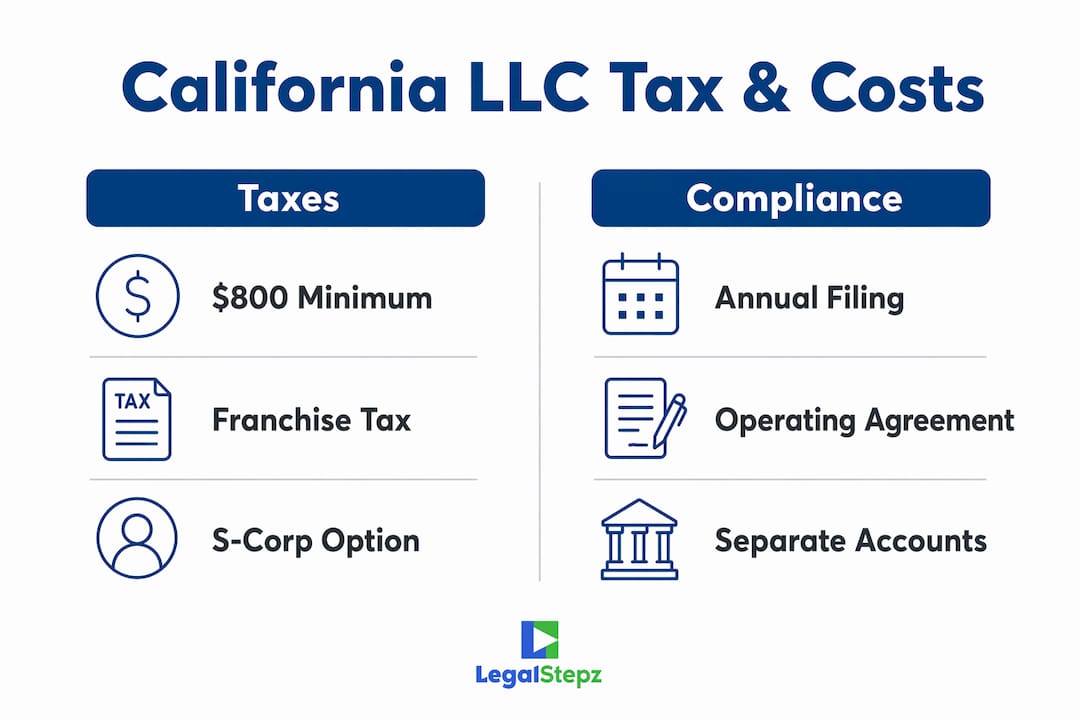
California adds its own layer on top of federal treatment. The California Franchise Tax Board requires every LLC to pay an $800 minimum annual franchise tax, regardless of revenue or profitability. That fee applies even in years when the business earns nothing. LLCs with California-sourced gross receipts above $250,000 pay an additional tiered fee ranging from $900 to $11,790 per year based on income brackets.
Pro Tip: If you form your California LLC late in the calendar year, you may owe the $800 franchise tax for that partial year and again for the following full year within just a few months. Timing your formation date strategically can defer that second payment by nearly 12 months.
The LLC tax benefits available in California are genuine, but they require planning. Working with a CPA who understands both federal pass-through rules and California's gross receipts fee structure will save you money and prevent surprises at tax time.
What are the key compliance and cost considerations for California LLCs?
California imposes more ongoing obligations on LLCs than most other states. Understanding these costs upfront is part of why form an LLC decision should be made with full information rather than enthusiasm alone. The core compliance requirements include:
- File Articles of Organization with the California Secretary of State and pay the initial filing fee to legally create the LLC.
- Pay the $800 annual minimum franchise tax to the California Franchise Tax Board each year, due by the 15th day of the fourth month of the taxable year.
- File a Statement of Information every two years with the Secretary of State to keep your registered agent and address current.
- Pay the gross receipts fee if your California-sourced revenue exceeds $250,000, with amounts scaling up to $11,790 for the highest revenue tier.
- Maintain a registered agent with a California street address to receive legal notices on behalf of the LLC.
The cost comparison between a California LLC and a California corporation is worth examining directly:
| Cost factor | California LLC | California C-Corporation |
|---|---|---|
| Minimum annual tax | $800 | $800 |
| Gross receipts fee | $900 to $11,790 (over $250K) | Not applicable |
| Formation complexity | Lower | Higher |
| Ongoing compliance burden | Moderate | High |
| Double taxation risk | None (default pass-through) | Yes (corporate + dividend tax) |
The costs to form an LLC in California are predictable once you understand the fee structure. The $800 minimum tax is the most discussed cost, but the gross receipts fee catches many growing businesses off guard. A company hitting $500,000 in California revenue will owe $2,500 in gross receipts fees on top of the $800 minimum, which is still far less than the compliance overhead of maintaining a full C-corporation.
How should entrepreneurs approach governance and internal agreements for their California LLC?
Governance is where many California LLCs run into trouble, not because the law is unclear, but because owners skip the operating agreement and rely on default rules. California's LLC Act fills in any gaps your operating agreement leaves silent, and those defaults can conflict with your intentions in ways that cause real disputes between members.
A written operating agreement is not legally required in California, but it is the single most important document your LLC will have. Without one, the state's default rules govern how profits are split, how decisions are made, and what happens when a member wants to leave. Those defaults are designed for a generic business, not yours.
A well-drafted operating agreement should address:
- Management structure: Member-managed means all owners share decision-making authority. Manager-managed means a designated manager (who may or may not be a member) runs day-to-day operations. Choose deliberately.
- Voting rights and thresholds: Specify what percentage of member votes is required for major decisions like taking on debt, admitting new members, or dissolving the company.
- Profit and loss allocation: California allows flexible allocation that does not have to match ownership percentages, but you must document the arrangement explicitly.
- Dispute resolution: Include a process for resolving disagreements before they escalate to litigation, such as mediation or arbitration clauses.
- Member exit provisions: Define what happens when a member wants to sell their interest, becomes incapacitated, or dies.
Maintaining what attorneys call "separateness proof" also supports your liability protection. This means keeping minutes of significant decisions, using the LLC name on all external communications, and never treating the business account as a personal piggy bank. The operating agreement for your California LLC is the foundation of that separateness, and it should be drafted before you open your first bank account.
Key takeaways
The LLC structure remains the preferred choice for California entrepreneurs because it delivers liability protection, tax flexibility, and manageable compliance costs in a single entity form.
| Point | Details |
|---|---|
| Liability protection is conditional | Maintain separate accounts and records or courts may pierce the LLC veil. |
| Tax flexibility is a core advantage | Single-member LLCs default to Schedule C; S-Corp election saves self-employment tax above ~$70K profit. |
| California adds real costs | The $800 annual franchise tax applies even with zero revenue; gross receipts fees scale with income. |
| Operating agreements prevent disputes | California default rules govern silent agreements and may not match your intentions. |
| Formation timing affects tax bills | Forming late in the year can trigger two $800 payments within months; plan your start date carefully. |
The LLC decision is simpler than most attorneys make it sound
I have worked with hundreds of California entrepreneurs who spent months paralyzed by the LLC versus corporation question. The honest answer is that for the vast majority of small business owners, the LLC wins on almost every practical dimension. The liability protection is real. The tax flexibility is genuine. The compliance burden is manageable.
What I see go wrong is not the choice of structure. It is the execution afterward. Owners form the LLC, feel accomplished, and then never draft an operating agreement, never open a separate bank account, and never pay attention to the franchise tax deadline. That is where the protection evaporates and the costs pile up unexpectedly.
The $800 annual franchise tax surprises people, but it should not. It is a known, fixed cost of doing business in California. What surprises people more is the gross receipts fee at higher revenue levels. A business hitting $1 million in California revenue owes $6,000 in gross receipts fees alone, on top of the $800 minimum. That is still a reasonable cost for the legal protection and tax flexibility the LLC provides, but you need to build it into your financial projections from day one.
My strongest advice: do not treat the operating agreement as optional paperwork. It is your business's constitution. The California LLC Act is a blunt instrument designed for the average case. Your business is not average. Write the agreement that reflects your actual intentions, your actual ownership split, and your actual plan for what happens if a partner wants out. That document will save you more money and stress than any other single action you take after formation.
— Peter
How Legalstepz helps California entrepreneurs get their LLC right

Legalstepz supports California entrepreneurs at every stage of LLC formation and ongoing compliance. From filing your Articles of Organization and drafting a California-compliant operating agreement to handling your Statement of Information and registered agent services, Legalstepz covers the administrative and legal steps that most founders overlook. The California franchise tax obligations alone require careful tracking, and Legalstepz keeps you ahead of deadlines so you never face penalties for missed filings. If you are ready to form your LLC or get your existing one into compliance, Legalstepz is the practical next step.
FAQ
What does LLC stand for and why does it matter?
LLC stands for limited liability company, a legal entity defined by state law that separates your personal assets from your business obligations. The "limited liability" part is the core benefit: it caps your personal financial exposure to what you invest in the business.
How much does it cost to maintain a California LLC each year?
Every California LLC owes a minimum of $800 per year in franchise tax, regardless of revenue. LLCs with California gross receipts above $250,000 pay an additional fee ranging from $900 to $11,790 depending on the income bracket.
Do I need an operating agreement for my California LLC?
California does not legally require an operating agreement, but operating without one means the state's default LLC Act rules govern your business. Those defaults frequently conflict with what members actually intend, making a written agreement the most important document you can create.
When does an S-Corp election make sense for a California LLC?
An S-Corp election typically makes financial sense when your LLC's net profit exceeds $60,000 to $80,000 annually. At that income level, the self-employment tax savings on distributions outweigh the added compliance costs of running payroll and filing a separate S-Corp return.
Is an LLC better than a sole proprietorship for a California freelancer?
Yes, for most freelancers. A sole proprietorship offers no legal separation between personal and business assets, meaning a client lawsuit can reach your personal savings and property. An LLC creates that separation for a predictable annual cost, which is the $800 California franchise tax plus filing fees.