

Yes. Under California Labor Code §3700, any employer with one or more employees must carry workers' compensation coverage, no matter how small the business is or how few hours that employee works. You have three lawful ways to comply: a policy from a licensed private insurer, coverage through the State Compensation Insurance Fund, or state-approved self-insurance. Skip all three and you're exposed to stop orders, fines, and criminal penalties. The Division of Workers' Compensation is your first stop for questions.
TL;DR:
- Employers of any size must maintain workers' compensation coverage, including part-time, seasonal, and temporary workers, regardless of hours worked.
- The three compliant options are private insurers, the State Compensation Insurance Fund, or state-approved self-insurance, with regular license status checks recommended.
- Employers must take immediate action after an injury by providing claim forms within one workday and ensuring proper documentation and medical treatment authorization.
- Failure to have coverage can lead to stop orders, fines, criminal penalties, and potential jail time, especially if an injury occurs before correction.
- Proper recordkeeping of insurance certificates, claim forms, notices, and injury logs is essential for proof and avoiding penalties during audits or claims.
Table of Contents
- Who Counts as an Employee Under California Workers Comp Eligibility Rules?
- How Do You Get Workers Comp Insurance in California?
- What Deadlines Do Employers Have to Meet?
- What Does Workers' Comp Actually Pay For?
- What Happens If You Don't Have Coverage?
- Are There Any Exemptions From California Workers Comp Requirements?
- What Should You Do the Day an Employee Gets Injured?
- What Compliance Records Should Every California Employer Keep?
- Why Proactive Compliance Beats Reactive Fixes
- Get Help With the Compliance Paperwork Around Your Coverage
- Where to Verify These Requirements Yourself
- Sources
Who Counts as an Employee Under California Workers Comp Eligibility Rules?
Almost everyone on your payroll counts, and that catches a lot of business owners off guard. Part-time staff, seasonal hires, and temporary workers are typically covered from day one, regardless of how few hours they log or how short the assignment runs. There's no minimum hours threshold and no grace period where a new hire is exempt.
Labeling someone an "independent contractor" doesn't settle the question. California courts and the DWC look past the title to how the work actually functions: who controls the schedule, who supplies the tools, whether the work is central to your business. Misclassify a worker who legally qualifies as an employee, and you can find yourself on the hook for unpaid coverage plus penalties after an injury already happened, which is the worst possible time to discover the mistake.
A few categories get special treatment:
- Corporate officers and directors are generally covered employees unless the corporation elects to exclude them, which requires a formal endorsement on the policy.
- Sole proprietors and partners aren't automatically covered, but can add themselves through an optional endorsement.
- Roofers face a narrower exclusion path than most trades, reflecting the injury risk regulators associate with that work.
Adding or removing an owner from a policy isn't automatic. It requires notifying your insurer directly and documenting the change, something worth pairing with your corporate officer records so the paperwork trail matches what your policy actually says.
How Do You Get Workers Comp Insurance in California?
You have three legitimate paths, and most employers only ever need the first one.
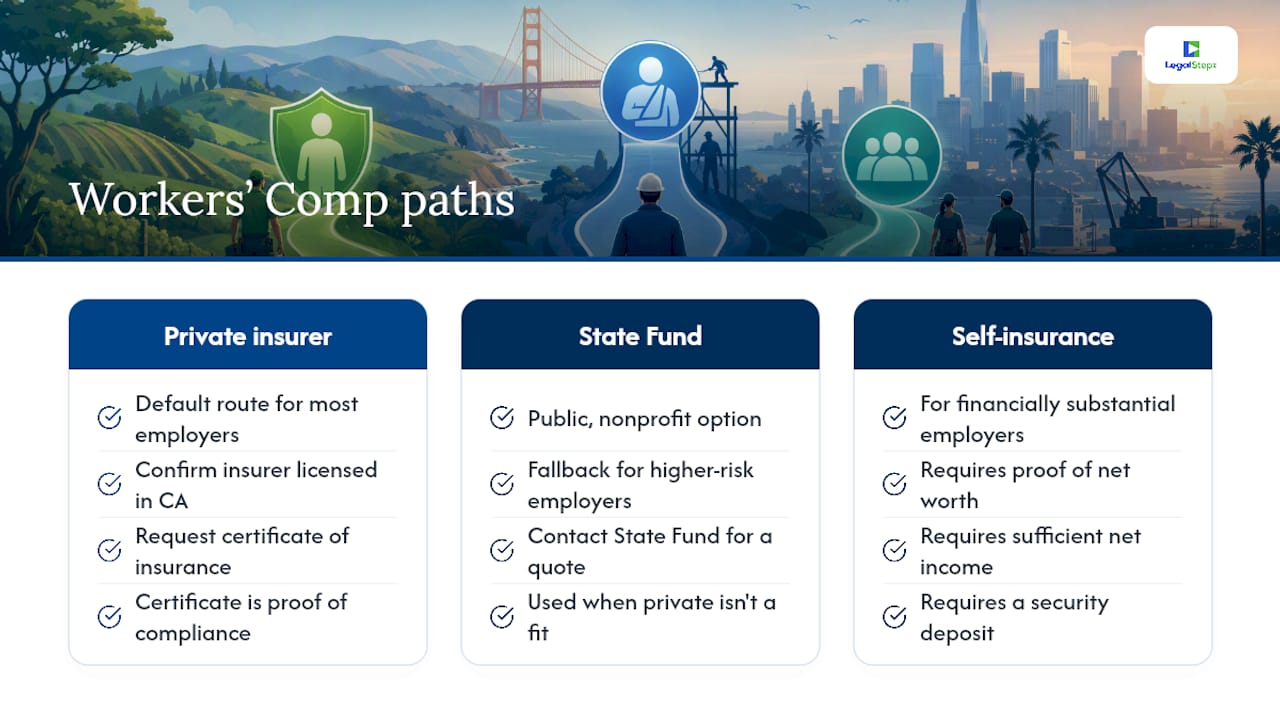
Private insurers. This is where the vast majority of California businesses buy coverage. Confirm the insurer is licensed to write workers' compensation policies in California before you sign anything, and once bound, request a certificate of insurance. That certificate is your proof of compliance if a client, contractor, or regulator asks for it. Industry data from the WCIRB confirms this is still the default route for most employers with staff on payroll.
State Compensation Insurance Fund. The State Fund exists as a public, nonprofit option, and it's often the fallback for employers in higher-risk industries who struggle to find affordable private coverage. You can contact State Fund directly for a quote if a private insurer isn't a fit for your business model.
Self-insurance. This route is only realistic for financially substantial employers. The state requires proof of adequate net worth, sufficient net income, and a security deposit before granting approval, according to DWC guidance. Group self-insurance, where similar employers pool resources, has become a more workable alternative for mid-sized companies that don't qualify individually. The Office of Self-Insurance Plans is the place to start that conversation early, since the financial-security requirements take time to document.
Pro Tip: Don't wait until renewal season to verify your insurer's license status. A quick check with the DWC before you bind a policy saves you from discovering a coverage gap after a claim is already filed.
What Deadlines Do Employers Have to Meet?
California doesn't give you much runway once an injury happens, and missing these deadlines is one of the most common ways employers rack up avoidable penalties.
Before anyone gets hurt:
- Give every new hire a workers' compensation pamphlet explaining their rights and how to report an injury.
- Post the required "notice to employees" poster somewhere staff actually see it. Skipping this isn't a minor paperwork miss. DWC guidance states it's a misdemeanor that can carry civil penalties of up to $7,000 per violation.
- Keep records of both the pamphlet distribution and the poster placement in case you ever need to prove compliance.
After an injury is reported:
- Provide the injured worker a claim form and return their completed copy within one working day, a timeline confirmed by DWC's guidance for injured workers.
- Forward that claim form to your claims administrator within the same one working day window.
- Authorize initial medical treatment up to the level specified by the DWC while the claim is being evaluated.
If you've set up a Medical Provider Network (MPN) or Health Care Organization (HCO), and your employee predesignated their own physician in writing before the injury, your treatment-authorization obligations shift. Predesignation has to happen in advance; you can't retroactively honor it after the injury occurs.
What Does Workers' Comp Actually Pay For?
Workers' compensation in California isn't a single benefit. It's a bundle of protections that kick in at different points in a worker's recovery.
- Medical care, guided by the Medical Treatment Utilization Schedule (MTUS), which sets evidence-based treatment standards claims administrators must follow.
- Temporary disability payments, which replace a portion of lost wages while the employee can't work and recovery is still ongoing.
- Permanent disability benefits, triggered when an injury leaves lasting impairment, calculated against state disability rating schedules.
- Supplemental job-displacement benefits, aimed at workers who can't return to their previous role and need retraining vouchers.
- Death benefits, paid to dependents when a workplace injury proves fatal.
Every one of these categories runs through your insurer or claims administrator, not directly through you as the employer, but you're the one who sets the clock running by handling that initial claim form correctly.
What Happens If You Don't Have Coverage?
The consequences escalate fast, and none of them are theoretical. The Labor Commissioner can issue a stop order, which shuts down your ability to use employee labor immediately until you secure coverage, according to DIR enforcement guidance.
- Operating without coverage is a misdemeanor under Labor Code §3700.5, carrying potential jail time and fines.
- Civil penalties run to the greater of $1,500 per employee or twice the estimated premium you should have been paying, per Labor Code §3722.
- A stop order violation on top of the underlying noncompliance adds separate penalties.
Pro Tip: If you've realized you're uninsured, don't wait for an inspection to fix it. Call the DWC's Information and Assistance unit the same day, get coverage bound immediately, and document every step you took once you discovered the gap. Regulators respond very differently to an employer actively correcting a mistake versus one who got caught.
Are There Any Exemptions From California Workers Comp Requirements?
Real exemptions exist, but they're narrower than most employers assume.
- Corporate officers can be excluded, but only through a formal elective exclusion filed with the insurer, and only certain ownership structures qualify.
- Sole proprietors and partners aren't automatically covered but can purchase optional coverage for themselves through an endorsement.
- Roofers face restrictions on how broadly they can be excluded, given the elevated injury risk regulators associate with that trade.
- Out-of-state employers with workers regularly performing duties in California generally still need California coverage for those employees, even if the company is based elsewhere.
None of these exemptions apply automatically. Each requires documentation, usually tied to your corporate structure. Keeping your officer roles and elections properly documented matters here, since insurers and regulators will ask for that paperwork if a claim or audit ever raises the question.
What Should You Do the Day an Employee Gets Injured?
Handle this in order, and don't skip steps even when the injury seems minor.
- Get the employee medical attention first. Safety comes before paperwork, always.
- Document the incident immediately while details are fresh: time, location, witnesses, what happened.
- Give the employee a claim form and get their completed copy back within one working day.
- Forward the claim form to your claims administrator within that same one working day window.
- Authorize initial treatment at the level required, and notify your MPN if you have one so treatment routes through the right network.
- Log the claim internally, noting dates and who handled each step, in case timelines are ever questioned later.
- Start return-to-work planning early, even for injuries that will take weeks to resolve.
- Cooperate with utilization review or independent medical review if the claims administrator or insurer requests it.
- Call the DWC's Information and Assistance unit or your attorney if anything about the claim looks disputed or unusual.
Speed matters more than most employers expect. A delayed claim form doesn't just risk a penalty. It can also complicate the injured worker's benefits and sour a relationship you'll want intact once they're back on the job.
What Compliance Records Should Every California Employer Keep?
Good recordkeeping is what turns "we're insured" into "we can prove it," and that distinction matters the moment a claim or audit shows up.
- Certificates of insurance, kept current and renewed on time.
- Copies of every claim form issued, along with the date each was provided and returned.
- Evidence the notice-to-employees poster was displayed, ideally a dated photo or inspection log.
- A running claims log tracking dates, outcomes, and who on your team handled each case.
A few operational habits make this easier to sustain. Designate one person, even in a small business, who owns claims handling so nothing falls through the cracks when an injury happens on a chaotic day. Build the workers' compensation pamphlet into your new-hire onboarding packet rather than handling it as a separate task. Schedule an annual review of your Injury and Illness Prevention Program, since Cal/OSHA requires an active IIPP, not just a document sitting in a drawer. A broader compliance checklist, like the one partner resource MyIncTeam publishes for California businesses, can help you spot gaps beyond workers' comp specifically.
Pro Tip: There are services available to help with the corporate-side paperwork, like registered agent services and annual filings, that often get neglected while owners focus on insurance. Compliance rarely fails in one big way. It fails in a dozen small missed details.
Why Proactive Compliance Beats Reactive Fixes
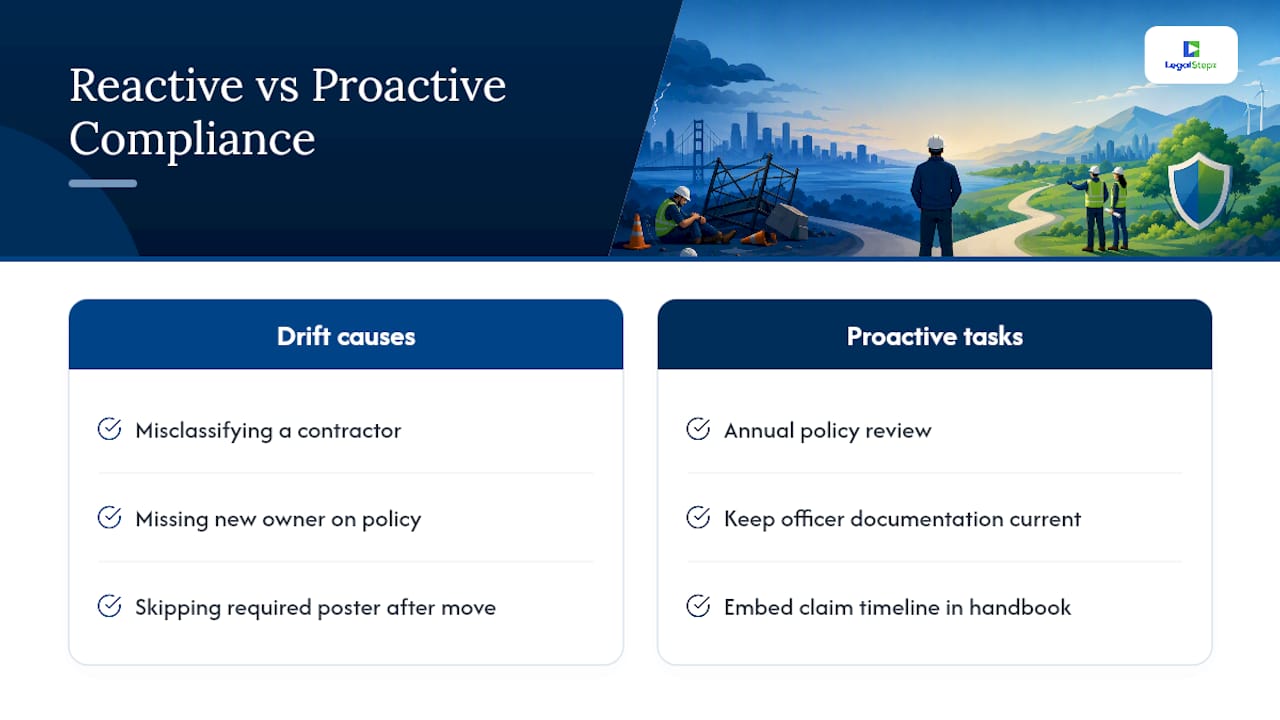
Most California employers I've seen get into trouble with workers' comp didn't decide to skip coverage. They drifted into noncompliance through misclassifying a contractor, forgetting to add a new owner to the policy, or letting the poster requirement slide after an office move. None of it was deliberate, but the penalties don't care about intent.
The businesses that avoid this treat compliance as a recurring operational task, not a one-time setup step. They review their policy annually, keep officer documentation current, and build the claim-handling timeline into their employee handbook so nobody's scrambling to remember the one-working-day rule during an actual emergency. That habit pays for itself. Fewer disputed claims and cleaner records tend to mean fewer audit headaches and, over time, more stable premiums.
— Peter
Get Help With the Compliance Paperwork Around Your Coverage
Buying the actual insurance policy still runs through a licensed insurer, a broker, or the State Fund. That part doesn't change. But the paperwork that surrounds it, keeping your corporate filings current, documenting officer elections, maintaining a registered agent, is exactly where Legalstepz steps in.

Some providers handle the California Statement of Information filings, draft annual corporate minutes and bylaws, and provide registered agent services so the administrative side of your business stays clean while you focus on running it. If you're adding an owner to your workers' comp policy and need that ownership change properly documented, or your officer records need updating before a policy renewal, that's exactly the kind of filing gap that turns into a compliance headache later. Visit Legalstepz to see the full range of filing and registered agent services, and get your corporate paperwork squared away before it becomes the reason a claim or audit gets complicated.
Where to Verify These Requirements Yourself
- DWC employer FAQs for statutory basics and coverage options.
- DIR enforcement and stop order guidance for penalty details.
- WCIRB's California overview for industry-wide coverage data.
- Office of Self-Insurance Plans for self-insurance applications.
This article is general information, not a substitute for advice from a qualified lawyer. Consult a qualified legal professional about your own circumstances before acting on anything here.
Sources
- Answers to frequently asked questions about workers' compensation for employers — DWC (DIR)
- Division of Labor Standards Enforcement enforcement and stop orders — DIR
- Overview of California workers' compensation — WCIRB