

To dissolve a California corporation, you need a shareholder vote (at least 50% of the voting power), notice to shareholders and known creditors, and a wind-up of the business. You then file a Certificate of Dissolution with the Secretary of State (SOS) and a final return with the Franchise Tax Board (FTB). The state charges no filing fee for the certificates. Skipping the formal filing is the costly mistake, because an unfiled corporation can keep owing the annual minimum tax.
This guide walks through the order of work, the forms, the tax side and the cases where a shortcut applies.
TL;DR
- Shareholders holding at least 50% of the voting power must approve dissolution, unless your articles or bylaws set a higher threshold.
- File Form DISS STK with the SOS. If the vote was not unanimous, file Form ELEC STK first or with it. There is no filing fee for either.
- File your final FTB return, pay what you owe and stop doing business in California after the final taxable year.
- Closing the doors or checking a "final return" box does not end the corporation. Only formal dissolution does.
- If the corporation is dormant and has no assets, an administrative dissolution route through the FTB may fit.
Table of Contents
- The order of work at a glance
- Who can approve a California corporation's voluntary dissolution
- Step 1: Hold the vote and document it
- Step 2: File the Certificate of Election, if the vote was not unanimous
- Step 3: Notify shareholders and creditors
- Step 4: Wind up the business
- Step 5: Sign and file the Certificate of Dissolution
- Step 6: Handle the Franchise Tax Board
- What it costs to dissolve a corporation in California
- What happens if you never dissolve
- When administrative dissolution may fit
- Perspective
- Keep your records in order while you close
- Related steps owners often forget
- FAQ
- Sources
The order of work at a glance
Most owners get stuck because the steps come from three places: the Corporations Code, the SOS and the FTB. In practice the sequence runs like this:
- Confirm who can approve and hold the vote.
- File the Certificate of Election to Wind Up and Dissolve, if the vote was not unanimous.
- Notify shareholders and known creditors by mail.
- Wind up: collect receivables, pay debts, distribute what is left.
- Sign and file the Certificate of Dissolution.
- File the final tax return and settle every balance.
The Nolo summary of the California process follows the same arc: approval, election certificate, notices, wind-up, Certificate of Dissolution, final returns. The sections below fill in the detail.
Who can approve a California corporation's voluntary dissolution
Under California Corporations Code §1900, shareholders holding at least 50% of the voting power may elect to wind up and dissolve. The board alone can make the election in three narrow cases: the corporation has been ordered into Chapter 7 bankruptcy, it has disposed of all assets and conducted no business for five years, or it never issued shares.
Two practical points:
- Check your own documents. Nolo notes that the articles of incorporation or bylaws can require a higher vote, such as two-thirds. If you cannot find your bylaws or your stock records, sort that out before you call a vote.
- Know who your shareholders are. If stock was never properly issued or recorded, the vote is hard to prove. Our guide on how to issue stock in a California corporation explains what clean records look like.
If what you really want is to sell the business rather than close it, the answer changes. A buyer, a deal and an announcement come first, and dissolution may follow later. Owners in that position can read about announcing a brokerage acquisition to see how a transaction gets planned and communicated.
Write the vote down. A short set of minutes or a written consent, signed and dated, records the decision. It is the document you will point to if anyone later asks who approved the dissolution and when.
Step 1: Hold the vote and document it
Call a shareholder meeting or collect written consents, depending on what your bylaws allow. Record:
- the date of the vote;
- the number of shares outstanding and the number voting in favor;
- whether the vote was unanimous, because that decides whether you need Form ELEC STK;
- who was authorized to sign the filings.
A corporation with a single shareholder has an easy vote. A corporation with several shareholders, or with a deadlocked board, needs more care, and a business attorney is worth consulting if the owners disagree about closing at all.
Step 2: File the Certificate of Election, if the vote was not unanimous
The SOS form for this is ELEC STK, the Certificate of Election to Wind Up and Dissolve. According to the SOS form page, the election must have been made by shareholders holding at least 50% of the voting power, or by the board if no shares were issued. A stock corporation that did not vote unanimously must file it before or together with the Certificate of Dissolution.
If every outstanding share voted yes, the election certificate is not needed. As the Stimmel Law checklist explains, the Certificate of Dissolution then has to say that the election was made by all outstanding shares. The SOS charges no fee for filing the election certificate.
Step 3: Notify shareholders and creditors
Once shareholders approve, the board must mail written notice of the winding-up to all shareholders. It must also mail notice to all known creditors and claimants whose addresses the corporation has, per Corporations Code §1901 as summarized by Nolo.
Keep copies of the notices and proof of mailing. Creditor notice matters because the dissolution certificate states that debts have been paid or provided for. Think of landlords, vendors, lenders, equipment lessors, payroll providers and any customer with a warranty claim.
Step 4: Wind up the business
Winding up means finishing the corporation's affairs. A working checklist:
- Collect outstanding receivables.
- Pay or make provision for debts and liabilities.
- Close or transfer contracts, leases and licenses.
- Cancel local business licenses and permits.
- Close out payroll accounts and file final payroll reports.
- Sell or distribute remaining assets to shareholders according to their rights.
- Keep the books and corporate records in a safe place.
Do not pay out shareholders before creditors. Distributing assets while debts remain unpaid is the kind of shortcut that creates personal exposure later. If the debts exceed the assets, talk to a business attorney before you sign anything.
Step 5: Sign and file the Certificate of Dissolution
Under Corporations Code §1905, once the corporation is completely wound up, a majority of the directors then in office sign and verify a certificate. It states that the corporation has been completely wound up, debts are paid or provided for, assets are distributed, and a final franchise tax return has been or will be filed with the FTB.
A California stock corporation uses Form DISS STK, per the SOS forms page. Filing online gets priority handling there, while in-person submissions carry a $15 special handling fee.
The short-form option
Some young corporations qualify for Form DSF STK. The same SOS page says you can use it within 12 months if the corporation:
- issued no shares,
- conducted no business since incorporation, and
- has no debts or liabilities other than tax liability.
Corporations Code §1900.5 sets the same conditions: a filing within 12 months of the articles, no debts, no business conducted, and tax liability to be satisfied. In that case a majority of directors, or the incorporator if no directors were named, can sign.
Which form, quickly
| Situation | Form | Notes |
|---|---|---|
| Vote of at least 50% but not all shares | ELEC STK, then DISS STK | File ELEC STK before or with DISS STK |
| Every outstanding share voted yes | DISS STK only | Certificate states the vote was unanimous |
| No shares issued, no business, no debts, within 12 months | DSF STK | Short form |
Step 6: Handle the Franchise Tax Board
The SOS filing does not replace the tax closeout. FTB Publication 1038 lists what a dissolving entity must do:
- file all delinquent returns and pay all balances, including penalties, fees and interest;
- file the final or current-year return with the Final Return box checked and "final" written at the top;
- stop doing or transacting business in California after the final taxable year.
The same publication says the dissolution forms go to the SOS within 12 months of filing the final tax return.
The California Code of Regulations adds a wrinkle. A domestic corporation filing for dissolution submits the required documents plus a tax clearance certificate, a request for one, or language in the certificate saying tax liability will be satisfied on a taxes-paid basis or assumed by a named person. Without a clearance certificate the dissolution is "conditional" until the FTB issues a valid one. Your CPA can tell you which wording fits your situation.
A C corporation files the final year on Form 100. One tax-preparer guide points out that the $800 minimum tax is still owed in the final year unless the corporation is exempt. For background on that tax, see our explainer on the California franchise tax.
What it costs to dissolve a corporation in California
The state side is cheap. The SOS form page shows no filing fee for Form DISS STK or Form ELEC STK, with an optional $5 certification fee and the $15 in-person handling fee mentioned above (SOS form page).
The real costs sit elsewhere:
- unpaid franchise tax, penalties and interest from earlier years;
- the final-year minimum tax;
- CPA or attorney time for the final return and any clearance;
- debts you settle during the wind-up.
Plan the budget around those items, not the filing itself. Keeping tax filings current before you dissolve is the best way to keep the closeout simple. Our California corporation filing deadlines calendar helps you see what is due and when.
What happens if you never dissolve
A corporation that stops operating but is never formally dissolved can stay active in state records. One California CPA firm notes it can keep accruing the $800 annual minimum franchise tax with penalties and interest. The same firm estimates that a business that stopped operating five years ago may face a bill of $6,000 to $10,000 or more. Treat those as estimates, not guarantees, and confirm your actual balance with the FTB.
A common trap: a tax preparer reports that owners often check the Final box on Form 100 and assume they are done. Without a Certificate of Dissolution the corporation stays legally alive and the minimum tax keeps coming.
When administrative dissolution may fit
Two FTB-driven routes exist for corporations that walked away.
Voluntary administrative dissolution. Under a 2017 law (AB 2503), a corporation can apply to the FTB on Form 3715. According to Allen Matkins, the entity must have been registered with the SOS for more than 12 months, have ceased doing business or never conducted business in California, and have no assets.
Involuntary administrative dissolution. Brothers Smith Law reports that after 60 consecutive months of FTB suspension, the FTB may start the process. If the business does not respond within 60 days of notice, it is dissolved and the accrued minimum tax, interest and penalties are abated.

There is a catch. The same law firm says abated amounts become due again if the business keeps operating after requesting dissolution, or if undisclosed assets turn up, and a penalty of 50% of the abated tax plus interest applies. Administrative dissolution also does not erase debts owed to creditors. Use this route only when the corporation truly has no assets and no activity.
Perspective
We see the same pattern with California corporations again and again. The owner closes the business in spirit, stops the bank account and moves on. The corporation, on paper, keeps going.
Our view is that dissolution is a records problem before it is a filing problem. If your bylaws, stock records and meeting minutes are in order, the vote, the election certificate and the Certificate of Dissolution take an afternoon. If they are not, every step turns into detective work.
That is why we build our work around the paperwork a corporation should keep all year: annual minutes, bylaws and changes throughout the year, plus a registered agent so legal notices reach someone. Owners who keep those current dissolve faster and with fewer surprises.
Our advice: decide early, vote in writing, file the final return, and file the certificate. Do not leave a corporation half-closed.
Peter
Keep your records in order while you close
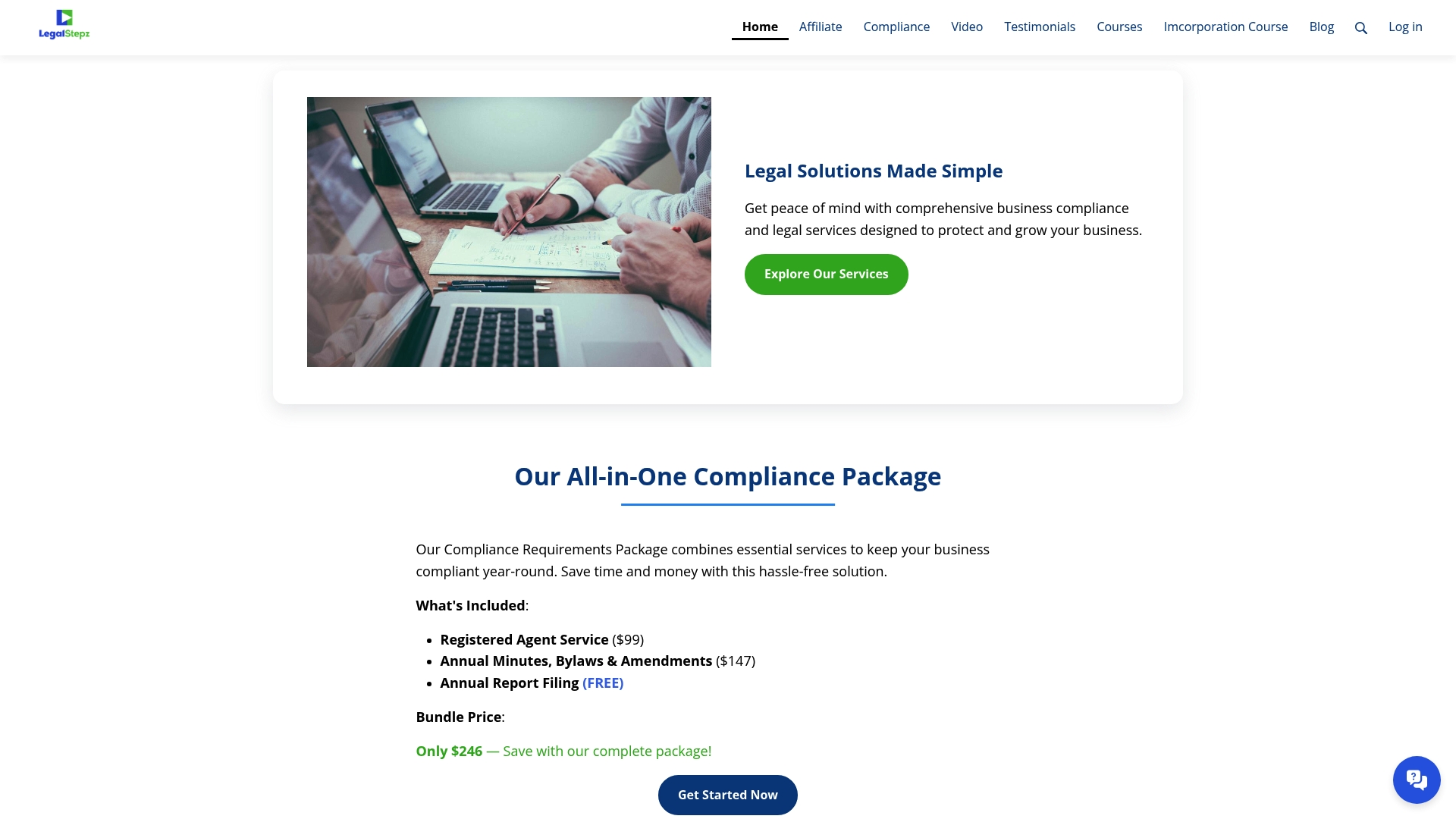
Dissolution goes faster when the corporate file is complete. Our compliance services include Annual Minutes, Bylaws and Changes Throughout the Year for $147 and Registered Agent Service for $99, both one-off prices as published. Current minutes and bylaws give you the proof of your vote and your voting thresholds in one place, and a registered agent gives the corporation a California address for legal papers during the wind-up.
If you are also planning a fresh start with a new entity, our Incorporation Course ($37) and Limited Liability Company Course ($37) walk through formation step by step on the courses page.
Related steps owners often forget
- Statement of Information. A corporation that is still active must keep filing it. Our SI-550 checklist shows how to avoid suspension while you wind up.
- Annual report items. If the closeout runs across a filing period, review the annual report requirements so nothing lapses mid-process.
- Other tax duties. Payroll, sales tax and local taxes follow their own closeout rules. Our small business tax obligations guide gives an overview.
- An LLC instead. The process differs. See our guide to dissolving an LLC in California.
FAQ
How do I dissolve a California corporation?
Get approval from shareholders holding at least 50% of the voting power, file Form ELEC STK if the vote was not unanimous, and notify shareholders and known creditors. Then wind up the business, file Form DISS STK with the Secretary of State, and file your final return with the Franchise Tax Board.
How much does it cost to dissolve a corporation in California?
The Secretary of State charges no filing fee for the election or dissolution certificates. An optional certification costs $5, and in-person filing adds a $15 handling fee. Your real costs are any back taxes, the final-year minimum tax and professional help.
Is it hard to dissolve a corporation?
It is simple when the records are clean, taxes are current and there are few debts. It gets harder with unpaid taxes, missing stock records, disagreeing owners or creditors. In those cases, ask a CPA or business attorney.
What happens if a corporation is not dissolved?
It can remain active in state records and keep accruing the $800 minimum franchise tax plus penalties and interest, even if business has stopped. Formal dissolution, or an administrative dissolution where it qualifies, is what ends that.
Sources
- 7 Steps to Dissolving a California Corporation (Nolo)
- California Corporations Code §1900
- California Corporations Code §1905
- California Secretary of State: Stock Corporation Certificate of Election and Dissolution forms
- California Corporations Code, Voluntary Dissolution (Justia)
- Checklist for Voluntary Dissolution (Stimmel Law)
- FTB Publication 1038
- California Code of Regulations on dissolution and tax clearance
- Closed Your Business but Never Dissolved It?
- California Businesses That Stopped Operating but Never Closed
- Franchise Tax Board Is Now Able To Dissolve Zombie Entities (Allen Matkins)
- Administrative Dissolution of California Domestic Corporations and LLCs (Brothers Smith)
- How to Fill Out California Form 100 (TaxShark)