

If your corporation was formed outside California and transacts intrastate business here, you must qualify with the California Secretary of State and then file a Statement of Information on a recurring schedule. The immediate next step is to confirm your qualification status, verify your agent for service of process, and file through the Secretary of State's bizfile Online portal or with help from a filing service.
TL;DR:
- Repeated, regular activity within California, such as keeping an office or staff, triggers qualification; an isolated sale or remote interstate contract generally does not.
- Qualification is a one time registration, while the first Statement of Information is due based on registration date and recurs annually thereafter.
- Before filing, match the registered name exactly, provide complete physical addresses, and confirm the agent has a current California certificate on file.
- Online filing validates required fields and provides confirmation; late filings can incur penalties, and continued noncompliance can suspend California business rights.
- File an updated Statement of Information when an officer, director, or agent changes; you do not need to wait for the next annual cycle.
Table of Contents
- Who Must File and When: Triggers, Qualification, and Key Deadlines
- What to Include on the Statement of Information
- How to File: Steps, Fees, and Confirmation
- Qualification vs. Statement of Information: Two Separate Filings
- Penalties and Remediation for Missed or Late Filings
- Your Compliance Checklist and Filing Calendar
- Why We Treat This Filing as a Priority, Not a Formality
- How Legal Stepz Keeps Your Filings Current
- FAQ
Who Must File and When: Triggers, Qualification, and Key Deadlines
California law requires a foreign corporation to register, or "qualify," once it transacts intrastate business in the state. The Secretary of State's own guidance frames this as the practical trigger for registration, and many foreign entities misinterpret an occasional sale or a single California customer as requiring qualification when it does not. Repeated, regular activity inside California, such as maintaining an office, employing staff, or regularly selling to California customers from a California location, counts. Shipping goods across state lines, occasional interstate transactions, or a single contract negotiated remotely generally does not trigger the requirement on its own.
Before any recurring filing applies, a corporation formed outside California must first submit a Statement and Designation by Foreign Corporation, which registers it with the Secretary of State and establishes its legal right to transact business here. This qualification filing should happen before, or as close as possible to, the start of intrastate activity.
Once qualified, the corporation enters the recurring Statement of Information cycle. California foreign corporations typically file this statement every year, and the specific due date depends on the entity's registration date. To stay on top of this, we recommend treating the filing cycle as a calendar item rather than a one-time task; our California corporate compliance checklist walks through how to build that habit.
A few steps help confirm where your corporation stands before you file anything:
- Search the entity name on the California Secretary of State business search to confirm active status and registration date.
- Check the "next statement due" information shown on the entity's record, since this varies by registration date rather than a fixed calendar date.
- Confirm the registered agent on file is current, since an outdated agent can cause downstream filing problems.
- Review any prior filings for errors in officer or address data that need correcting on the next statement.
Skipping this verification step is the most common reason foreign corporations discover a filing gap only after receiving a penalty notice.
What to Include on the Statement of Information
The Statement of Information asks for specific, structured data, and the Secretary of State will reject a filing that is missing required fields or carries an improperly designated agent. Before you start the online form or print a paper one, gather the following:
- The exact corporate name as registered with the Secretary of State, matching the qualification filing character for character.
- The California Secretary of State entity (file) number assigned at qualification.
- Full names and complete addresses for all officers and directors, including a designated agent for service of process.
- The street address of the corporation's principal executive office, which can be located outside California but must be a physical address, not a P.O. box.
- The name and California street address of the agent for service of process, along with confirmation that the agent has a valid certificate on file.
- The signature of an authorized officer certifying the information is true and correct.
Officer and director addresses can be anywhere, including outside the United States, but they must be complete physical addresses. A P.O. box alone will not satisfy the requirement. Foreign corporations sometimes list a corporate office abroad in a format that the Secretary of State's system finds nonstandard, which slows processing; formatting the address the way the portal expects reduces manual rework.
A corporation cannot act as its own agent for service of process in most circumstances, and listing an individual or entity without a current certificate on file is a frequent rejection cause. Confirm the agent's certificate status before submitting, not after.
Pro Tip: Keep a single document with your entity number, current officer list, and agent certificate confirmation so you can complete the form in minutes instead of researching it each cycle.
How to File: Steps, Fees, and Confirmation
California gives filers three paths: online, by mail, or in person. Online filing through bizfile Online is generally the fastest route because the portal validates required fields before accepting the submission, which cuts down on the rejections common with paper forms.
- Create or log into a bizfile Online account and locate your corporation by entity number.
- Select the Statement of Information filing option tied to your entity type and confirm the pre-filled entity details are accurate.
- Enter or update officer, director, and agent information, then review the principal address fields for correct formatting.
- Pay the filing fee by the accepted online payment method shown in the portal.
- Submit and download the electronic confirmation, which serves as your proof of filing.
For mail or in-person filing, print the current version of the Statement of Information form from the Secretary of State's forms page, since an outdated form version is a common rejection reason. Complete every required field by hand or typewriter, attach a check or money order for the fee, and mail it to the Secretary of State's Sacramento office, or deliver it in person for same-day drop-off. Processing by mail takes longer than online filing, and you will not receive instant confirmation, so request a certified copy if you need documented proof for a lender, landlord, or bank.
If information changes shortly after you file, such as a new officer or a different agent, you do not need to wait for the next annual cycle. File an updated Statement of Information whenever a material change occurs, since the Secretary of State's records are expected to reflect current officers, directors, and agent details at all times.
For a closer walkthrough of the portal itself, our guide to using bizfile for Statement of Information filings covers the screens you will encounter step by step.
Qualification vs. Statement of Information: Two Separate Filings

These two filings get confused constantly, and mixing them up creates real compliance gaps. The Statement and Designation by Foreign Corporation is the one-time registration that establishes your corporation's legal presence in California. It names your initial agent for service of process and puts your entity on record with the Secretary of State before you transact intrastate business.
The Statement of Information is the recurring report that keeps that record current. It does not re-register the corporation. It confirms, on a regular schedule, that the officers, directors, and agent information on file are still accurate.
- Qualification happens once, at the start of doing business in California, and establishes your legal right to operate here.
- The first Statement of Information becomes due on a schedule tied to your qualification date, not a fixed calendar date shared by every entity.
- After that, the Statement of Information recurs annually, independent of whether anything about the corporation has changed.
A common mistake is treating the qualification filing as the end of the compliance task. Corporations that qualify and then forget about the recurring statement often discover the gap only when a penalty notice or suspension letter arrives. Another frequent error is naming an agent on the qualification form without confirming the agent has an active certificate on file, which can create friction on every subsequent filing. Our foreign corporation registration checklist separates the one-time qualification tasks from the ongoing reporting tasks so the two don't get blurred together.
Penalties and Remediation for Missed or Late Filings
Missing a Statement of Information deadline carries real consequences. State guidance describes late fees, administrative suspension, and forfeiture as the escalating consequences of noncompliance, and a suspended or forfeited corporation loses its ability to transact business in California until it corrects the record.
- A late filing typically triggers a penalty fee on top of the standard filing fee.
- Continued noncompliance can lead to suspension of the corporation's powers, rights, and privileges in California.
- Suspension can also affect standing with contracts, lawsuits, and bank relationships that depend on good standing certificates.
Franchise Tax Board obligations can overlap with Secretary of State penalties, since a suspended corporation may also face franchise tax consequences, so it is worth checking both agencies when remediating a lapse. For the tax side of this overlap, Tolliver CPA's overview of California S corp tax obligations is a useful reference for owners untangling franchise tax questions alongside a Secretary of State suspension.
Fixing a lapse generally means filing the overdue Statement of Information, paying any penalty and standard fees, and confirming the agent for service of process is current before resubmitting. If the corporation has been suspended for an extended period or the record shows conflicting prior filings, loop in legal counsel before resubmitting, since reinstatement sometimes requires additional documentation beyond the standard form.
Your Compliance Checklist and Filing Calendar
A short, repeatable checklist prevents most of the rejections and missed deadlines described above.
- Confirm entity status and next due date on the Secretary of State's business search.
- Gather current officer, director, and principal address data, formatted as complete physical addresses.
- Verify your agent for service of process has an active certificate on file before listing them.
- Complete the Statement of Information online through bizfile for the fastest validation and confirmation.
- Pay the filing fee and download or save the electronic confirmation as proof of filing.
- File an amended statement immediately if an officer, director, or agent changes mid-cycle.
- Store the confirmation, qualification certificate, and corporate minutes together in one folder.
For the calendar side, mark three recurring dates: the qualification anniversary, the annual Statement of Information due date tied to that anniversary, and a mid-year check to confirm no officer or agent changes have gone unreported. Our annual report requirements guide breaks the annual cycle down further if your corporation also has other state-level reporting obligations.
Pro Tip: A single well-maintained folder with certified proofs of filing makes responding to a Secretary of State query, or a Franchise Tax Board notice, a matter of minutes instead of days.
Naming consistency, correctly formatted addresses, and a verified agent certificate account for most of the preventable rejections we see in foreign corporation filings. None of these take long to check, but skipping the check is what turns a routine filing into a multi-week delay.
Why We Treat This Filing as a Priority, Not a Formality
A missed Statement of Information rarely feels urgent until a lender asks for a good standing certificate or a lawsuit depends on the corporation's legal standing in California. By then, fixing a lapse costs more time and money than filing on schedule ever would have.
The fix is usually small: verify the agent, keep one folder of proofs, and calendar the recurring date instead of relying on memory. Corporations that treat the Statement of Information as a routine task, rather than an afterthought, rarely face suspension or the scramble that comes with it. We built our compliance services around that same principle, handling the filing and the agent verification so foreign corporations can keep their attention on running the business itself.
— Peter
How Legal Stepz Keeps Your Filings Current
We handle the Statement of Information filing itself, along with the registered agent service and the paperwork that tends to pile up around it. Our Registered Agent Service costs $99 one-off and keeps a qualified agent with a current certificate on file, which removes one of the most common rejection causes described above.
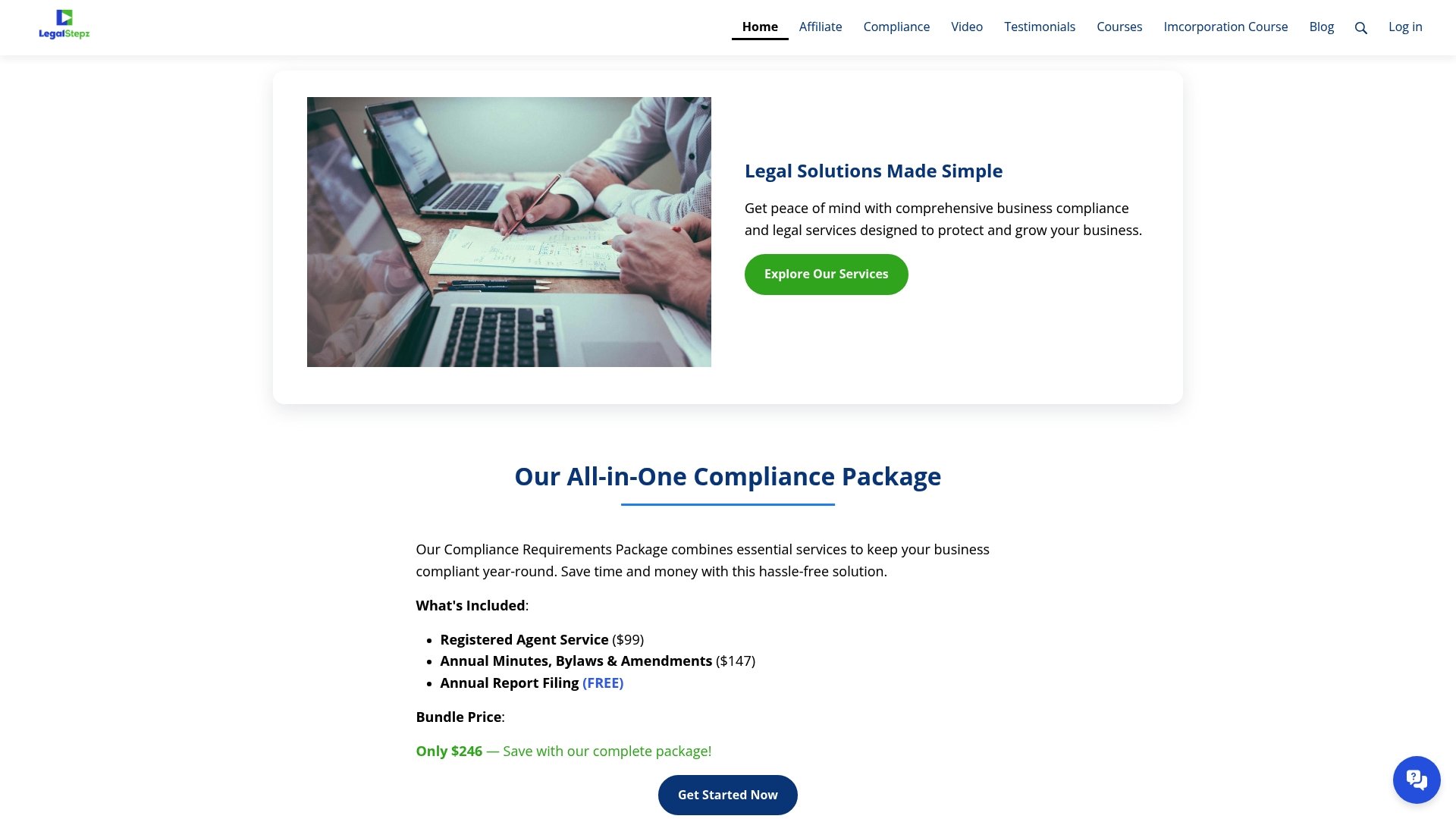
- Our Annual Minutes, Bylaws and Changes Throughout the Year service, priced at $147 one-off, keeps your corporate records consistent with what the Statement of Information reports.
- Our Annual Report service covers the recurring Statement of Information filing itself, with pricing available on request.
- Readers who prefer to handle filings themselves can work through our Incorporation Course for $37 one-off, which walks through entity setup and ongoing filing mechanics.
Start on our compliance services page to see which package matches your corporation's current filing status.
FAQ
Can a foreign company own a US corporation?
Yes, a corporation or individual based outside the United States can own shares in a US corporation, since federal and state corporate law generally does not restrict foreign ownership. The California-formed corporation still follows standard filing and reporting rules regardless of where its owners are located.
What are the four types of corporations?
Businesses in the United States commonly organize as C corporations, S corporations, nonprofit corporations, and professional corporations, each with different tax treatment and ownership rules. The right structure depends on the owners' tax situation and the nature of the business, so many founders confirm the choice with a tax professional before filing.
How do I register a foreign LLC in California?
A foreign LLC registers by filing an Application to Register a Foreign Limited Liability Company with the California Secretary of State, which is the LLC equivalent of the Statement and Designation by Foreign Corporation used by corporations. After registering, the LLC files its own recurring Statement of Information on a schedule tied to its registration date.
Why register as a foreign LLC?
Registering establishes the LLC's legal right to transact business in California and keeps it in good standing to sign contracts, open accounts, and bring or defend lawsuits in state courts. Operating without registering while transacting intrastate business can expose the LLC to penalties and limit its access to California courts.