

Every California corporation and LLC must name an agent for service of process and keep one in place at all times. The agent must be either an individual who lives in California or a registered corporate agent, and the business cannot act as its own agent. The agent receives lawsuits and other court papers on the company's behalf, so a missed handoff can cost you a case. Our Registered Agent Service is $99 one-off and is built for California businesses that want this requirement covered continuously.
TL;DR
- California LLCs and corporations must designate and continuously maintain an agent for service of process on file with the Secretary of State.
- The agent must be a California-resident individual or a corporation that has filed a Form 1505 certificate with the state. A business cannot be its own agent.
- An individual agent needs a physical California street address. A corporate agent's address cannot be a P.O. Box or an in-care-of address.
- Changing your agent takes effect only once an updated Statement of Information is filed.
- With no working agent, a plaintiff can serve your company through the Secretary of State, and you may not learn of the case in time.
Table of Contents
- Who has to have a registered agent in California
- What the agent actually does
- Who can be a registered agent in California
- What counts as a registered agent address
- What a corporate agent must meet
- How to name or change your agent
- What happens if you have no working agent
- A practical checklist for your business
- What we do for California businesses
- Our view: the agent is a compliance asset, not a formality
- FAQ
- Sources
Who has to have a registered agent in California
The California Secretary of State says corporations, LLCs, limited partnerships and limited liability partnerships are required by statute to designate an agent for service of process. For LLCs, Corporations Code section 17701.13 says the company must designate and continuously maintain two things in California: an office and an agent for service of process. A foreign LLC, meaning one formed in another state that registers to do business in California, has the same duty.
Two details matter here.
- The word continuously is the point. The requirement does not stop once the first filing is accepted. It lasts for as long as the entity exists.
- The office does not have to be where you do business. It is a California location the state can associate with the entity.
A registered agent is often called a resident agent or statutory agent. In California the formal term is agent for service of process, and that is the term on the state's forms.
What the agent actually does
Service of process is the formal delivery of court papers: a summons, a complaint or similar documents that tell a business it is being sued and by when it must respond. The agent's job is to be the known, findable person to whom those papers are handed. The agent then gets them to you.
That sounds routine until you consider the timing. A defendant that does not respond by the deadline in the papers can lose by default. The agent is the first link in a chain, and the chain breaks if papers go to someone who no longer works for you, a mailbox nobody checks or an address you left a year ago.
The agent also does not make legal decisions for you. Its role is to receive papers and pass them on promptly. Any question about how to respond to a lawsuit goes to your attorney.
Who can be a registered agent in California
The rule for an LLC is in section 17701.13(c). The agent must be one of two kinds of person:
- An individual who is a California resident.
- A corporation that has complied with Corporations Code section 1505 and whose capacity to act as agent has not ended.
The Secretary of State's frequently asked questions say the same thing in plain terms, and add three points.
- A business cannot be its own agent. The entity needs someone or something separate to name.
- Individual agents are public. The agent's name and physical street address appear in public records.
- Corporate agents need advance approval. The agent must be active with a current Registered Corporate Agent (1505) application on file, and you must get its approval before designating it.
That last point is why we cover the consent step in detail in our guide on getting registered agent consent before filing. Naming an agent that has not agreed to serve creates a problem on the first day.
Can you or an employee be the agent?
Yes, if the person is an individual who lives in California and is not the company itself. A founder, an officer or an employee can qualify. The trade-off is practical rather than legal. The individual's name and street address go on the public record, and that person has to be at the listed address whenever a process server arrives. If the person travels, moves, leaves the company or works from home, you are exposed. We explain this in more detail in Can You Be Your Own Registered Agent in California?
For most owners, the reliable route is a registered corporate agent. It removes your home address from the public record and keeps the role from depending on one person's schedule. That is the reason we offer the Registered Agent Service at $99 one-off.
What counts as a registered agent address
An individual agent must list a physical California street address. A P.O. Box is not a street address, and an agent who is only reachable by mail does not meet the requirement. The Secretary of State's FAQ says the individual agent's name and street address are public.
For a corporate agent the rules are stricter. The Form 1505 instructions call for the complete California street address, city and ZIP code of the office where the entity naming the corporation as agent may be served. The instructions bar P.O. Boxes and in-care-of addresses, and the city name may not be abbreviated.
When you name a corporate agent on your own filing, you give only its name. Under section 17701.13(c), no address for the corporate agent may appear in the instrument filed with the Secretary of State. Its address is already on its own 1505 certificate.
This is a quick way to see the difference.
| Point | Individual agent | Registered corporate agent |
|---|---|---|
| Who qualifies | A person who resides in California | A corporation with a Form 1505 certificate on file |
| Address on your filing | Name and physical California street address | Name only |
| Address type | Street address, no P.O. Box | Street address on its 1505 certificate, no P.O. Box or in-care-of |
| Consent | The person should agree before you name them | Advance approval needed before you designate it |
| Public record | Name and street address are public | Corporate agent's name appears on your filing |
What a corporate agent must meet
Under Corporations Code section 1505, a corporation that wants to serve as an agent files a certificate signed by an officer. The certificate states:
- its complete California street address,
- the names of the employees authorized to accept process, and
- its consent that delivery of process to an authorized employee counts as delivery to the corporation itself.
The corporation must also be authorized to do business in California and be in good standing. The Form 1505 instructions add that the filing fee is $30.00 and that the corporation's status must be active. If the corporate agent is suspended or forfeited by the Secretary of State or the Franchise Tax Board, its authority to act as agent stops until it is restored and files a new, fully completed Form 1505.
That last rule is worth a moment. Your agent's standing is part of your compliance. An agent in good standing is a requirement for you as much as for it.
How to name or change your agent
You name the agent when you form the entity, and you report it again in the Statement of Information. Under section 17702.09, an LLC must file a Statement of Information within 90 days after filing its articles or registering, and every two years after that. The statement lists the agent's name and street address, or only the name if the agent is a corporation. It also lists the principal office address and other required details.
Cooperative corporations file annually, and the statute for cooperatives sets that cycle separately. If you run a nonprofit or a cooperative, check which Corporations Code section governs your entity before assuming the LLC timetable applies.

Changing the agent mid-cycle
You do not wait for the next biennial filing. When the agent or the agent's address changes, section 17702.09(d) requires a current statement, and the new one supersedes earlier ones. Under section 17701.16(b), no change in the agent's address or appointment of a new agent is effective until an amendment to the statement is filed.
In practice that means a handoff has a gap. If your old agent resigns or moves and nobody files the updated statement, the public record still points to the old agent. Papers delivered there may count as served on you even though no one at your company will see them.
A clean change looks like this:
- Choose the new agent and get its consent before you name it.
- File a current Statement of Information with the new agent's details.
- Confirm the Secretary of State's record shows the new agent before the old one stops serving.
- Tell the old agent that the change is filed so papers do not keep arriving there.
Our walkthrough on how to change your registered agent in California covers each step, and why corporations update their agent of service explains the common triggers. Because we file the Statement of Information as part of our work, changes to the agent and the filing that records them can be handled together.
What happens if you have no working agent
The state does not leave a plaintiff stuck. The California Courts self-help guide says that when no agent is listed or the information is out of date, a plaintiff can ask the court for an order allowing service through the Secretary of State. For a corporation, serving an officer is another route.
The law lays out when this applies. Under section 17701.16(c), if the agent has resigned without replacement or cannot be found with reasonable diligence at the designated address, a court may order service by hand delivery to the Secretary of State. Service is deemed complete on the 10th day after that delivery. Los Angeles County's consumer and business department describes the same timing and says the Secretary of State then forwards the papers to the entity.
Read that carefully from the defendant's side. The clock starts running on delivery to the state, not on the day you open an envelope. If the state forwards papers to an old address, you may find out well into your response period, or after it ends.
The same county page notes that serving through an agent is substitute service. It requires that the papers be served at least 25 days before the court date if the agent is in Los Angeles County, or 30 days if outside it, along with a second copy mailed first class to the agent. The details of a particular case belong with your attorney. The point for your planning is that the agent is the front door to the legal process, and a broken door costs time you may not get back.
The Secretary of State also stresses that serving the designated agent is not the only way to serve an entity. The Code of Civil Procedure and the Corporations Code allow other direct and substituted methods. A good agent does not make you unservable. It makes sure the usual route works and that papers reach you.

A practical checklist for your business
Use this before you file or at your next review.
- Confirm who your entity type must report to. LLCs, corporations, cooperatives and nonprofits cite different sections of the Corporations Code, with different filing cycles.
- Pick an agent that can be reached during business hours. The legal test is a California street address. The practical test is a person who can receive papers when a server arrives.
- Get consent in writing. Do it before naming anyone, individual or corporate.
- Match your records. The name and address on your Statement of Information should match the agent's actual details.
- Calendar your filings. Mark the 90-day deadline for new entities and the periodic renewal that follows.
- Revisit after any move or change. A new principal office, a departing employee or a retired agent each call for a fresh look at the record.
If you are forming a new entity, our guide on how to form a California LLC shows where the agent fits in the sequence. For ongoing duties such as annual filings, see California corporation annual report requirements.
What we do for California businesses
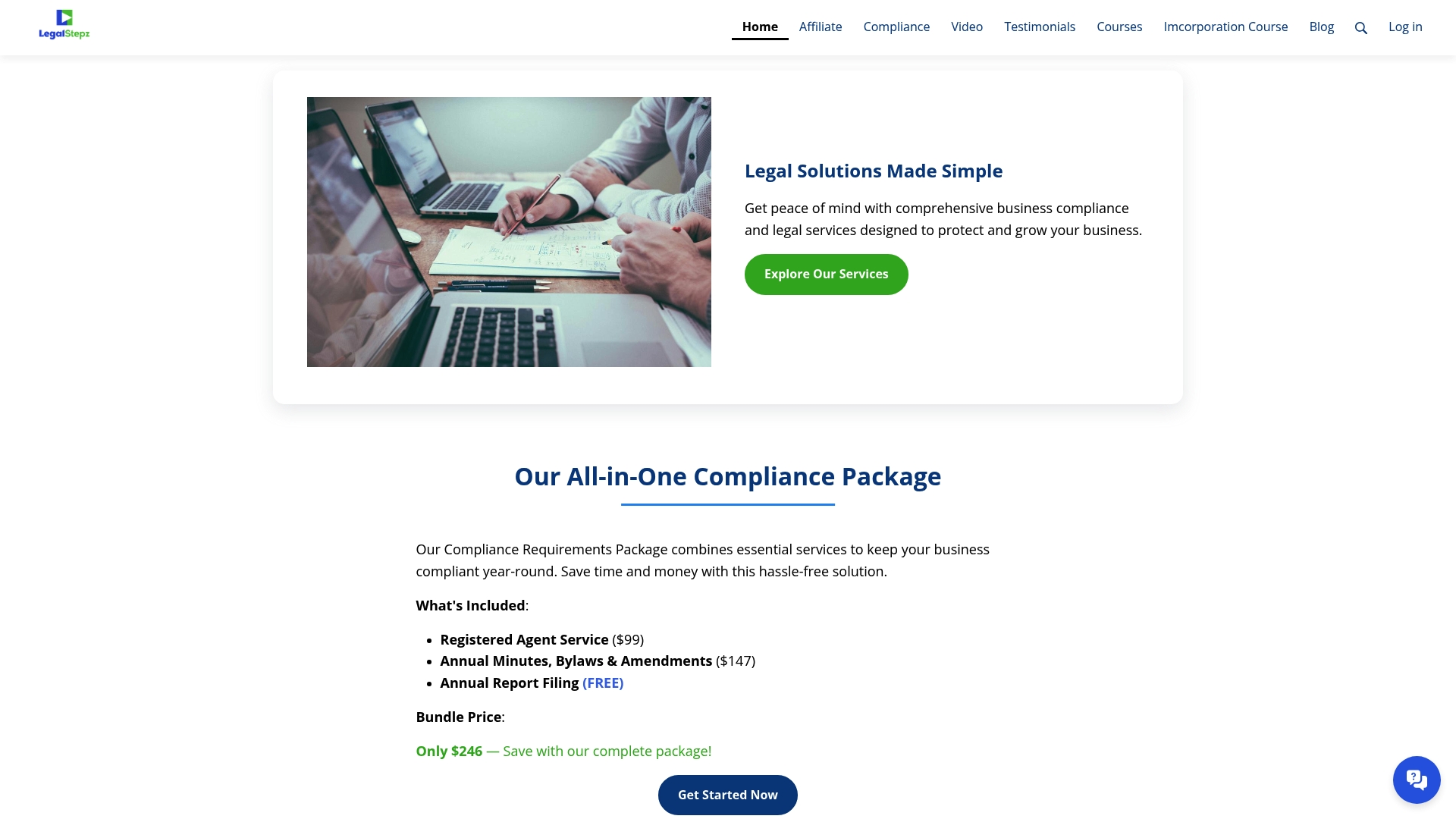
Our Registered Agent Service is $99 one-off. We also prepare annual minutes and bylaws, including changes through the year, for $147 one-off, and we file the California Statement of Information. These cover the agent requirement and the paperwork that sits next to it, so the agent on file and the records you keep as a corporation stay in step.
If you would rather form the entity yourself, our Limited Liability Company Course and Incorporation Course are $37 each, one-off. Each walks you through formation step by step, including naming the agent.
Start with the Registered Agent Service and compliance packages.
If formation is your next step, see the Limited Liability Company Course or the Incorporation Course.
Our view: the agent is a compliance asset, not a formality
Most California owners treat the agent line on a form as a box to fill in. We treat it as the one point of contact between your company and the court system, and that deserves more attention than it gets.
The law gives you real choices, but they are not equal in practice. An individual agent works until that individual moves, travels or leaves. A registered corporate agent does not have that single point of failure. That is why we built our service around the corporate agent model and why we put the $99 price on the page without a bundle you have to decode.
We also pair the agent with the paperwork that keeps a California corporation in good order: the Statement of Information, annual minutes, bylaws and changes during the year. The agent line, the filing and the records should all tell the same story. When they do, a change of address or officer is a short task rather than a scramble.
If you are unsure where your own records stand, start with the agent. It is the quickest item to verify and the costliest one to get wrong.
Peter
FAQ
Can a California LLC be its own registered agent?
No. The Secretary of State says a business entity cannot act as its own agent for service of process. The agent must be a California-resident individual or a registered corporate agent that has filed Form 1505.
Does the agent need a physical address in California?
Yes. An individual agent lists a physical California street address, which becomes public. A corporate agent's own certificate must show a complete California street address with no P.O. Box or in-care-of line, and you list only its name on your filing.
How do I change my agent after I have formed the company?
File a current Statement of Information naming the new agent. The change is not effective until that filing is made, so get the new agent's consent first and file before the old agent stops serving. Our guide on changing a registered agent in California walks through it.
What if my agent cannot be found or has resigned?
A plaintiff can ask the court to allow service through the Secretary of State. Service is deemed complete on the 10th day after delivery to the Secretary of State, which then forwards the papers to you. Replace the agent and file your updated statement promptly.
Sources
- California Corporations Code section 17701.13
- California Secretary of State: Service of Process
- California Secretary of State: Frequently Asked Questions
- California Courts Self-Help: Find the name of a business and the agent for service
- Instructions for Completing the Registered Corporate Agent Form 1505
- California Corporations Code section 1505
- California Corporations Code section 17702.09
- California Corporations Code section 17701.16
- Los Angeles County: Serving a Corporation, LLC, or LP